
Catalogue Search | MBRL


Are you sure you want to remove the book from the shelf?

{{itemTitle}}
4
result(s) for
"Devaluation of currency United States History 21st century."
Sort by:


Exorbitant Privilege
In the wake of the worldwide financial crisis, attention has turned to America's position in the global economic order. Will the U.S. continue to occupy the commanding heights? Or will rising powers like China and European Union gradually achieve parity or even surpass the U.S.' If there is one indicative measure of America's shifting status in the global econwmy, it is the dollar. The dollar, the world's international reserve currency for over eighty years, has been a pillar of American economic hegemony. As a critic of U.S. policies once put it, it bestows upon the dollar \"exorbitant privilege\" in international finance and reinforces U.S. economic power. In Exorbitant Privilege, eminent economist Barry Eichengreen explains how the dollar rose to the top of the monetary order before turning to the current situation. The current crisis has placed serious strains on the dollar, and many fear that Americans are in for a prolonged period of belt tightening because of increasing interest rates and the rise of competing currencies like the Euro and the Chinese renminbi. Eichengreen suggests that while we are most likely entering an era with more than one reserve currency, it does not constitute a crisis. While the US will lose some of its power, a multiple-reserve currency system has worked before--in the era prior to World War I. Given the pervasive predictions of US decline, this will be a counterintuitive--and welcome--rejoinder to the emerging conventional wisdom about American decline.
eBook
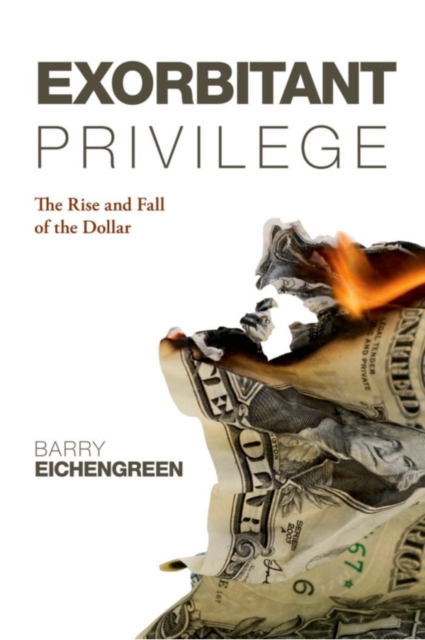
Exorbitant Privilege
For more than half a century, the dollar has been not just America's currency but the world's. It is used globally by importers, exporters, investors, governments and central banks alike. This singular role of the dollar is a source of strength for the United States. It is, as a critic of U.S. policies once put it, America's \"exorbitant privilege.\" But now, with U.S. budget deficits extending as far as the eye can see, holding dollars is viewed as a losing proposition. Some say that the dollar may soon cease to be the world's standard currency DS which would depress U.S. living standards and weaken the country's international influence. In Exorbitant Privilege, one of our foremost economists, Barry Eichengreen, traces the rise of the dollar to international prominence. He shows how the greenback dominated internationally in the second half of the 20th century for the same reasons that the United States dominated the global economy. But now, with the rise of China, India, Brazil and other emerging economies, America no longer towers over the global economy. It follows, Eichengreen argues, that the dollar will not be as dominant. But this does not mean that coming changes need be sudden and dire DL or that the dollar is doomed to lose its international status. Challenging the presumption that there is room for only one true global currency, Eichengreen shows that several currencies have regularly shared this role. What was true in the distant past will be true, once again, in the not-too-distant future. The dollar will lose its international currency status, Eichengreen warns, only if the United States repeats the mistakes that led to the financial crisis and only if it fails to put its fiscal and financial house in order. Incisive, challenging and iconoclastic, Exorbitant Privilege, is a fascinating analysis of the changes that lie ahead. It is a challenge, equally, to those who warn that the dollar is doomed and to those who regard its continuing dominance as inevitable.
eBook
