
Catalogue Search | MBRL


Are you sure you want to remove the book from the shelf?

{{itemTitle}}
49,415
result(s) for
"Developmental Education"
Sort by:

Compassion and education : cultivating compassionate children, schools and communities
This book makes a defence of compassion as an essential and significant quality that should be at the heart of the education of young people. It provides a careful exploration of what compassion means; how it is relevant to the various relationships among students, teachers, and the wider community; and the particular pedagogical processes that can and might develop compassion. Understanding and justifying compassion as a virtue, this book argues that compassion is a virtue central to all human relationships from the familial, to the communal and to the global. It will be of interest to academics, research and students of education.
Book

Innovative Pathways Through Developmental Education and Postsecondary Success: An Examination of Developmental Math Interventions Across Texas
This study assessed alternative course delivery for developmental education (DE) math and student outcomes in community colleges in Texas. We examined 2 innovative interventions: (a) study skills courses offered alongside DE math and (b) DE math courses that are shorter than a full semester. Our model leveraged detailed demographic information and DE placement exam scores to compare students in these interventions to similar students in traditional DE math. We found that students in shorter courses were 12% more likely to pass DE math and 2% more likely to pass a first college-level (FCL) math course within a year. Likewise, students also enrolled in a study skills course were 4% more likely to pass DE math, 1% more likely to pass FCL math within a year, and 4% more likely to persist to the next college year. These findings suggest that emerging reforms to DE show promise and deserve further study.
Journal Article

Teaching compassion : humane education in early childhood
In response to highly publicized incidents of school violence, educators across the United States and in many other nations are seeking effective ways to prevent and modify aggressive and anti-social behaviors in students. One of the major recommendations of the research is that efforts to prevent cruelty need to begin early, during the early childhood years of birth through age eight. The focus of Teaching Compassion: Humane Education in Early Childhood is guiding young children to accept responsibility for and to be kind in their interactions with fellow human beings, animals and the environment. Although humane education is a relatively new concept in the field of early childhood education, professionals in the field are very familiar with many of the related concepts, including: promoting positive interpersonal interactions, teaching children the skills of self-regulation, giving children experience in caring for living things and protecting the environment. This edited volume is an interdisciplinary compendium of professional wisdom gathered from experts in the fields of education, child development, science, psychology, sociology and humane organizations. As the book amply documents, the concept of humane education is powerful, integrative, timely and appropriate in work with young children. Teaching Compassion: Humane Education in Early Childhood shows how it is possible for adults dedicated to the care and education of young children to balance attention to the cognitive and affective realms and, in so doing, to elevate the overall quality of early childhood programs for children, families and communities.
Book

Predictors of First-Year Student Retention in the Community College
This study analyzed predictors of fall-to-spring and fall-to-fall retention for 9,200 first-time-in-college students who enrolled in a community college over a four-year period. Findings highlight the impact of developmental education programs and internet-based courses on student persistence. Additional predictors include financial aid, parents' education, the number of semester hours enrolled in and dropped during the first fall semester, and participation in the Student Support Services program.
Journal Article

Children's multilingual development and education : fostering linguistic resources in home and school contexts
\"The study of families and educators who successfully sustain children's linguistic resources is a novelty in current educational research, where focus has largely been on the development of students' English language skills. In this book, Alison L. Bailey and Anna V. Osipova provide a systematic examination of the beliefs and practices of parents and educators who share the common goal of improving educational and social outcomes for multilingual children. Giving voice to parents and educators, they explore the strategies being devised to foster multilingualism and support its development both at home and in the classroom. This book presents new research findings and combines these with compelling firsthand accounts of the successes and concerns of both families and educators, making its content pertinent to a wide audience of researchers and a range of higher education courses\"-- Provided by publisher.
Book

The Relationship Between Accelerated Dev-Ed Coursework and Early College Milestones: Examining College Momentum in a Reformed Mathematics Pathway
More than half of community college students fail to meet college-readiness standards in math. Developmental education (dev-ed) aims to help students acquire the knowledge and skills to succeed in college-level math but is plagued with low rates of advancement. We examined the impact of a model that accelerates developmental math coursework so that students can complete dev-ed and college math courses in their programs of study within 1 year. Using data from Texas and a propensity score matching approach, we tested the impact of the model on several college milestones. Results suggest that students in the accelerated model were more likely to persist and accumulate college-level credits during the 1st year than those in traditional dev-ed math. After 3 years, there was a strong positive relationship between participation in the accelerated model and important college milestones, like college math course completion and total accumulated college-level credits.
Journal Article

Deaf education beyond the western world : context, challenges, and prospects
\" If teachers want to educate deaf learners effectively, they have to apply evidence-informed methods and didactics with the needs of individual deaf students in mind. Education in general -- and education for deaf learners in particular -- is situated in broader societal contexts, where what works within the Western world may be quite different from what works beyond the Western world. By exploring practice-based and research-based evidence about deaf education in countries that largely have been left out of the international discussion thus far, this volume encourages more researchers in more countries to continue investigating the learning environment of deaf learners, based on the premise of leaving no one behind. Featuring chapters centering on 19 countries, from Africa, Asia, Latin America, and Central and Eastern Europe, the volume offers a picture of deaf education from the perspectives of local scholars and teachers who demonstrate best practices and challenges within their respective regional contexts. This volume addresses the notion of learning through the exchange of knowledge; outlines the commonalities and differences between practices and policies in educating deaf and hard-of-hearing learners; and looks ahead to the prospects for the future development of deaf education research in the context of recently adopted international legal frameworks. Stimulating academic exchange regionally and globally among scholars and teachers who are fascinated by and invested in deaf education, this volume strengthens the foundation for further improvement of education for deaf children all around the world. \"-- Provided by publisher.
Book
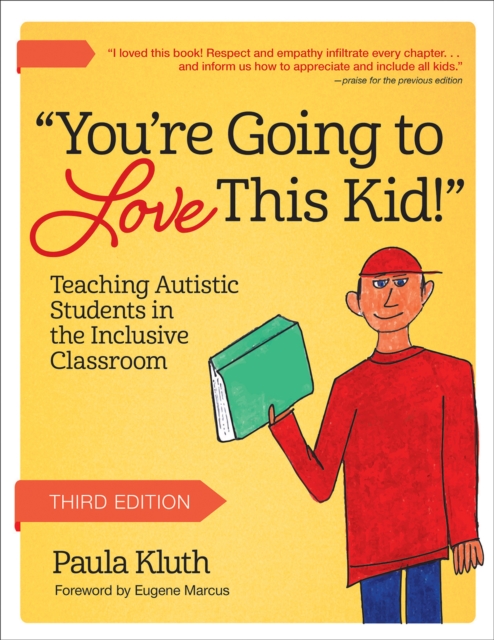
\You're Going to Love This Kid!\: Teaching Autistic Students in the Inclusive Classroom
One of the most popular, practical, and trusted books on inclusive education, this bestselling guide is now in a fully updated third edition—perfect for K–12 educators teaching the growing number of students on the autism spectrum. Created by Paula Kluth, a former teacher and celebrated inclusion expert who works with teachers and families nationwide, this book gives educators sensitive new ways to see autistic students and instantly useful strategies for teaching and welcoming them in general education classrooms.Both pre- and in-service educators will find the up-to-date research and ready-to-use tips they need to make schools safe, accessible, and appropriately challenging for learners on the autism spectrum. Drawing on decades of experience, Paula Kluth offers a comprehensive, real-world guide to supporting autistic students—from big-picture guidance on the law, planning, and collaboration to the practical details of classroom arrangement, teaching strategies, and positive behavior supports. With a clear focus on the strengths, gifts, and perspectives of autistic learners, the book prominently features the voices of autistic people and their families and includes their valuable ideas and insights.A professional resource and textbook that teachers will keep forever, this new edition of “You're Going to Love this Kid!” is the ultimate guide to supporting autistic students and meeting each learner's individual needs in the inclusive classroom.WHAT'S NEWAll chapters thoroughly updated to reflect the latest research and recommended practicesMore insights from autistic people and their family membersEngaging new features: learning objectives, bulleted organizers, and all-new discussion questionsNew and updated reproducible materials: includes 20 online forms, student worksheets, planning tools, activities, and checklistsA new chapter co-author adding expert advice on making classrooms supportive for those with sensory needsIdentity-first language that reflects the preferences of autistic peopleMore graphics, photos, and artwork that illustrate and reinforce key pointsTOPICS COVERED INCLUDE:values and beliefs that support inclusive schoolingdefinitions and characteristics of autismrespectful partnerships with parents and caregiversclassroom arrangement and sensory supportsclassroom community and social relationshipscommunication tools and considerationseffective literacy instructionrespectful and effective responses to behaviorlesson planningco-teaching and collaboration with team membersfederal laws related to special education
eBook

Knowledge development in early childhood : sources of learning and classroom implications
\"Synthesizing cutting-edge research from multiple disciplines, this book explores how young children acquire knowledge in the \"real world\" and describes practical applications for early childhood classrooms. The breadth and depth of a child's knowledge base are important predictors of later literacy development and academic achievement. Leading scholars describe the processes by which preschoolers and primary-grade students acquire knowledge through firsthand experiences, play, interactions with parents and teachers, storybooks, and a range of media. Chapters on exemplary instructional strategies vividly show what teachers can do to build children's content knowledge while also promoting core literacy skills\"-- Provided by publisher.
Book

Does Remediation Work for All Students? How the Effects of Postsecondary Remedial and Developmental Courses Vary by Level of Academic Preparation
We examine the impact of remedial and developmental courses on college students with varying levels of academic preparedness, thus focusing on a wider range of students than previous studies. Using a regression discontinuity design, we provide causal estimates of the effects of placement in different levels of remedial courses on short-, intermediate-, and long-term outcomes at both 2- and 4-year colleges. Similar to other research, we find that remediation has negative effects for students on the margin of needing one developmental course. However, for students with lower levels of academic preparation, the effects of remediation are estimated to be positive in some subjects. These results suggest that remedial courses can help or hinder students differently depending on their incoming levels of academic preparedness. Moreover, our conclusions are largely driven by positive and negative effects observed for students at 2-year institutions, and we discuss several hypotheses that may explain these findings.
Journal Article