
Catalogue Search | MBRL


Are you sure you want to remove the book from the shelf?

{{itemTitle}}
20
result(s) for
"Dialectical materialism-History"
Sort by:


Universality and Utopia
This book explores the intersection between philosophical and literary universalism in Latin America, tracing its configuration within the twentieth-century Peruvian socialist indigenista tradition, following from the work of José Carlos Mariátegui and elaborated in the literary works of César Vallejo and José MaríaArguedas. Departing from conventional accounts that interpret indigenismo as part of a regionalist literature seeking to describe and vindicate the rural Indian in particular, I argue that Peruvian indigenista literature formed part of a historical sequence through which urban mestizo intellectuals sought to imagine a future for Peruvian society as a whole. Going beyond the destiny of acculturation imagined by liberal writers, such as Manuel González Prada, in the late nineteenth century, I show how the socialist indigenista tradition imagined a bilateral process of appropriation and mediation between the rural Indian and mestizo, integrating pre-Hispanic, as well as Western cultural and economic forms, so as to give shape to a process of alternative modernity apposite to the Andean world. In doing so, indigenista authors interrogated the foundations of European Marxism in light of the distinctiveness of Peruvian society and its history, expressing ever more nuanced figurations of the emancipatory process and the forms of its revolutionary agency.
eBook

Tillie Olsen and the dialectical philosophy of proletarian literature
\"This study historicizes Tillie Olsen's fiction in the context of the Depression-era proletarian literary movement in the United States and its philosophy of dialectical materialism. It argues that dialectical materialism informs both the form and content of her fiction\"-- Provided by publisher.
Book
Adam Smith's Economics
The conventional received opinion of Adam Smith as an isolated figure, the founder of ‘modern’ economics, is thoroughly mistaken and misleading. This is the central premise of this book, first published in 1988, in which the author argues that by placing Smith’s work in its historical context, we discover profound continuities between Smith’s work and that of his predecessors, and his contemporaries. The effect is to re-orientate our perception of Smith and his achievement. No longer the single-handed champion of free markets and competition whose work revolutionised and completely redirected economics. He appears instead as a brilliant contributor to a deep-rooted contemporary debate, someone who can be placed in a line of thinkers that stretches between Machiavelli and Kant.
eBook
The Algebra of Revolution
The Algebra of Revolution is the first book to study Marxist method as it has been developed by the main representatives of the classical Marxist tradition, namely Marx and Engels, Luxembourg, Lenin, Lukacs, Gramsci and Trotsky. This book provides the only single volume study of major Marxist thinkers' views on the crucial question of the dialectic, connecting them with pressing contemporary, political and theoretical questions. John Rees's The Algebra of Revolution is vital reading for anyone interested in gaining a new and fresh perspective on Marxist thought and on the notion of the dialectic.
eBook

Adam Smith's economics : its place in the development of economic thought
The conventional received opinion of Adam Smith as an isolated figure, the founder of 'modern' economics, is thoroughly mistaken and misleading. This is the central premise of this book, first published in 1988, in which the author argues that by placing Smith's work in its historical context, we discover profound continuities between Smith's work and that of his predecessors, and his contemporaries. The effect is to re-orientate our perception of Smith and his achievement. No longer the single-handed champion of free markets and competition whose work revolutionised and completely redirect
Book

Smart Machines and Service Work
In recent decades digital devices have reshaped daily life, while tech companies' stock prices have thrust them to the forefront of the business world. In this rapid, global development, the promise of a new machine age has been accompanied by worries about accelerated joblessness thanks to new forms of automation. Jason E. Smith looks behind the techno-hype to lay out the realities of a period of economic slowdown and expanding debt: low growth rates and an increase of labour-intensive jobs at the bottom of the service sector. He shows how increasing inequality and poor working conditions have led to new forms of workers' struggles. Ours is less an age of automation, Smith contends, than one in which stagnation is intertwined with class conflict.
eBook
Gramsci, language, and translation
This anthology brings together key articles translated into English for the first time from Italian debates concerning Antonio Gramsci's writings on language and translation as central to his entire social and political thought. It includes recent scholarship by Italian, German and English-speaking scholars providing important contributions to debates concerning culture, language, Marxism, post-Marxism, and identity as well as the many fields in which Gramsci's notion of hegemony has been influential. Given the growing literature on the role of language and so-called 'global English' within process of globalisation or cultural and economic imperialism, this is a timely collection. Franco Lo Piparo is often cited as the key source for how Gramsci's university studies in linguistics is at the core of his entire political theory, and yet none of this work has been translated into English nor have the debates that it spawned. Lo Piparo's specific thesis concerning the 'non-Marxist roots' of Gramsci's originality and the critical responses to it have been almost unknown to non-Italian readers. These debates paved the way for important recent Italian work on the role of the concept of 'translation' in Gramsci's thought. While translation has become a staple metaphor in discussions of multiculturalism, globalization, and the politics of recognition, until now, Gramsci's focus on it has been undeveloped. What is at stake in this literature is more than Gramsci's understanding of language as one of the many themes in his writings, but the core of his central ideas including hegemony, culture, the philosophy of praxis, and Marxism in general. This volume presents the most important arguments of these debates in English in conjunction with the latest research on these central aspects of Gramsci's thought. The essays this volume rectify lacunae concerning language and translation in Gramsci's writings. They open dialogue and connections between Gramscian approaches to the relationships among language, culture, political economy, and historical materialism with other Marxist and non-Marxist thinkers such as Walter Benjamin, Valentin Volosinov, Mikhail Bakhtin, Ludwig Wittgenstein, Jurgen Habermas, Pierre Bourdieu, Michel Foucault, and Jacques Derrida. It provides novel arguments concerning Gramsci's theories and the relationships among power, politics, language, consciousness, and capitalism.
eBook
Cultures of Uneven and Combined Development
Cultures of Uneven and Combined Development seeks to explore and develop Leon Trotsky's concept of uneven and combined development, aiming to adapt the political and historical analysis which originated in Trotsky's Russia for use within the contemporary field of world literature.
eBook
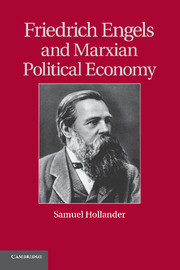
Friedrich Engels and Marxian Political Economy
This book rejects the commonly encountered perception of Friedrich Engels as perpetuator of a 'tragic deception' of Marx, and the equally persistent body of opinion treating him as 'his master's voice'. Engels' claim to recognition is reinforced by an exceptional contribution in the 1840s to the very foundations of the Marxian enterprise, a contribution entailing not only the 'vision' but some of the building blocks in the working out of that vision. Subsequently, he proved himself to be a sophisticated interpreter of the doctrine of historical materialism and an important contributor in his own right. This volume serves as a companion to Samuel Hollander's The Economics of Karl Marx (Cambridge University Press, 2008).
eBook