
Catalogue Search | MBRL


Are you sure you want to remove the book from the shelf?

{{itemTitle}}
9
result(s) for
"Digital electronics Political aspects Forecasting"
Sort by:

The future of the Internet : and how to stop it
This extraordinary book explains the engine that has catapulted the Internet from backwater to ubiquity-and reveals that it is sputtering precisely because of its runaway success. With the unwitting help of its users, the generative Internet is on a path.
eBook

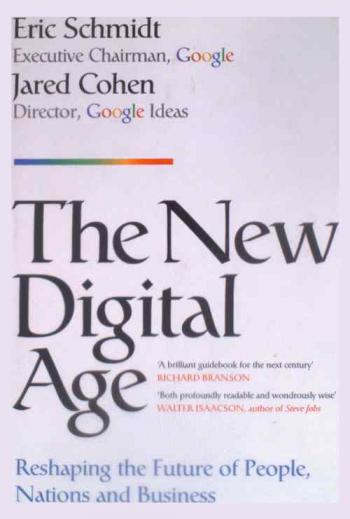
The new digital age : transforming nations, businesses, and our lives
In collaboration, two leading global thinkers from in technology and foreign affairs from Google give readers their widely anticipated, transformational vision of the future: a world where everyone is connected, a world full of challenges and benefits that are ours to meet and to harness. With their combined knowledge and experiences, the authors are uniquely positioned to take on some of the toughest questions about our future: Who will be more powerful in the future, the citizen or the state? Will technology make terrorism easier or harder to carry out? What is the relationship between privacy and security, and how much will we have to give up to be part of the new digital age? In this they combine observation and insight to outline the promise and peril awaiting us in the coming decades. This is a forward-thinking account of where our world is headed and what this means for people, states and businesses. With the confidence and clarity of visionaries, the authors illustrate just how much we have to look forward to, and beware of, as the greatest information and technology revolution in human history continues to evolve. On individual, community and state levels, across every geographical and socioeconomic spectrum, they reveal the dramatic developments both good and bad, that will transform both our everyday lives and our understanding of self and society, as technology advances and our virtual identities become more and more fundamentally real. As their nuanced vision of the near future unfolds, an urban professional takes his driverless car to work, attends meetings via hologram and dispenses housekeeping robots by voice; a Congolese fisherwoman uses her smart phone to monitor market demand and coordinate sales (saving on costly refrigeration and preventing overfishing); the potential arises for \"virtual statehood\" and \"Internet asylum\" to liberate political dissidents and oppressed minorities, but also for tech-savvy autocracies (and perhaps democracies) to exploit their citizens' mobile devices for ever more ubiquitous surveillance. Along the way, we meet a cadre of international figures, including Julian Assange, who explain their own visions of our technology-saturated future. This book is an analysis of how our hyper-connected world will soon look.
Book

The Rise of Technosocialism
What is the impact of COVID-19 on world economies? If the cost of providing universal health care is lower than the cost of building a political movement to prevent it, would politicians still view it as socialism? In a world where algorithms and robots take the jobs of immigrants and citizens alike, are border controls an effective response? If unemployment skyrockets due to automation, would conservative governments rather battle long-term social unrest, or could they agree on something like universal basic income? When renewable energy sources are a fraction of the cost of coal generated electricity, should lobbyists be able to prevent changes to energy infrastructure? When the crowd's mood is measured in influence and exabytes, will real-time democracy render elections a thing of the past? International Bestselling authors Brett King and Dr. Richard Petty explore the seismic social changes that will be thrust on the world over the coming decades. The Rise of Technosocialism seeks to answer how our children will live with AI and climate disruption, the impact of COVID-19 in our lives along with which economies will likely emerge victorious in an always-on, smart world. Website: https://riseoftechnosocialism.com/ The Authors: Brett King is an entrepreneur, futurist, and International Bestselling Author. China's President Xi Jinping cited his book Augmented: Life in the Smart Lane in his 2018 national address; Augmented was a Top 10 non-fiction book in North America. In 2019 his book Bank 4.0 was awarded the Top Book by a Foreign Author in Russia. In 2015 he was shortlisted for the Advance Global Australian of the Year Award. Banking Exchange magazine dubbed him the \"King of Disruptors\". He advised the Obama Administration, and governments and regulators around the world on future tech.Dr Richard Petty is a policy advisor, entrepreneur and
awarded academic. Based in Hong Kong, Richard has lived and worked in Greater China since the 1990's. Richard has chaired entities with global footprint, and presently sits on the boards of listed companies in the United States and Australia. He has advised on projects with an aggregate economic impact in the hundreds of billions of dollars, and has led studies on economic competitiveness. Richard previously served as a member of the B20--the official G20 dialogue forum with the global business community--on the Financing Growth and Infrastructure Taskforce. Richard has authored or co-authored more than 100 academic and professional works including several books, and several of his journal articles are among the top cited in their fields.
eBook

Mexico's transition to a knowledge-based economy : challenges and opportunities
Unlock Mexico's Economic Potential in the Knowledge Era. This insightful study examines Mexico's journey toward a knowledge-based economy, revealing both challenges and opportunities for sustainable growth. Authored by experts Yevgeny Kuznetsov and Carl Dahlman, this volume provides strategies for enhancing Mexico's competitiveness through innovation, education reform, and strategic investment in ICT infrastructure. Discover how Mexico can leverage its regional diversity and existing strengths to transform its economy and improve the lives of its citizens. * Understand the key sources of growth in the global knowledge economy * Identify challenges and opportunities for Mexico's economic transformation * Explore strategies for enhancing competitiveness through innovation and education * Learn how to promote regional development and overcome institutional rigidities For policymakers, economists, business leaders, and academics interested in Mexico's economic future.
eBook

The Global Course of the Information Revolution
Advances in information technology are heavily influencing ways in which business, society, and government work and function throughout the globe, bringing many changes to everyday life, in a process commonly termed the \"information revolution.\" This book paints a picture of the state of the information revolution today and how it will likely progress in the near- to mid-term future (10 to 15 years), focusing separately on different regions of the world-North America, Europe, the Asia-Pacific region, Latin America, the Middle East and North Africa, and sub-Saharan Africa.
eBook

In Athena's Camp
The information revolution--which is as much an organizational as a technological revolution--is transforming the nature of conflict across the spectrum: from open warfare, to terrorism, crime, and even radical social activism. The era of massed field armies is passing, because the new information and communications systems are increasing the lethality of quite small units that can call in deadly, precise missile fire almost anywhere, anytime. In social conflicts, the Internet and other media are greatly empowering individuals and small groups to influence the behavior of states. Whether in military or social conflicts, all protagonists will soon be developing new doctrines, strategies, and tactics for swarming their opponents--with weapons or words, as circumstances require. Preparing for conflict in such a world will require shifting to new forms of organization, particularly the versatile, hardy, all-channel network. This shift will prove difficult for states and professional militaries that remain bastions of hierarchy, bound to resist institutional redesign. They will make the shift as they realize that information and knowledge are becoming the key elements of power. This implies, among other things, that Mars, the old brute-force god of war, must give way to Athena, the well-armed goddess of wisdom. Accepting Athena as the patroness of this information age represents a first step not only for preparing for future conflicts, but also for preventing them.
eBook
The MoneyWatch Report
Pollution caused about nine million people to die prematurely in 2019. That's according to a new study from the Lancet. That's about one in six deaths worldwide. In recent years fewer people have died from poverty-related issues, such as household air pollution, but that's been offset by an increase in air pollution and toxic chemicals.
Transcript

Electronic Cash and the End of National Markets
As the use of electronic cash soars, governments will face growing difficulty controlling monetary policy, taxation, financial regulation and crime. Will this be a lethal blow to national autonomy? Is anyone thinking about it?
Magazine Article