
Catalogue Search | MBRL


Are you sure you want to remove the book from the shelf?

{{itemTitle}}
215,124
result(s) for
"Digital video"
Sort by:

Creating in the digital world
Access to digital tools has made it easier than ever for individuals to be creative with media. This important book gives advice on choosing the appropriate platforms and tools to achieve your creative goal, how to use feedback to improve and grow as a digital creator, and how to make sure you get credit for your work, as well as give credit to others where it is due. Inspiring examples show creative young people contributing to the digital world in a positive way, not just taking from it.
Book

Practical Image and Video Processing Using MATLAB
UP-TO-DATE, TECHNICALLY ACCURATE COVERAGE OF ESSENTIAL TOPICS IN IMAGE AND VIDEO PROCESSING This is the first book to combine image and video processing with a practical MATLAB®-oriented approach in order to demonstrate the most important image and video techniques and algorithms. Utilizing minimal math, the contents are presented in a clear, objective manner, emphasizing and encouraging experimentation. The book has been organized into two parts. Part I: Image Processing begins with an overview of the field, then introduces the fundamental concepts, notation, and terminology associated with image representation and basic image processing operations. Next, it discusses MATLAB® and its Image Processing Toolbox with the start of a series of chapters with hands-on activities and step-by-step tutorials. These chapters cover image acquisition and digitization; arithmetic, logic, and geometric operations; point-based, histogram-based, and neighborhood-based image enhancement techniques; the Fourier Transform and relevant frequency-domain image filtering techniques; image restoration; mathematical morphology; edge detection techniques; image segmentation; image compression and coding; and feature extraction and representation. Part II: Video Processing presents the main concepts and terminology associated with analog video signals and systems, as well as digital video formats and standards. It then describes the technically involved problem of standards conversion, discusses motion estimation and compensation techniques, shows how video sequences can be filtered, and concludes with an example of a solution to object detection and tracking in video sequences using MATLAB®. Extra features of this book include: * More than 30 MATLAB® tutorials, which consist of step-by-step guides toexploring image and video processing techniques using MATLAB® * Chapters supported by figures, examples, illustrative problems, and exercises * Useful websites and an extensive list of bibliographical references This accessible text is ideal for upper-level undergraduate and graduate students in digital image and video processing courses, as well as for engineers, researchers, software developers, practitioners, and anyone who wishes to learn about these increasingly popular topics on their own.
eBook


Killer tapes and shattered screens
Since the mid-1980s, US audiences have watched the majority of movies they see on a video platform, be it VHS, DVD, Blu-ray, Video On Demand, or streaming media. Annual video revenues have exceeded box office returns for over twenty-five years. In short, video has become the structuring discourse of US movie culture. Killer Tapes and Shattered Screens examines how prerecorded video reframes the premises and promises of motion picture spectatorship. But instead of offering a history of video technology or reception, Caetlin Benson-Allott analyzes how the movies themselves understand and represent the symbiosis of platform and spectator. Through case studies and close readings that blend industry history with apparatus theory, psychoanalysis with platform studies, and production history with postmodern philosophy, Killer Tapes and Shattered Screens unearths a genealogy of post-cinematic spectatorship in horror movies, thrillers, and other exploitation genres. From Night of the Living Dead (1968) through Paranormal Activity (2009), these movies pursue their spectator from one platform to another, adapting to suit new exhibition norms and cultural concerns in the evolution of the video subject.
eBook

Lonely Planet's best ever video tips : learn to shoot and share better travel video
For the novice and experienced videographer alike, Lonely Planet's pearls of wisdom on kit, techniques and editing will give you the skills to capture great moments on film and share them with the world.
Book
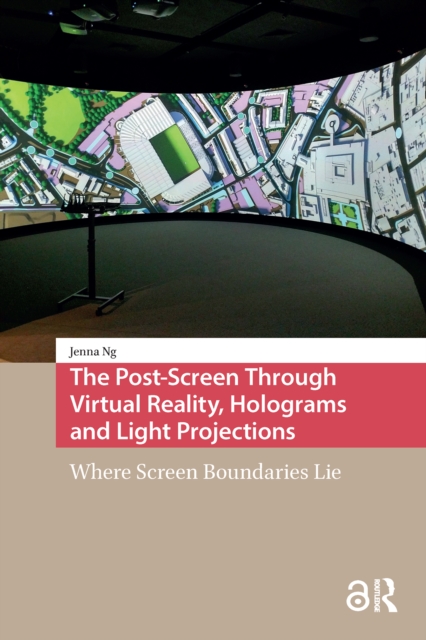
The Post-Screen Through Virtual Reality, Holograms and Light Projections
Screens are ubiquitous today. They display information; present image worlds; are portable; connect to mobile networks; mesmerize. However, contemporary screen media also seek to eliminate the presence of the screen and the visibilities of its boundaries. As what is image becomes increasingly indistinguishable against the viewer’s actual surroundings, this unsettling prompts re-examination about not only what is the screen, but also how the screen demarcates and what it stands for in relation to our understanding of our realities in, outside and against images. Through case studies drawn from three media technologies – Virtual Reality; holograms; and light projections – this book develops new theories of the surfaces on and spaces in which images are displayed today, interrogating critical lines between art and life; virtuality and actuality; truth and lies. What we have today is not just the contestation of the real against illusion or the unreal, but the disappearance itself of difference and a gluttony of the unreal which both connect up to current politics of distorted truth values and corrupted terms of information. The Post-Screen Through Virtual Reality, Holograms and Light Projections: Where Screen Boundaries Lie is thus about not only where the image’s borders and demarcations are established, but also the screen boundary as the instrumentation of today’s intense virtualizations that do not tell the truth. In all this, a new imagination for images emerges, with a new space for cultures of presence and absence, definitions of object and representation, and understandings of dis- and re-placement – the post-screen.
eBook

Producing great sound for film and video : expert tips from preproduction to final mix
\"Make your film and video projects sound as good as they look with this popular guide. Learn practical, timesaving ways to get better recordings, solve problems with existing audio, create compelling tracks, and boost your filmmaking to the next level! In this fourth edition of Producing Great Sound for Film and Video, audio guru Jay Rose revises his popular text for a new generation of filmmakers. You'll find real world advice and practical guidelines for every aspect of your soundtrack: planning and budgeting, field and studio recording, editing, sound effects and music, audio repair and processing, and mixing. The combination of solid technical information and a clear, step-by-step approach has made this the go-to book for producers and film students for over a decade. This new edition includes: - Insights and from-the-trenches tips from film and video professionals - Advice on how to get the best results from new equipment including DSLRs and digital recorders - Downloadable diagnostics and audio examples you can edit on your own computer - Instruction for dealing with new regulations for wireless mics and broadcast loudness - Techniques that work with any software or hardware - An expanded \"How Do I Fix This?\" section to help you solve problems quickly - An all new companion website (www.GreatSound.info) with audio and video tutorial files, demonstrations, and diagnostics Whether you're an aspiring filmmaker who wants rich soundtracks that entertain and move an audience, or an experienced professional looking for a reference guide, Producing Great Sound for Film and Video, Fourth Edition has the information you need\"-- Provided by publisher.
Book

Emerging Technologies for 3D Video
With the expectation of greatly enhanced user experience, 3D video is widely perceived as the next major advancement in video technology. In order to fulfil the expectation of enhanced user experience, 3D video calls for new technologies addressing efficient content creation, representation/coding, transmission and display. Emerging Technologies for 3D Video will deal with all aspects involved in 3D video systems and services, including content acquisition and creation, data representation and coding, transmission, view synthesis, rendering, display technologies, human perception of depth and quality assessment. Key features: * Offers an overview of key existing technologies for 3D video * Provides a discussion of advanced research topics and future technologies * Reviews relevant standardization efforts * Addresses applications and implementation issues * Includes contributions from leading researchers The book is a comprehensive guide to 3D video systems and services suitable for all those involved in this field, including engineers, practitioners, researchers as well as professors, graduate and undergraduate students, and managers making technological decisions about 3D video.
eBook

Video game storytelling : what every developer needs to know about narrative techniques
\"This handy, to-the-point reference guide for video game development emphasizes the significance of storytelling and writing skills for creating today's most popular, narratively-engrossing video games. Video Game Storytelling provides developers with comprehensive, but easy-to-follow advice for facilitating the creation of compelling storylines in today's most popular and narratively successful video games. Video game writer and game writing instructor Evan Skolnick offers a clear and concise development reference guide for aspiring and professional developers, showing how each role (from character designer to animator to audio engineer and more) is impacted by and can affect the story/narrative of a game. This book aims to instill an understanding and appreciation of the basic storytelling principles that are essential for producing truly memorable video games that will bring today's savvy gamers back time and time again\"-- Provided by publisher.
Book
Versatile Video Coding
Video is the main driver of bandwidth use, accounting for over 80 per cent of consumer Internet traffic. Video compression is a critical component of many of the available multimedia applications, it is necessary for storage or transmission of digital video over today's band-limited networks. The majority of this video is coded using international standards developed in collaboration with ITU-T Study Group and MPEG. The MPEG family of video coding standards begun on the early 1990s with MPEG-1, developed for video and audio storage on CD-ROMs, with support for progressive video. MPEG-2 was standardized in 1995 for applications of video on DVD, standard and high definition television, with support for interlaced and progressive video. MPEG-4 part 2, also known as MPEG-2 video, was standardized in 1999 for applications of low- bit rate multimedia on mobile platforms and the Internet, with the support of object-based or content based coding by modeling the scene as background and foreground. Since MPEG-1, the main video coding standards were based on the so-called macroblocks. However, research groups continued the work beyond the traditional video coding architectures and found that macroblocks could limit the performance of the compression when using high-resolution video. Therefore, in 2013 the high efficiency video coding (HEVC) also known and H.265, was released, with a structure similar to H.264/AVC but using coding units with more flexible partitions than the traditional macroblocks. HEVC has greater flexibility in prediction modes and transform block sizes, also it has a more sophisticated interpolation and de blocking filters. In 2006 the VC-1 was released. VC-1 is a video codec implemented by Microsoft and the Microsoft Windows Media Video (VMW) 9 and standardized by the Society of Motion Picture and Television Engineers (SMPTE). In 2017 the Joint Video Experts Team (JVET) released a call for proposals for a new video coding standard initially called Beyond the HEVC, Future Video Coding (FVC) or known as Versatile Video Coding (VVC). VVC is being built on top of HEVC for application on Standard Dynamic Range (SDR), High Dynamic Range (HDR) and 360° Video. The VVC is planned to be finalized by 2020. This book presents the new VVC, and updates on the HEVC. The book discusses the advances in lossless coding and covers the topic of screen content coding. Technical topics discussed include: Beyond the High Efficiency Video CodingHigh Efficiency Video Coding encoderScreen contentLossless and visually lossless coding algorithmsFast coding algorithmsVisual quality assessmentOther screen content coding algorithmsOverview of JPEG Series
Preface Acknowledgements List of Figures List of Tables List of Abbreviations Number of References and Projects Introduction 1 Beyond High Efficiency Video Coding (HEVC) 2 HEVC Encoder 3 Screen Content Coding for HEVC 4 Lossless and Visually Lossless Coding Algorithms Appendix Index About the Authors
Humberto Ochoa Dominguez, K.R. Rao
eBook