
Catalogue Search | MBRL


Are you sure you want to remove the book from the shelf?

{{itemTitle}}
259
result(s) for
"Dio Chrysostom"
Sort by:


Post-Hellenistic Perspectives on Divination, the Individual, and the Cosmos
Abstract This article investigates the relation between ancient divinatory theories and ontological assumptions about individuals, the gods, and the cosmos through the writings of Dio Chrysostom, Epictetus, and Maximus of Tyre—three philosophers who belong to the first Roman imperial age. By exploring their works in light of recent anthropological studies, this article will discuss how different divinatory systems generate, and are embedded in, specific ontologies. All three writers analyze divination as a means to bridge contingency and transcendence and to situate individuals within the cosmos. As such, their analysis of divination relates to specific ontological systems: a mono-ontology reducible to one divine-material principle for Epictetus, and the poly-ontology of a graduated cosmos for Dio Chrysostom and Maximus of Tyre.
Journal Article

TOPPLING THE STATUES OF FAVORINUS AND DEMETRIUS OF PHALERUM
The Corinthian Speech (Corinthiaca) in the corpus of Dio Chrysostom (Or. 31) is attributed to Favorinus (c.80–160) based on internal criteria of content and style. This article argues that a reference to an author of a Corinthian speech found in a collection of sayings in codex Vaticanus Graecus 1144 is a unique external reference to Favorinus as author of this speech.
Journal Article
PHILOSOPHY IN DIO CHRYSOSTOM, ON ANACHÔRÊSIS (ORATION 20)
This article uncovers the intellectual traditions behind Dio Chrysostom's Oration 20: On Anachôrêsis. The examination reveals a variety of subtexts and traditions with which Dio engages, and shows that at its core the text inspects three types of lives promoted by three philosophical schools: Epicurean, Stoic and Peripatetic. They are never referred to directly, however, which raises questions concerning Dio's strategy of not acknowledging the sources of the ideas with which he engages. The article also develops our understanding of anachôrêsis and the controversies surrounding it in pagan antiquity.
Journal Article

Hagar on Sinai: The Choice of Heracles, Mountain Women, and Pauline Allegory in Galatians
Paul’s allegory of Hagar and Sarah in Gal 4:21–5:1 remains a perennial puzzle as its enigmatic chain of associations (two biblical women—two covenants—two geographical locations of Mount Sinai and Jerusalem) has no clear parallel. In this study, I offer a fresh perspective by exploring striking similarities with an allegorical parable that was widely popular across antiquity among Greeks and Romans and within Judaism and Christianity. The so-called Choice of Heracles—commonly attributed to Prodicus (Xenophon, Mem. 2.1.21–33)—also features two women as personified abstractions of two opposing moral principles. They are named “Virtue” and “Vice” and appear to Heracles as he is coming of age, deciding which road his life would take. The story’s allegorical qualities enabled a remarkable range of adaptations for new scenarios, two of which stand out for their proximity to Paul. Philo of Alexandria reinvents and expands the Choice of Heracles for his exegesis of several opposing pairs of biblical mothers, including Hagar and Sarah, their sons, and respective inheritance rights (Sacr. 20–45). Dio Chrysostom reworks the myth for a political speech in which the two women—Royalty and Tyranny—are identified with eponymous mountain peaks upon which they sit (1 Regn. 49–84 [Or. 1]).
Journal Article

An ancient debate on urban renewal and built heritage: Dio Chrysostom and the city of Prusa
Scholarship on architecture and urbanism in antiquity has focused on building activity and investment in the fabric of cities as positive processes, typically starting from the assumption that such developments were welcomed by inhabitants – but were they? This article examines objections to urban renewal and the construction of monumental public building in the Roman world. Specifically, it focuses on the city of Prusa and the controversy surrounding the renovation of its civic centre by the local politician Dio Chrysostom in the early 2nd century AD. Using speeches and letters written at the time, the article presents both a new interpretation of this specific episode and brings to the fore the rarely articulated and yet highly controversial nature of building projects that are traditionally thought of as being beneficial. In the conclusion, we also see how this example contributes to research on the issue of heritage as a pre-modern phenomenon.
Journal Article
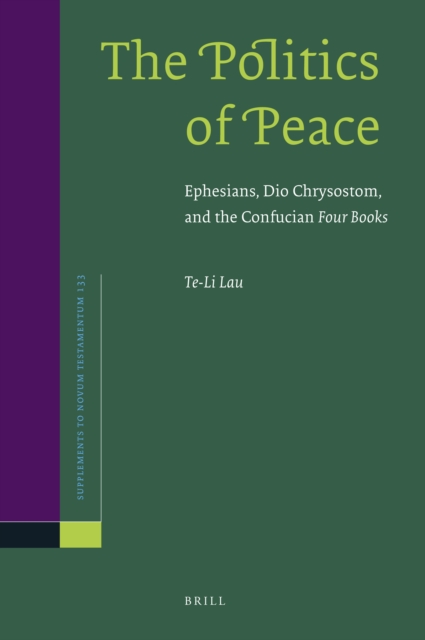
The Politics of Peace
This study examines the topos of peace in Ephesians by comparison with Colossians, Dio Chrysostom's Orations, and the Confucian Four Books; and shows that Ephesians can be read as a politico-religious letter \"concerning peace\" within the church.
eBook

The School of Libanius in Late Antique Antioch
This book is a study of the fourth-century sophist Libanius, a major intellectual figure who ran one of the most prestigious schools of rhetoric in the later Roman Empire. He was a tenacious adherent of pagan religion and a friend of the emperor Julian, but also taught leaders of the early Christian church like St. John Chrysostom and St. Basil the Great. Raffaella Cribiore examines Libanius's training and personality, showing him to be a vibrant educator, though somewhat gloomy and anxious by nature. She traces how he cultivated a wide network of friends and former pupils and courted powerful officials to recruit top students. Cribiore describes his school in Antioch--how students applied, how they were evaluated and trained, and how Libanius reported progress to their families. She details the professional opportunities that a thorough training in rhetoric opened up for young men of the day. Also included here are translations of 200 of Libanius's most important letters on education, almost none of which have appeared in English before.
Cribiore casts into striking relief the importance of rhetoric in late antiquity and its influence not only on pagan intellectuals but also on prominent Christian figures. She gives a balanced view of Libanius and his circle against the far-flung panorama of the Greek East.
eBook

Politics, Justice, and Reform in Dio's Euboicus
This paper uses a close reading of Dio's Euboicus to reflect on the understandings of law, justice, and politics among Greek intellectuals in the high empire more generally. The Euboicus can be read as a satire concerning urban political autonomy in an empire; these rituals of political autonomy and judgment, Dio argues, were ultimately empty. Accordingly, in the second part of the speech, Dio presents a vision of social reform in which he envisions the possibility of a world without legal politics.
Journal Article