
Catalogue Search | MBRL


Are you sure you want to remove the book from the shelf?

{{itemTitle}}
24,121
result(s) for
"Disabled people"
Sort by:

Young, Disabled and LGBT
Young, Disabled and LGBT+ brings together the work of an international team interested in exploring the intersection of sexuality, gender identity, and disability in the lives of young people and aims to further develop this area as a distinct area of study.
This volume features original research and writing into lives that are often misunderstood, marginalised and under-represented in research. It is framed with artwork, poetry and writing from young disabled LGBT+ people and centralises the voices and lives of young disabled LGBT+ people throughout. Drawing from disciplines including sociology, psychology, disability and youth studies, and with contributions from practitioners, it examines experiences and research from a number of perspectives, such as education, personal lives and activism.
Featuring work from the UK, Canada, United States, India and Australia, it is a timely and topical book which will appeal to scholars particularly interested in sexuality, gender, disability and youth studies; professionals within health, education, social work and youth work who aim to understand and support young disabled LGBT+ people; and young people themselves.
eBook


Supporting Transgender and Non-Binary People with Disabilities or Illnesses
Jennie Kermode MA (hons) MRes is Chair of Trans Media Watch and author of Transgender Employees in the Workplace: A Guide for Employers. She has written for The Independent, The New Statesman, Pink News and New Internationalist. She lives in Paisley, UK.
eBook


Constructing Disability after the Great War
As Americans--both civilians and veterans--worked to determine the meanings of identity for blind veterans of World War I, they bound cultural constructs of blindness to all the emotions and contingencies of mobilizing and fighting the war, and healing from its traumas. Sighted Americans’ wartime rehabilitation culture centered blind soldiers and veterans in a mix of inspirational stories. Veterans worked to become productive members of society even as ableism confined their unique life experiences to a collection of cultural tropes that suggested they were either downcast wrecks of their former selves or were morally superior and relatively flawless as they overcame their disabilities and triumphantly journeyed toward successful citizenship. Sullivan investigates the rich lives of blind soldiers and veterans and their families to reveal how they confronted barriers, gained an education, earned a living, and managed their self-image while continually exposed to the public’s scrutiny of their success and failures.
eBook


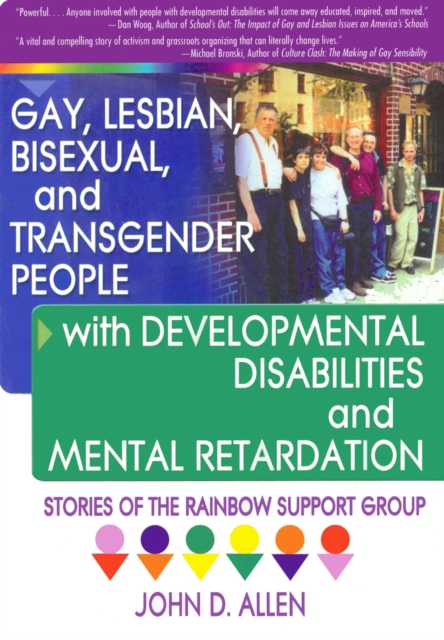
Gay, Lesbian, Bisexual, and Transgender People with Developmental Disabilities and Mental Retardation
Experience the birth of the first support group for sexual minorities with developmental disabilities!
Reflecting an unprecedented development in the disabled and sexual minority communities, Gay, Lesbian, Bisexual, and Transgender People with Developmental Disabilities and Mental Retardation: Stories of the Rainbow Support Group describes the founding, achievements, and history of a unique group providing support for people with developmental disabilities or mental retardation (DD/MR) who are gay, lesbian, bisexual, and transgender. In this pathbreaking book, group founder John D. Allen describes the Rainbow Support Group's beginnings in 1998 at the New Haven Gay & Lesbian Community Center in Connecticut and the ways in which it has been shattering myths and stereotypes surrounding people with mental retardation ever since.
From the author: 'Not only are people with DD/MR full human beings with the same needs and desires for intimacy and healthy sexual expression as people without intellectual disabilities, but the group is evidence that some people with DD/MR have an understanding of sexual orientation as well. Acknowledging that people with mental retardation are sexual is a new development in the human service field, but one that is still in the pre-Stonewall days regarding those who are gay. Although people with mental retardation are given unprecedented freedom to make personal vocational decisions, there is an unfounded expectation that they do not have a sexualitylet alone a homosexuality. Members of the Rainbow Support Group discuss the same concerns as other gay people, but in a support system that recognizes their unique perspective.'
This insightful book shows how membership in the Rainbow Support Group addresses the very real fears and concerns of its members, including:
being forced into heterosexual social situations, since that is the only available option for socialization
dealing with bein
eBook