
Catalogue Search | MBRL


Are you sure you want to remove the book from the shelf?

{{itemTitle}}
94,016
result(s) for
"Disabled persons"
Sort by:


The Social Construction of Intellectual Disability
Intellectual disability is usually thought of as a form of internal, individual affliction, little different from diabetes, paralysis or chronic illness. This study, the first book-length application of discursive psychology to intellectual disability, shows that what we usually understand as being an individual problem is actually an interactional, or social, product. Through a range of case studies, which draw upon ethnomethodological and conversation analytic scholarship, the book shows how persons categorized as 'intellectually disabled' are produced, as such, in and through their moment-by-moment interaction with care staff and other professionals. Mark Rapley extends and reformulates current work in disability studies and offers a reconceptualisation of intellectual disability as both a professionally ascribed diagnostic category and an accomplished - and contested - social identity. Importantly, the book is grounded in data drawn from naturally-occurring, rather than professionally orchestrated, social interaction.
eBook

Framing the moron
Many people are shocked upon discovering that tens of thousands of innocent persons in the United States were involuntarily sterilized, forced into institutions, and otherwise maltreated within the course of the eugenic movement (1900–30). Such social control efforts are easier to understand when we consider the variety of dehumanizing and fear-inducing rhetoric propagandists invoke to frame their potential victims. This book details the major rhetorical themes employed within the context of eugenic propaganda, drawing largely on original sources of the period. Early in the twentieth century the term “moron” was developed to describe the primary targets of eugenic control. This book demonstrates how the image of moronity in the United States was shaped by eugenicists. This book will be of interest not only to disability and eugenic scholars and historians, but to anyone who wants to explore the means by which pejorative metaphors are used to support social control efforts against vulnerable community groups.
eBook

Labeling the Mentally Retarded
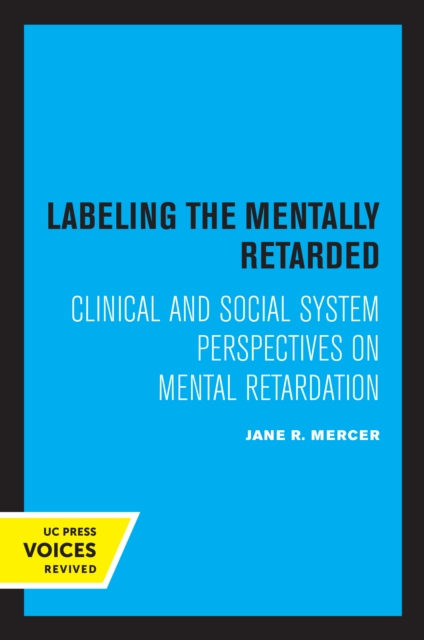
This eight-year study of an American city traces the answer to the question \"Who is retarded?\" by analyzing the labeling process in a large number of community agencies. Data for the study are drawn from a representative sample of 7,000 persons under fifty years of age who were tested ans screened for \"symptoms\" of mental retardation. The author finds that that schools label more persons as mentally retarded than any other agency and share their labels more widely with others in the community. Relying on IQ test scores for diagnosis, schools place many persons with scores above 70 and with no physical disabilities in the role of retardate. The author contends that both the statistical model of \"normal\" and the unicultural viewpoint of educators and clinicians work to the disadvantage of the poor and the ethnic minorities. Given the opportunity, many persons demonstrate by their ability to cope with the problems in other areas of life that they are not comprehensively incompetent. The author makes serval policy recommendations. First, she suggests lowering the IQ score cutoff point used by schools in determining who shall be labeled as retarded. Second, she recommends that the clinicians use the two-dimensional definition of retardation proposed by the American Association of Mental Deficiency, subnormality in both intellectual performance and adaptive behavior. Third, she concludes that pluralistic assessment procedures must be employed to take into account cultural biases in IQ tests designed to measure cognitive skills. This title is part of UC Press's Voices Revived program, which commemorates University of California Press's mission to seek out and cultivate the brightest minds and give them voice, reach, and impact. Drawing on a backlist dating to 1893, Voices Revived makes high-quality, peer-reviewed scholarship accessible once again using
print-on-demand technology. This title was originally published in 1973. Many titles in the Voices Revived program are also newly available as ebooks, offered at a discounted price to support wider access to scholarly work.
eBook


What low back pain is and why we need to pay attention
Low back pain is a very common symptom. It occurs in high-income, middle-income, and low-income countries and all age groups from children to the elderly population. Globally, years lived with disability caused by low back pain increased by 54% between 1990 and 2015, mainly because of population increase and ageing, with the biggest increase seen in low-income and middle-income countries. Low back pain is now the leading cause of disability worldwide. For nearly all people with low back pain, it is not possible to identify a specific nociceptive cause. Only a small proportion of people have a well understood pathological cause—eg, a vertebral fracture, malignancy, or infection. People with physically demanding jobs, physical and mental comorbidities, smokers, and obese individuals are at greatest risk of reporting low back pain. Disabling low back pain is over-represented among people with low socioeconomic status. Most people with new episodes of low back pain recover quickly; however, recurrence is common and in a small proportion of people, low back pain becomes persistent and disabling. Initial high pain intensity, psychological distress, and accompanying pain at multiple body sites increases the risk of persistent disabling low back pain. Increasing evidence shows that central pain-modulating mechanisms and pain cognitions have important roles in the development of persistent disabling low back pain. Cost, health-care use, and disability from low back pain vary substantially between countries and are influenced by local culture and social systems, as well as by beliefs about cause and effect. Disability and costs attributed to low back pain are projected to increase in coming decades, in particular in low-income and middle-income countries, where health and other systems are often fragile and not equipped to cope with this growing burden. Intensified research efforts and global initiatives are clearly needed to address the burden of low back pain as a public health problem.
Journal Article

Health inequalities and people with intellectual disabilities
\"People with intellectual disabilities die at a younger age and have poorer health than their non-disabled peers. This is largely avoidable and is unjust. This book uses concepts from contemporary public health to provide a comprehensive evidence-based overview of: the nature and extent of the health inequalities experienced by people with intellectual disabilities; why these inequalities occur and persist; and what can and needs to be done to address these inequalities. The authors have a wealth of firsthand experience gained from years of working at the interface between disability research and public health. This experience is collected and shared in this volume, which will be an invaluable resource for practitioners, advocates, policymakers and researchers concerned with health and social care and the wellbeing of disabled people\"--Provided by publisher.
Book

Madness in civilization
The loss of reason, a sense of alienation from the commonsense world we all like to imagine we inhabit, the shattering emotional turmoil that seizes hold and won't let go-these are some of the traits we associate with madness. Today, mental disturbance is most commonly viewed through a medical lens, but societies have also sought to make sense of it through religion or the supernatural, or by constructing psychological or social explanations in an effort to tame the demons of unreason.Madness in Civilizationtraces the long and complex history of this affliction and our attempts to treat it.
Beautifully illustrated throughout,Madness in Civilizationtakes readers from antiquity to today, painting a vivid and often harrowing portrait of the different ways that cultures around the world have interpreted and responded to the seemingly irrational, psychotic, and insane. From the Bible to Sigmund Freud, from exorcism to mesmerism, from Bedlam to Victorian asylums, from the theory of humors to modern pharmacology, the book explores the manifestations and meanings of madness, its challenges and consequences, and our varied responses to it. It also looks at how insanity has haunted the imaginations of artists and writers and describes the profound influence it has had on the arts, from drama, opera, and the novel to drawing, painting, and sculpture.
Written by one of the world's preeminent historians of psychiatry,Madness in Civilizationis a panoramic history of the human encounter with unreason.
eBook