
Catalogue Search | MBRL


Are you sure you want to remove the book from the shelf?

{{itemTitle}}
746
result(s) for
"Disappeared persons."
Sort by:

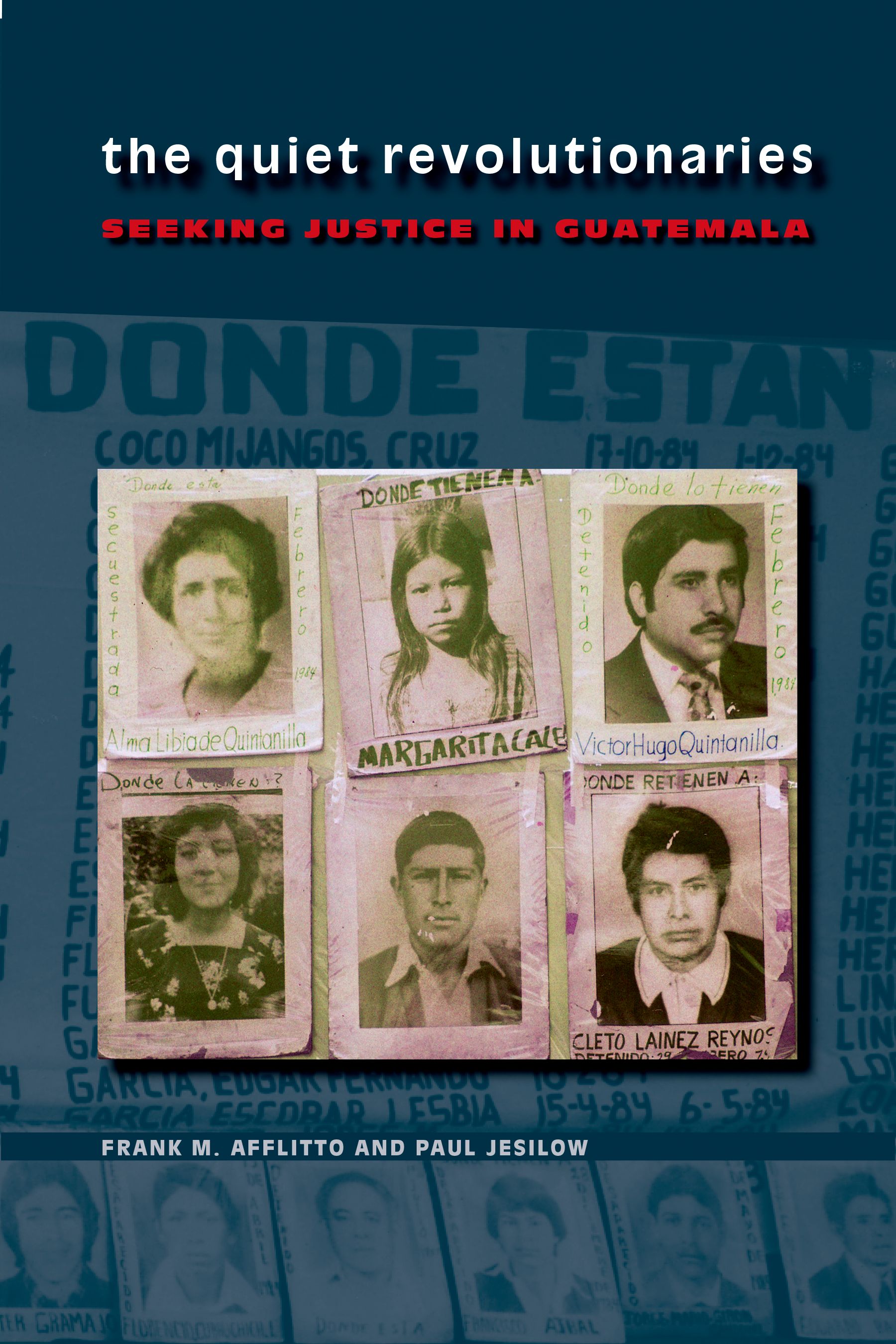
The Quiet Revolutionaries
The last three decades of the twentieth century brought relentless waves of death squads, political kidnappings, and other traumas to the people of Guatemala. Many people fled the country to escape the violence. Yet, at the same moment, a popular movement for justice brought together unlikely bands of behind-the-scenes heroes, blurring ethnic, geographic, and even class lines. The Quiet Revolutionaries is drawn from interviews conducted by Frank Afflitto in the early 1990s with more than eighty survivors of the state-sanctioned violence. Gathered under frequently life-threatening circumstances, the observations and recollections of these inspiring men and women form a unique perspective on collective efforts to produce change in politics, law, and public consciousness. Examined from a variety of perspectives, from sociological to historical, their stories form a rich ethnography. While it is still too soon to tell whether stable, long-term democracy will prevail in Guatemala, the successes of these fascinating individuals provide a unique understanding of revolutionary resistance.
eBook

A flower traveled in my blood : the incredible true story of the grandmothers who fought to find a stolen generation of children
\"The epic, true story of the Abuelas de Plaza de Mayo, grandmothers who fought to find their stolen grandchildren during Argentina's brutal dictatorship\"-- Provided by publisher.
BOOK

Missing
Stories of the missing offer profound insights into the tension between how political systems see us and how we see each other. The search for people who go missing as a result of war, political violence, genocide, or natural disaster reveals how forms of governance that objectify the person are challenged. Contemporary political systems treat persons instrumentally, as objects to be administered rather than as singular beings: the apparatus of government recognizes categories, not people. In contrast, relatives of the missing demand that authorities focus on a particular person: families and friends are looking for someone who to them is unique and irreplaceable.
InMissing, Jenny Edkins highlights stories from a range of circumstances that shed light on this critical tension: the aftermath of World War II, when millions in Europe were displaced; the period following the fall of the World Trade Center towers in Manhattan in 2001 and the bombings in London in 2005; searches for military personnel missing in action; the thousands of political \"disappearances\" in Latin America; and in more quotidian circumstances where people walk out on their families and disappear of their own volition. When someone goes missing we often find that we didn't know them as well as we thought: there is a sense in which we are \"missing\" even to our nearest and dearest and even when we are present, not absent. In this thought-provoking book, Edkins investigates what this more profound \"missingness\" might mean in political terms.
eBook

The disappearance of Adèle Bedeau : a historical thriller by Raymond Brunet
\"From the author of the Man Booker Prize Finalist, His Bloody Project comes a haunting literary mystery and engrossing psychological thriller\"-- Provided by publisher.
Book

The Disappeared
The Disappeared tells the extraordinary saga of
Argentina's attempt to right the wrongs of an unspeakably dark
past. Using a recent human rights trial as his lens, Sam Ferguson
addresses two central questions of our age: How is mass atrocity
possible, and What should be done in its wake? From 1976 to 1983
thousands of people were the victims of state terrorism during
Argentina's so-called Dirty War. Ferguson recounts a
twenty-two-month trial of the most notorious perpetrators of this
atrocity, who ran a secret prison from the Naval Mechanics School
in Buenos Aires. The navy executed as many as five thousand
political \"subversives,\" most of whom were sedated and thrown alive
out of airplanes into the South Atlantic. The victims of these
secret death flights and others who went missing during the regime
are known as los desaparecidos -\"the disappeared.\" Ferguson
explores Argentina's novel response to mass atrocity: the country's
remarkable and controversial decisions in 2003 to repeal a series
of amnesty laws passed in the 1980s and to prosecute anew the
perpetrators of the Dirty War a generation after the collapse of
the country's last dictatorship. As of 2022 more than one thousand
aging military officers have been indicted for their involvement in
the Dirty War and hundreds of trials have commenced in the
country's civilian courts. Among the many facets of the book,
Ferguson takes an in-depth look at allegations that Father Jorge
Mario Bergoglio, now Pope Francis, was involved in the
disappearance of two Jesuit priests under his supervision in 1976.
Bergoglio was called to testify in a closed-chambers session.
Ferguson reviewed those secret proceedings and uses them as a
springboard to explore the Argentine Catholic Church and its
broader role in the Dirty War. The lingering but acute trauma of
the victims who testified at the trial underscores the moral
urgency of accountability. When a state strips its citizens of all
their rights, the only response that approximates reparation is to
restore the rule of law and punish the perpetrators. Yet the trial
also revealed the limits of using criminal law to respond to mass
atrocity. Justice demands a laser-like focus on evidence relevant
to a crime, but atrocity begs for social understanding. Can the law
ever bring full justice?
eBook


The quiet revolutionaries : seeking justice in Guatemala
The last three decades of the twentieth century brought relentless waves of death squads, political kidnappings, and other traumas to the people of Guatemala. Many people fled the country to escape the violence. Yet, at the same moment, a popular movement for justice brought together unlikely bands of behind-the-scenes heroes, blurring ethnic, geographic, and even class lines. The Quiet Revolutionaries is drawn from interviews conducted by Frank Afflitto in the early 1990s with more than eighty survivors of the state-sanctioned violence. Gathered under frequently life-threatening circumstances, the observations and recollections of these inspiring men and women form a unique perspective on collective efforts to produce change in politics, law, and public consciousness. Examined from a variety of perspectives, from sociological to historical, their stories form a rich ethnography. While it is still too soon to tell whether stable, long-term democracy will prevail in Guatemala, the successes of these fascinating individuals provide a unique understanding of revolutionary resistance.
eBook

Purgatory : a novel
Simón Cardoso had been dead thirty years when his wife, Emilia Dupuy, spotted him at lunchtime in the lounge bar in Trudy Tuesday. So begins Purgatory. Simón, a cartographer like Emilia, vanished during a trip to map an obscure road in Argentina's back country. Later, testimonies suggested that he was one of the thousands of \"subversives\" arrested, tortured, and executed by the military regime. Yet Emilia, daughter of the regime's chief propagandist, has refused to accept this. She has spent her life longing for Simón to return, following elusive leads, never giving up hope. The husband who reappears to her, however, has not suffered those same years of uncertainty; for him, no time has passed at all.--From back cover.
Book

Enforced Disappearance: Family Members’ Experiences
The goal of this article is to describe the new experiences that close female family members of disappeared persons have after the enforced disappearance. These relatives experience rupture with their pre-disappearance lives. Their everyday routines cease and the search for the disappeared person takes over. Some relatives experience impoverishment and many lose their children or spouse to emigration. Parts or all of their extended family cut off ties, friendships end, and some neighbors avoid them. A local humanitarian or human rights organization and an association of relatives of disappeared persons come to occupy a central place in relatives’ lives and become “like a second family.” Focusing on enforced disappearance during the Pinochet dictatorship in Chile, this research is based on interviews with relatives of people who disappeared, on a year’s participant observation with a group of these relatives, and on the examination of relatives’ denunciatory art (dissident pictures in cloth called “arpilleras”).
Journal Article