
Catalogue Search | MBRL


Are you sure you want to remove the book from the shelf?

{{itemTitle}}
423
result(s) for
"Discourse analysis Data processing."
Sort by:

Bridging the gap between AI, cognitive science, and narratology with narrative generation
\"This book combines traditional theories of narratology with current narrative generation practices using artificial intelligence\"-- Provided by publisher.
BOOK

Reading Machines
Besides familiar and now-commonplace tasks that computers do all the time, what else are they capable of? Stephen Ramsay's intriguing study of computational text analysis examines how computers can be used as \"reading machines\" to open up entirely new possibilities for literary critics. Computer-based text analysis has been employed for the past several decades as a way of searching, collating, and indexing texts. Despite this, the digital revolution has not penetrated the core activity of literary studies: interpretive analysis of written texts._x000B__x000B_Computers can handle vast amounts of data, allowing for the comparison of texts in ways that were previously too overwhelming for individuals, but they may also assist in enhancing the entirely necessary role of subjectivity in critical interpretation. Reading Machines discusses the importance of this new form of text analysis conducted with the assistance of computers. Ramsay suggests that the rigidity of computation can be enlisted by intuition, subjectivity, and play.
eBook

Multilingual text analysis : challenges, models, and approaches
Text analytics (TA) covers a very wide research area. Its overarching goal is to discover and present knowledge - facts, rules, and relationships - that is otherwise hidden in the textual content. The authors of this book guide us in a quest to attain this knowledge automatically, by applying various machine learning techniques. This book describes recent development in multilingual text analysis. It covers several specific examples of practical TA applications, including their problem statements, theoretical background, and implementation of the proposed solution. The reader can see which preprocessing techniques and text representation models were used, how the evaluation process was designed and implemented, and how these approaches can be adapted to multilingual domains.
Book

Language in Scotland
The chapters in this volume take as their focus aspects of three of the languages of Scotland: Scots, Scottish English, and Scottish Gaelic. They present linguistic research which has been made possible by new and developing corpora of these languages: this encompasses work on lexis and lexicogrammar, semantics, pragmatics, orthography, and punctuation. Throughout the volume, the findings of analysis are accompanied by discussion of the methodologies adopted, including issues of corpus design and representativeness, search possibilities, and the complementarity and interoperability of linguistic resources. Together, the chapters present the forefront of the research which is currently being directed towards the linguistics of the languages of Scotland, and point to an exciting future for research driven by ever more refined corpora and related language resources.
eBook


Text Resources and Lexical Knowledge
This book contains selected state-of-the-art contributions to the 9th conference on natural language processing, KONVENS 2008 (Konferenz zur Verarbeitung natürlicher Sprache), with the central theme: text resources and lexical knowledge. The collection is unique in its placement of focus on the interaction between both of the above-mentioned fields, illustrating in particular the importance of methods in corpus linguistics for building lexical resources on the one hand, and the relevance of lexical resources for the analysis of and intelligent search methods for text corpora on the other. The selected articles all present novel approaches to one of three different research areas which in turn define the three parts of the book: * Techniques and models for the linguistic analysis of text resources: contributions from computational linguistics * Methods and tools for the acquisition of lexical knowledge from digitized and linguistically annotated text resources * Approaches to the representation of lexical knowledge in digital media for various purposes.
eBook


Textual information access
This book presents statistical models that have recently been developed within several research communities to access information contained in text collections. The problems considered are linked to applications aiming at facilitating information access:
- information extraction and retrieval;
- text classification and clustering;
- opinion mining;
- comprehension aids (automatic summarization, machine translation, visualization).
In order to give the reader as complete a description as possible, the focus is placed on the probability models used in the applications concerned, by highlighting the relationship between models and applications and by illustrating the behavior of each model on real collections.
Textual Information Access is organized around four themes: informational retrieval and ranking models, classification and clustering (regression logistics, kernel methods, Markov fields, etc.), multilingualism and machine translation, and emerging applications such as information exploration.
eBook

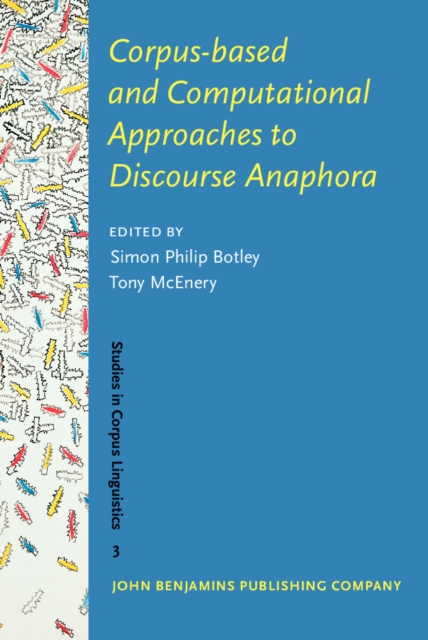
Corpus-based and Computational Approaches to Discourse Anaphora
Discourse anaphora is a challenging linguistic phenomenon that has given rise to research in fields as diverse as linguistics, computational linguistics and cognitive science. Because of the diversity of approaches these fields bring to the anaphora problem, the editors of this volume argue that there needs to be a synthesis, or at least a principled attempt to draw the differing strands of anaphora research together. The selected papers in this volume all contribute to the aim of synthesis and were selected to represent the growing importance of corpus-based and computational approaches to anaphora description, and to developing natural language systems for resolving anaphora in natural language.
eBook