
Catalogue Search | MBRL


Are you sure you want to remove the book from the shelf?

{{itemTitle}}
6
result(s) for
"Discourses (Meher Baba)"
Sort by:

A short life of Kierkegaard (new in paperback)
A small, insignificant-looking intellectual with absurdly long legs, Søren Kierkegaard (1813-1855) was a veritable Hans Christian Andersen caricature of a man. A strange combination of witty cosmopolite and melancholy introvert, he spent years writing under a series of fantastical pseudonyms, lavishing all the splendor of his magnificent mind on a seldom-appreciative world. He had a tragic love affair with a young girl, was dominated by an unforgettable Old Testament father, fought a sensational literary duel with a popular satiric magazine, and died in the midst of a violent quarrel with the state church for which he had once studied theology. Yet this iconoclast produced a number of brilliant books that have profoundly influenced modern thought.
In this classic biography, the celebrated Kierkegaard translator Walter Lowrie presents a charming and warmly appreciative introduction to the life and work of the great Danish writer. Lowrie tells the story of Kierkegaard's emotionally turbulent life with a keen sense of drama and an acute understanding of how his life shaped his thought. The result is a wonderfully informative and entertaining portrait of one of the most important thinkers of the past two centuries. This edition also includes Lowrie's wry essay \"How Kierkegaard Got into English,\" which tells the improbable story of how Lowrie became one of Kierkegaard's principal English translators despite not learning Danish until he was in his 60s, as well as a new introduction by Kierkegaard scholar Alastair Hannay.
eBook

The Essential Kierkegaard
This is the most comprehensive anthology of Søren Kierkegaard's works ever assembled in English. Drawn from the volumes of Princeton's authoritativeKierkegaard's Writingsseries by editors Howard and Edna Hong, the selections represent every major aspect of Kierkegaard's extraordinary career. They reveal the powerful mix of philosophy, psychology, theology, and literary criticism that made Kierkegaard one of the most compelling writers of the nineteenth century and a shaping force in the twentieth. With an introduction to Kierkegaard's writings as a whole and explanatory notes for each selection, this is the essential one-volume guide to a thinker who changed the course of modern intellectual history.
The anthology begins with Kierkegaard's early journal entries and traces the development of his work chronologically to the finalThe Changelessness of God. The book presents generous selections from all of Kierkegaard's landmark works, includingEither/Or, Fear and Trembling, Works of Love, andThe Sickness unto Death, and draws new attention to a host of such lesser-known writings asThree Discourses on Imagined OccasionsandThe Lily of the Field and the Bird of the Air. The selections are carefully chosen to reflect the unique character of Kierkegaard's work, with its shifting pseudonyms, its complex dialogues, and its potent combination of irony, satire, sermon, polemic, humor, and fiction. We see the esthetic, ethical, and ethical-religious ways of life initially presented as dialogue in two parallel series of pseudonymous and signed works and later in the \"second authorship\" as direct address. And we see the themes that bind the whole together, in particular Kierkegaard's overarching concern with, in his own words, \"What it means to exist; . . . what it means to be a human being.\"
Together, the selections provide the best available introduction to Kierkegaard's writings and show more completely than any other book why his work, in all its creativity, variety, and power, continues to speak so directly today to so many readers around the world.
eBook

Kierkegaard's journals and notebooks
For over a century, the Danish thinker Søren Kierkegaard (1813-55) has been at the center of a number of important discussions, concerning not only philosophy and theology, but also, more recently, fields such as social thought, psychology, and contemporary aesthetics, especially literary theory.
Despite his relatively short life, Kierkegaard was an extraordinarily prolific writer, as attested to by the 26-volume Princeton University Press edition of all of his published writings. But Kierkegaard left behind nearly as muchunpublishedwriting, most of which consists of what are called his \"journals and notebooks.\" Kierkegaard has long been recognized as one of history's great journal keepers, but only rather small portions of his journals and notebooks are what we usually understand by the term \"diaries.\" By far the greater part of Kierkegaard's journals and notebooks consists of reflections on a myriad of subjects--philosophical, religious, political, personal. Studying his journals and notebooks takes us into his workshop, where we can see his entire universe of thought. We can witness the genesis of his published works, to be sure--but we can also see whole galaxies of concepts, new insights, and fragments, large and small, of partially (or almost entirely) completed but unpublished works.Kierkegaard's Journals and Notebooksenables us to see the thinker in dialogue with his times and with himself.
Volume 4 of this 11-volume series includes the first five of Kierkegaard's well-known \"NB\" journals, which contain, in addition to a great many reflections on his own life, a wealth of thoughts on theological matters, as well as on Kierkegaard's times, including political developments and the daily press.
Kierkegaard wrote his journals in a two-column format, one for his initial entries and the second for the extensive marginal comments that he added later. This edition of the journals reproduces this format, includes several photographs of original manuscript pages, and contains extensive scholarly commentary on the various entries and on the history of the manuscripts being reproduced.
eBook

Kierkegaard's journals and notebooks
For over a century, the Danish thinker Søren Kierkegaard (1813-55) has been at the center of a number of important discussions, concerning not only philosophy and theology, but also, more recently, fields such as social thought, psychology, and contemporary aesthetics, especially literary theory.
Despite his relatively short life, Kierkegaard was an extraordinarily prolific writer, as attested to by the 26-volume Princeton University Press edition of all of his published writings. But Kierkegaard left behind nearly as muchunpublishedwriting, most of which consists of what are called his \"journals and notebooks.\" Kierkegaard has long been recognized as one of history's great journal keepers, but only rather small portions of his journals and notebooks are what we usually understand by the term \"diaries.\" By far the greater part of Kierkegaard's journals and notebooks consists of reflections on a myriad of subjects--philosophical, religious, political, personal. Studying his journals and notebooks takes us into his workshop, where we can see his entire universe of thought. We can witness the genesis of his published works, to be sure--but we can also see whole galaxies of concepts, new insights, and fragments, large and small, of partially (or almost entirely) completed but unpublished works.Kierkegaard's Journals and Notebooksenables us to see the thinker in dialogue with his times and with himself.
Volume 5 of this 11-volume series includes five of Kierkegaard's important \"NB\" journals (Journals NB6 through NB10), covering the months from summer 1848 through early May 1849. This was a turbulent period both in the history of Denmark--which was experiencing the immediate aftermath of revolution and the fall of absolutism, a continuing war with the German states, and the replacement of the State Church with the Danish People's Church--and for Kierkegaard personally. The journals in the present volume include Kierkegaard's reactions to the political upheaval, a retrospective account of his audiences with King Christian VIII, deliberations about publishing an autobiographical explanation of his writings, and an increasingly harsh critique of the Danish Church. These journals also reflect Kierkegaard's deep concern over his collision with the satirical journalCorsair, an experience that helped radicalize his view of \"essential Christianity\" and caused him to ponder the meaning of martyrdom.
Kierkegaard wrote his journals in a two-column format, one for his initial entries and the second for the extensive marginal comments that he added later. This edition of the journals reproduces this format, includes several photographs of original manuscript pages, and contains extensive scholarly commentary on the various entries and on the history of the manuscripts being reproduced.
eBook
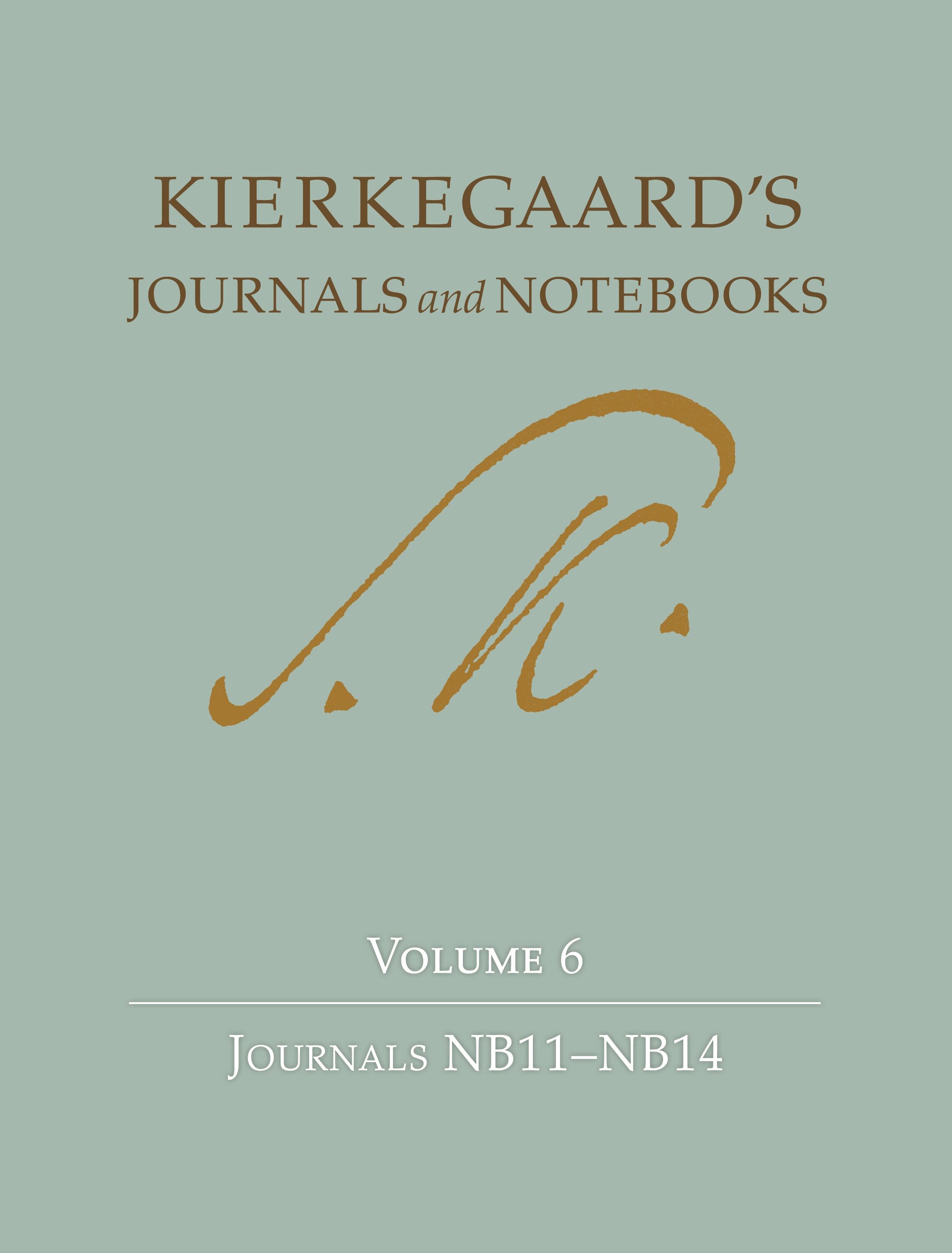
Kierkegaard's journals and notebooks
For over a century, the Danish thinker Søren Kierkegaard (1813-55) has been at the center of a number of important discussions, concerning not only philosophy and theology, but also, more recently, fields such as social thought, psychology, and contemporary aesthetics, especially literary theory.
Despite his relatively short life, Kierkegaard was an extraordinarily prolific writer, as attested to by the 26-volume Princeton University Press edition of all of his published writings. But Kierkegaard left behind nearly as much unpublished writing, most of which consists of what are called his \"journals and notebooks.\" Kierkegaard has long been recognized as one of history's great journal keepers, but only rather small portions of his journals and notebooks are what we usually understand by the term \"diaries.\" By far the greater part of Kierkegaard's journals and notebooks consists of reflections on a myriad of subjects--philosophical, religious, political, personal. Studying his journals and notebooks takes us into his workshop, where we can see his entire universe of thought. We can witness the genesis of his published works, to be sure--but we can also see whole galaxies of concepts, new insights, and fragments, large and small, of partially (or almost entirely) completed but unpublished works.Kierkegaard's Journals and Notebooksenables us to see the thinker in dialogue with his times and with himself.
Volume 6 of this 11-volume series includes four of Kierkegaard's important \"NB\" journals (Journals NB11 through NB14), covering the months from early May 1849 to the beginning of 1850. At this time Denmark was coming to terms with the 1848 revolution that had replaced absolutism with popular sovereignty, while the war with the German states continued, and the country pondered exactly what replacing the old State Church with the Danish People's Church would mean. In these journals Kierkegaard reflects at length on political and, especially, on ecclesiastical developments. His brooding over the ongoing effects of his fight with the satirical journalCorsaircontinues, and he also examines and re-examines the broader personal and religious significance of his broken engagement with Regine Olsen. These journals also contain reflections by Kierkegaard on a number of his most important works, including the two works written under his \"new\" pseudonym Anti-Climacus (The Sickness unto DeathandPractice in Christianity) and his various attempts at autobiographical explanations of his work. And, all the while, the drumbeat of his radical critique of \"Christendom\" continues and escalates.
Kierkegaard wrote his journals in a two-column format, one for his initial entries and the second for the extensive marginal comments that he added later. This edition of the journals reproduces this format, includes several photographs of original manuscript pages, and contains extensive scholarly commentary on the various entries and on the history of the manuscripts being reproduced.
eBook

The quotable Kierkegaard
\"Why I so much prefer autumn to spring is that in the autumn one looks at heaven--in the spring at the earth.\"--Søren Kierkegaard
The father of existentialism, Søren Kierkegaard (1813-1855) was a philosopher who could write like an angel. With only a sentence or two, he could plumb the depths of the human spirit. In this collection of some 800 quotations, the reader will find dazzling bon mots next to words of life-changing power. Drawing from the authoritative Princeton editions of Kierkegaard's writings, this book presents a broad selection of his wit and wisdom, as well as a stimulating introduction to his life and work.
Organized by topic, this volume covers notable Kierkegaardian concerns such as anxiety, despair, existence, irony, and the absurd, but also erotic love, the press, busyness, and the comic. Here readers will encounter both well-known quotations (\"Life must be understood backward. But then one forgets the other principle, that it must belived forward\") and obscure ones (\"Beware false prophets who come to you in wolves' clothing but inwardly are sheep--i.e., the phrasemongers\"). Those who spend time in these pages will discover the writer who said, \"my grief is my castle,\" but who also taught that \"the best defense against hypocrisy is love.\"
Illuminating and delightful, this engaging book also provides a substantial portrait of one of the most influential of modern thinkers.
Gathers some 800 quotations Drawn from the authoritative Princeton editions of Kierkegaard's writings Includes an introduction, a brief account and timeline of Kierkegaard's life, a guide to further reading, and an index
eBook