
Catalogue Search | MBRL


Are you sure you want to remove the book from the shelf?

{{itemTitle}}
40
result(s) for
"Discrimination against people with disabilities Law and legislation United States."
Sort by:


Disability harassment
Building on the insights of both disability studies and civil rights scholars, Mark C. Weber frames his examination of disability harassment on the premise that disabled people are members of a minority group that must negotiate an artificial yet often damaging environment of physical and attitudinal barriers. The book considers courts’ approaches to the problem of disability harassment, particularly the application of an analogy to race and sex harassment and the development of legal remedies and policy reforms under the Americans with Disabilities Act (ADA).
While litigation under the ADA has addressed discrimination in public accommodations, employment, and education, Weber points out that the law has done little to combat disability harassment. He recommends that arguments based on unused provisions of the ADA should be developed and new legal remedies advanced to address the problem. Disability Harassment also draws on case law to explore special problems of harassment in the public schools, and closes with an appeal to judges and lawmakers for expanded legal protection against harassment.
eBook

eQuality : the struggle for web accessibility by persons with cognitive disabilities
\"The Struggle for Web Accessibility by Persons with Cognitive Disabilities Never before have the civil rights of people with disabilities aligned so well with developments in information and communication technology. The center of the technology revolution is the Internet's World Wide Web, which fosters unprecedented opportunities for engagement in democratic society. The Americans with Disabilities Act likewise is helping to ensure equal participation in society by people with disabilities. Globally, the Convention on the Rights of Persons with Disabilities further affirms that persons with disabilities are entitled to the full and equal enjoyment of fundamental personal freedoms. This book is about the lived struggle for disability rights, with a focus on web eQuality for people with cognitive disabilities, such as those with intellectual disabilities, autism, and print-related disabilities. The principles derived from the right to the web - freedom of speech and individual dignity - are bound to lead towards full and meaningful involvement in society for persons with cognitive and other disabilities\"-- Provided by publisher.
Book

Law and the Contradictions of the Disability Rights Movement
The passage of the Americans with Disabilities Act in 1990 was hailed as revolutionary legislation, but in the ensuing years restrictive Supreme Court decisions have prompted accusations that the Court has betrayed the disability rights movement. The ADA can lay claim to notable successes, yet people with disabilities continue to be unemployed at extremely high rates. In this timely book, Samuel R. Bagenstos examines the history of the movement and discusses the various, often-conflicting projects of diverse participants. He argues that while the courts deserve some criticism, some may also be fairly aimed at the choices made by prominent disability rights activists as they crafted and argued for the ADA. The author concludes with an assessment of the limits of antidiscrimination law in integrating and empowering people with disabilities, and he suggests new policy directions to make these goals a reality.
eBook


Twenty-Two Cents an Hour
In Twenty-Two Cents an
Hour , Doug Crandell uncovers the harsh
reality of people with disabilities in the United States who are
forced to work in unethical conditions for subminimum wages with
little or no opportunity to advocate for themselves, while wealthy
CEOs grow even wealthier as a direct result.
As recently as 2016, the United States Congress enacted
bipartisan legislation which continued to allow workers with
disabilities to legally be paid far lower than the federal minimum
wage. Drawing on ongoing federal Department of Justice lawsuits,
the horrifying story of Henry's Turkey Farm in Iowa, and more,
Crandell shows the history of the policies that have led to these
unjust outcomes, examines who benefits from this legislation, and
asks important questions about the rise of a disability industrial
complex. Exposing this complex-which is rooted in profit, lobbying,
and playing on the emotions of workers' parents and families, as
well as the public-Crandell challenges readers to reexamine how we
treat some of our most vulnerable fellow citizens. Twenty-Two
Cents an Hour forces the reader to face the reality of this
exploitation, and builds the framework needed for reform.
eBook

The Ugly Laws
The murky history behind municipal laws criminalizing
disability In the late-nineteenth and early-twentieth
centuries, municipal laws targeting \"unsightly beggars\" sprang up
in cities across America. Seeming to criminalize disability and
thus offering a visceral example of discrimination, these \"ugly
laws\" have become a sort of shorthand for oppression in disability
studies, law, and the arts. In this watershed study of the ugly
laws, Susan M. Schweik uncovers the murky history behind the laws,
situating the varied legislation in its historical context and
exploring in detail what the laws meant. Illustrating how the laws
join the history of the disabled and the poor, Schweik not only
gives the reader a deeper understanding of the ugly laws and the
cities where they were generated, she locates the laws at a crucial
intersection of evolving and unstable concepts of race, nation,
sex, class, and gender. Moreover, she explores the history of
resistance to the ordinances, using the often harrowing life
stories of those most affected by their passage. Moving to the
laws' more recent history, Schweik analyzes the shifting cultural
memory of the ugly laws, examining how they have been used-and
misused-by academics, activists, artists, lawyers, and
legislators.
eBook

Disability and Aging Discrimination
As the average age of our citizens rises, this book argues that success at ameliorating the effects of disability and age-related bias, prejudice, and discrimination requires a psycholegal approach that reconciles legal theory with psychological reality.
eBook

Rights of inclusion : law and identity in the life stories of Americans with disabilities
Rights of Inclusion provides an innovative, accessible perspective on how civil rights legislation affects the lives of ordinary Americans. Based on eye-opening and deeply moving interviews with intended beneficiaries of the Americans with Disabilities Act (ADA), David M. Engel and Frank W. Munger argue for a radically new understanding of rights-one that focuses on their role in everyday lives rather than in formal legal claims.
Although all sixty interviewees had experienced discrimination, none had filed a formal protest or lawsuit. Nevertheless, civil rights played a crucial role in their lives. Rights improved their self-image, enhanced their career aspirations, and altered the perceptions and assumptions of their employers and coworkers-in effect producing more inclusive institutional arrangements. Focusing on these long-term life histories, Engel and Munger incisively show how rights and identity affect one another over time and how that interaction ultimately determines the success of laws such as the ADA.
eBook
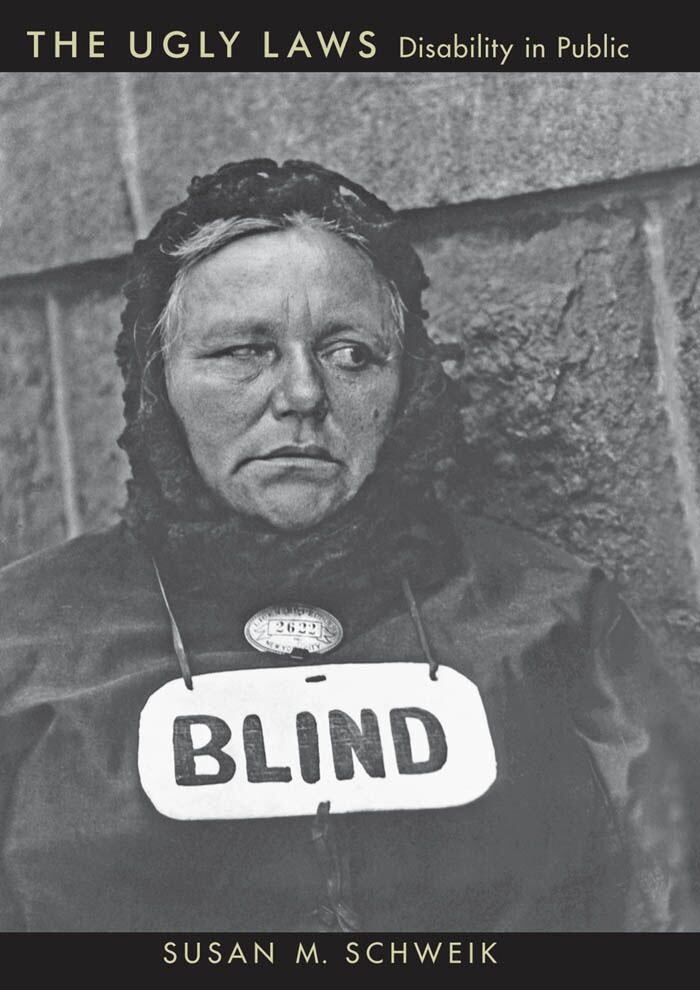
The ugly laws : disability in public
The murky history behind municipal laws criminalizing disability In the late-nineteenth and early-twentieth centuries, municipal laws targeting \"unsightly beggars\" sprang up in cities across America. Seeming to criminalize disability and thus offering a visceral example of discrimination, these “ugly laws” have become a sort of shorthand for oppression in disability studies, law, and the arts. In this watershed study of the ugly laws, Susan M. Schweik uncovers the murky history behind the laws, situating the varied legislation in its historical context and exploring in detail what the laws meant. Illustrating how the laws join the history of the disabled and the poor, Schweik not only gives the reader a deeper understanding of the ugly laws and the cities where they were generated, she locates the laws at a crucial intersection of evolving and unstable concepts of race, nation, sex, class, and gender. Moreover, she explores the history of resistance to the ordinances, using the often harrowing life stories of those most affected by their passage. Moving to the laws’ more recent history, Schweik analyzes the shifting cultural memory of the ugly laws, examining how they have been used—and misused—by academics, activists, artists, lawyers, and legislators.
eBook