
Catalogue Search | MBRL


Are you sure you want to remove the book from the shelf?

{{itemTitle}}
379
result(s) for
"Discrimination in juvenile justice administration"
Sort by:


Who Gets a Childhood?
Using Texas as a case study for understanding change in the American juvenile justice system over the past century, William S. Bush tells the story of three cycles of scandal, reform, and retrenchment, each of which played out in ways that tended to extend the privileges of a protected childhood to white middle- and upper-class youth, while denying those protections to blacks, Latinos, and poor whites. On the forefront of both progressive and \"get tough\" reform campaigns, Texas has led national policy shifts in the treatment of delinquent youth to a surprising degree. Changes in the legal system have included the development of courts devoted exclusively to young offenders, the expanded legal application of psychological expertise, and the rise of the children's rights movement. At the same time, broader cultural ideas about adolescence have also changed. Yet Bush demonstrates that as the notion of the teenager gained currency after World War II, white, middle-class teen criminals were increasingly depicted as suffering from curable emotional disorders even as the rate of incarceration rose sharply for black, Latino, and poor teens. Bush argues that despite the struggles of reformers, child advocates, parents, and youths themselves to make juvenile justice live up to its ideal of offering young people a second chance, the story of twentieth-century juvenile justice in large part boils down to \"the exclusion of poor and nonwhite youth from modern categories of childhood and adolescence.\"
eBook


The Evolution of the Juvenile Court
A major statement on the juvenile justice system by one of America's leading experts
The juvenile court lies at the intersection of youth policy and crime policy. Its institutional practices reflect our changing ideas about children and crime control.The Evolution of the Juvenile Courtprovides a sweeping overview of the American juvenile justice system's development and change over the past century. Noted law professor and criminologist Barry C. Feld places special emphasis on changes over the last 25 years-the ascendance of get tough crime policies and the more recent Supreme Court recognition that \"children are different.\"
Feld's comprehensive historical analyses trace juvenile courts' evolution though four periods-the original Progressive Era, the Due Process Revolution in the 1960s, the Get Tough Era of the 1980s and 1990s, and today's Kids Are Different era. In each period, changes in the economy, cities, families, race and ethnicity, and politics have shaped juvenile courts' policies and practices. Changes in juvenile courts' ends and means-substance and procedure-reflect shifting notions of children's culpability and competence.
The Evolution of the Juvenile Courtexamines how conservative politicians used coded racial appeals to advocate get tough policies that equated children with adults and more recent Supreme Court decisions that draw on developmental psychology and neuroscience research to bolster its conclusions about youths' reduced criminal responsibility and diminished competence. Feld draws on lessons from the past to envision a new, developmentally appropriate justice system for children. Ultimately, providing justice for children requires structural changes to reduce social and economic inequality-concentrated poverty in segregated urban areas-that disproportionately expose children of color to juvenile courts' punitive policies.
Historical, prescriptive, and analytical,The Evolution of the Juvenile Courtevaluates the author's past recommendations to abolish juvenile courts in light of this new evidence, and concludes that separate, but reformed, juvenile courts are necessary to protect children who commit crimes and facilitate their successful transition to adulthood.
eBook

The black child-savers
During the Progressive Era, a rehabilitative agenda took hold of American juvenile justice, materializing as a citizen-and-state-building project and mirroring the unequal racial politics of American democracy itself. Alongside this liberal \"manufactory of citizens,\" a parallel structure was enacted: a Jim Crow juvenile justice system that endured across the nation for most of the twentieth century. In The Black Child Savers, the first study of the rise and fall of Jim Crow juvenile justice, Geoff Ward examines the origins and organization of this separate and unequal juvenile justice system. Ward explores how generations of \"black child-savers\" mobilized to challenge the threat to black youth and community interests and how this struggle grew aligned with a wider civil rights movement, eventually forcing the formal integration of American juvenile justice. Ward's book reveals nearly a century of struggle to build a more democratic model of juvenile justice - an effort that succeeded in part, but ultimately failed to deliver black youth and community to liberal rehabilitative ideals. At once an inspiring story about the shifting boundaries of race, citizenship, and democracy in America and a crucial look at the nature of racial inequality, The Black Child Savers is a stirring account of the stakes and meaning of social justice. Summary reprinted by permission of University of Chicago Press
eBook

Just mercy : adapted for young adults : a true story of the fight for justice
Lawyer and social justice advocate Bryan Stevenson offers a glimpse into the lives of the wrongfully imprisoned and his efforts to fight for their freedom.
BOOK

The contexts of juvenile justice decision making : when race matters
An in-depth examination of the contextual nature of decision making and the causes of disproportionate minority confinement in four relatively homogenous juvenile courts in Iowa, this book explores the subjective social psychological processes of juvenile court officers and the factors that influence those processes. Iowa, although a state with a predominantly white population, has one of the highest minority incarceration rates for juveniles. Michael J. Leiber focuses on the relationships between adherence to correctional orientations (such as retribution and rehabilitation) and decision-makers’ views concerning race, crime, family, and respect for authority with judgments and differential outcomes for youth. Quantitative and qualitative methodologies are used to determine the extent to which correctional ideologies and decision-makers’ stereotyping of minorities are fueled by a wide range of contingencies, the impact of case processing and outcomes of whites, African Americans, and Native Americans, and how it varies by jurisdiction.
eBook

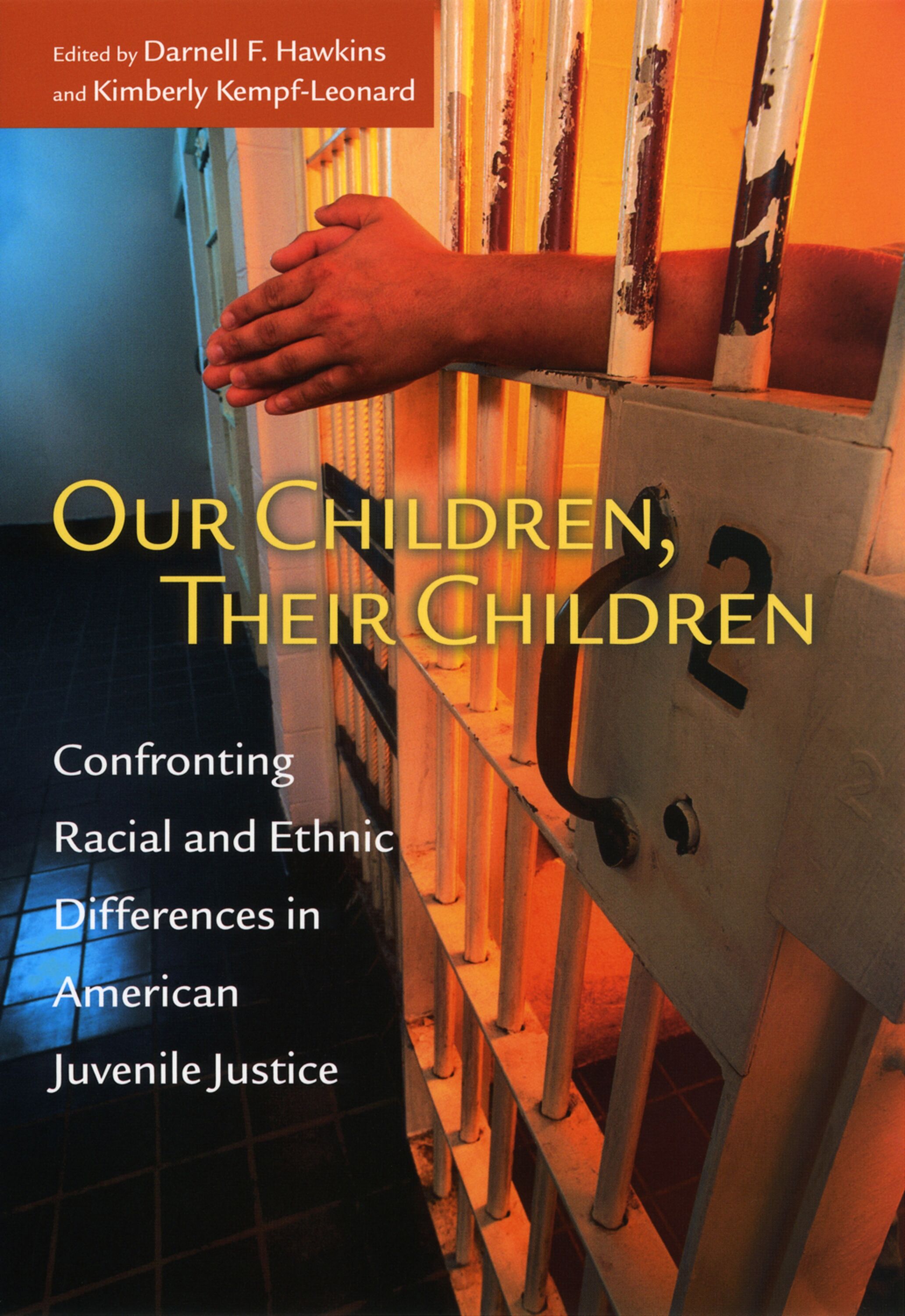
Our children, their children
In Our Children, Their Children, a prominent team of researchers argues that a second-rate and increasingly punitive juvenile justice system is allowed to persist because most people believe it is designed for children in other ethnic and socioeconomic groups. While public opinion, laws, and social policies that convey distinctions between \"our children\" and \"their children\" may seem to conflict with the American ideal of blind justice, they are hardly at odds with patterns of group differentiation and inequality that have characterized much of American history. Our Children, Their Children provides a state-of-the-science examination of racial and ethnic disparities in the American juvenile justice system. Here, contributors document the precise magnitude of these disparities, seek to determine their causes, and propose potential solutions. In addition to race and ethnicity, contributors also look at the effects on juvenile justice of suburban sprawl, the impact of family and neighborhood, bias in postarrest decisions, and mental health issues. Assessing the implications of these differences for public policy initiatives and legal reforms, this volume is the first critical summary of what is known and unknown in this important area of social research.
eBook