
Catalogue Search | MBRL


Are you sure you want to remove the book from the shelf?

{{itemTitle}}
384
result(s) for
"Discussion Political aspects."
Sort by:

Mere civility : disagreement and the limits of toleration
Civility is often treated as an essential virtue in liberal democracies that promise to protect diversity as well as active disagreement in the public sphere. Yet the fear that our tolerant society faces a crisis of incivility is gaining ground. Politicians and public intellectuals call for \"more civility\" as the solution--but is civility really a virtue? Or is it something more sinister--a covert demand for conformity that silences dissent? Mere Civility sheds light on this tension in contemporary political theory and practice by examining similar appeals to civility in early modern debates about religious toleration. In seventeenth-century England, figures as different as Roger Williams, Thomas Hobbes, and John Locke could agree that some restraint on the wars of words and \"persecution of the tongue\" between sectarians would be required; and yet, they recognized that the prosecution of incivility was often difficult to distinguish from persecution.-- Provided by publisher
Book

Post-Soviet social
The Soviet Union created a unique form of urban modernity, developing institutions of social provisioning for hundreds of millions of people in small and medium-sized industrial cities spread across a vast territory. After the collapse of socialism these institutions were profoundly shaken--casualties, in the eyes of many observers, of market-oriented reforms associated with neoliberalism and the Washington Consensus. InPost-Soviet Social, Stephen Collier examines reform in Russiabeyondthe Washington Consensus. He turns attention from the noisy battles over stabilization and privatization during the 1990s to subsequent reforms that grapple with the mundane details of pipes, wires, bureaucratic routines, and budgetary formulas that made up the Soviet social state.
Drawing on Michel Foucault's lectures from the late 1970s,Post-Soviet Socialuses the Russian case to examine neoliberalism as a central form of political rationality in contemporary societies. The book's basic finding--that neoliberal reforms provide a justification for redistribution and social welfare, and may work to preserve the norms and forms of social modernity--lays the groundwork for a critical revision of conventional understandings of these topics.
eBook
Climate change and migration
Climate change is a major source of concern in the Middle East and North Africa (MENA) region, and migration is often understood as one of several strategies used by households to respond to changes in climate and environmental conditions, including extreme weather events. This study focuses on the link between climate change and migration. Most micro-level studies measure climate change either by the incidences of extreme weather events or by variation in temperature or rainfall. A few studies have found that formal and informal institutions as well as policies also affect migration. Institutions that make government more responsive to households (for example through public spending) discourage both international and domestic migration in the aftermath of extreme weather events. Migration is often an option of last resort after vulnerable rural populations attempting to cope with new and challenging circumstances have exhausted other options such as eating less, selling assets, or removing children from school. This study is based in large part on new data collected in 2011 in Algeria, Egypt, Morocco, Syria, and the Republic of Yemen. The surveys were administered by in-country partners to a randomly selected set of 800 households per country. It is also important to emphasize that neither the household survey results nor the findings from the qualitative focus groups are meant to be representative of the five countries in which the work was carried, since only a few areas were surveyed in each country. This report is organized as follows: section one gives synthesis. Section two discusses household perceptions about climate change and extreme weather events. Section three focuses on migration as a coping mechanisms and income diversification strategy. Section four examines other coping and adaptation strategies. Section five discusses perceptions about government and community programs.
eBook

Wiki Government: How Technology Can Make Government Better, Democracy Stronger, and Citizens More Powerful
Wiki Government shows how to bring innovation to government. In explaining how to enhance political institutions with the power of networks, it offers a fundamental rethinking of democracy in the digital age. Collaborative democracy-government of the people, by the people, for the people-is an old dream. Today, Wiki Government shows how technology can make that dream a reality. In this thought-provoking book, Beth Simone Noveck illustrates how collaborative democracy strengthens public decisionmaking by connecting the power of the many to the work of the few. Equally important, she provides a step-by-step demonstration of how collaborative democracy can be designed, opening policymaking to greater participation. \"Wiki Government\" tells the story behind one of the most dramatic public sector innovations in recent years - inviting the public to participate in the patent examination process. Patent examiners usually work in secret, cut off from essential information and racing against the clock to master arcane technical claims. The Peer-to-Patent project radically transformed this process by allowing anyone with Internet access to collaborate with the agency in reviewing patent applications. \"Wiki Government\" describes how a far-flung team of technologists, lawyers, and policymakers pried open a tradition-bound agency's doors. Noveck explains how she brought both fiercely competitive companies and risk-averse bureaucrats on board. She discusses the design challenges the team faced in creating software to distill online collaboration into useful expertise, not just rants or raves. And she explains how law, policy, and technology can be revamped to help government work in more open and participatory ways in a wide range of policy arenas, including education and the environment.
eBook

Affective partisan polarization, citizens’ attitudes, and political behavior in Swiss democracy
There is a concern that citizens with different political positions and party affiliations increasingly dislike each other. We examine this affective polarization, which is often associated with a weakening of democracy, in the context of Switzerland’s multiparty landscape with proportional governmental representation. Evaluating the long-term development of affective polarization in Switzerland with both historical and newly gathered data for 2023, we find an increase between 1999 and 2003 but hardly any change over the last two decades. In a complementary perspective based on voters’ revealed preferences, our analysis of straight- vs. split-ticket voting behavior in national parliamentary elections with continuous data back to 1983 does not support any trend in partisan polarization. We further find that more affectively polarized individuals report, on average, lower satisfaction with democracy but show a higher willingness to participate in politics across a wide range of different forms of political engagement, even when controlling for individuals’ general sympathy toward political parties.
Journal Article
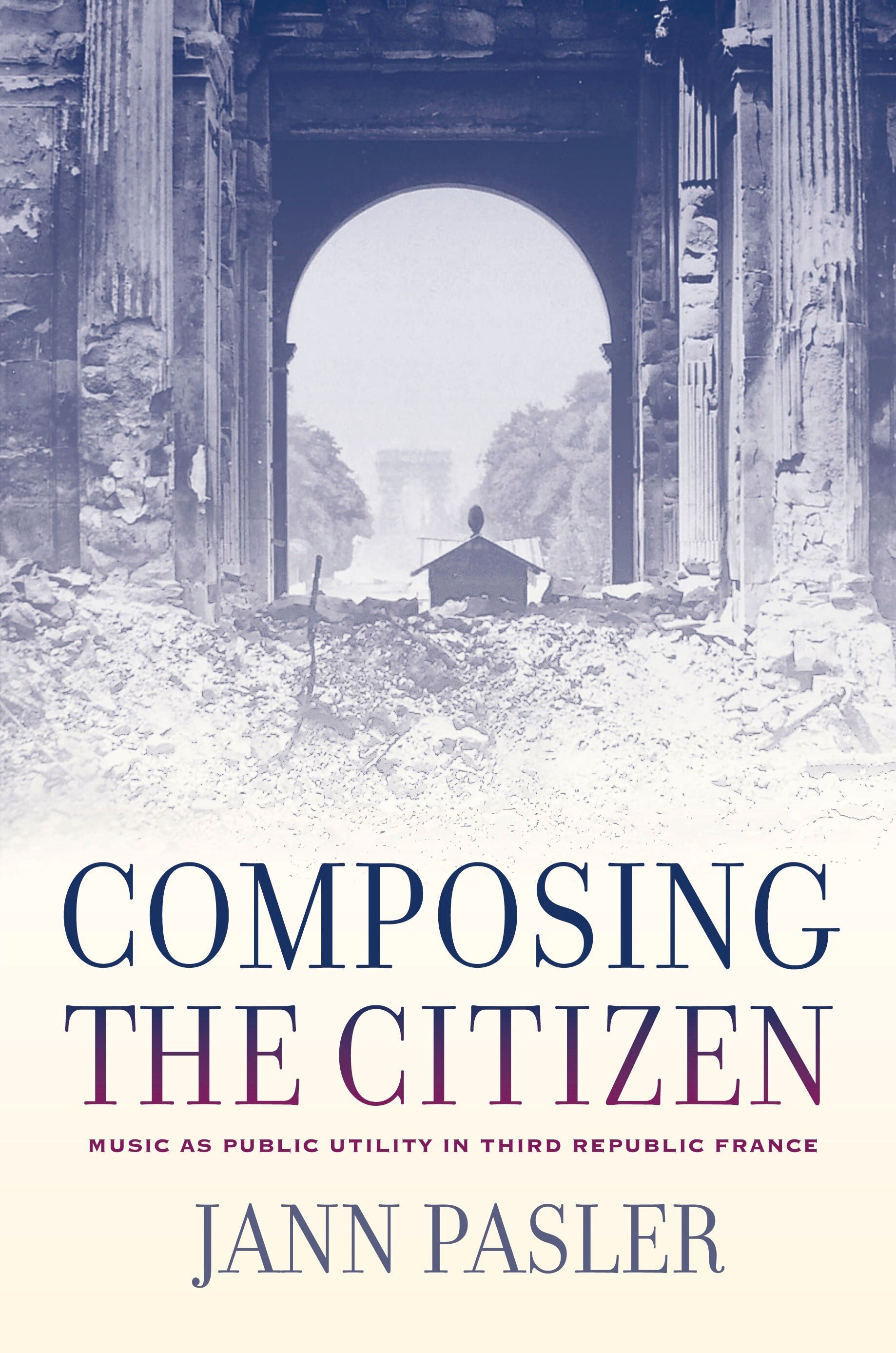
Composing the Citizen
In a book that challenges modernist ideas about the value and role of music in Western society,Composing the Citizendemonstrates how music can help forge a nation. Deftly exploring the history of Third Republic France, Jann Pasler shows how French people from all classes and political persuasions looked to music to revitalize the country after the turbulent crises of 1871. Embraced not as a luxury but for its \"public utility,\" music became an object of public policy as integral to modern life as power and water, a way to teach critical judgment and inspire national pride. It helped people to forget the past, voice conflicting aspirations, and imagine a shared future. Based on a dazzling survey of archival material, Pasler's rich interdisciplinary work looks beyond elites and the histories their agendas have dominated to open new windows onto the musical tastes and practices of amateurs as well as professionals. A fascinating history of the period emerges, one rooted in political realities and the productive tensions between the political and the aesthetic. Highly evocative and deeply humanistic,Composing the Citizenignites broad debates about music's role in democracy and its meaning in our lives.
eBook

Finding uncommon ground: Extremist online forum engagement predicts integrative complexity
How do interactions with an ideologically extreme online community affect cognition? In this paper, we examine whether engagement with an online neo-Nazi forum is associated with more one-sided, “black and white” thinking. Using naturalistic language data, we examined differences in integrative complexity, a measure of the degree to which people acknowledge and reconcile conflicting ideas and viewpoints, and contrasted it with Language Style Matching, a measure of group cohesion. In a large web scraping study ( N = 1,891), we tested whether two measures of engagement and interaction with the community are associated with less complex, balanced cognition. Using hierarchical regression modeling, we found that both individuals who had been community members for longer and those who had posted more tended to show less complexity in their language, even when accounting for mean differences between individuals. However, these differences in integrative complexity were distinct from group cohesion, which actually decreased with our measures of engagement. Despite small effect sizes, these findings indicate that ideologically extreme online communities may exacerbate the views of their members and contribute to ever-widening polarized cognitions.
Journal Article

Geography and political economy: Reflections by a geography convert
During my studies in Political Economy at the University of Sydney in the late 1980s/early 1990s, Frank Stilwell taught a class on 'The Political Economy of Cities and Regions'. Among the readings were pieces by David Harvey, Manuel Castells, and draft chapters of Frank’s 'Understanding Cities and Regions: Spatial Political Economy', published shortly afterwards as a book (Stilwell 1992). It was a brilliant class. As someone who had been turned on to radical politics when my dad sat me down to watch Pat Fiske’s documentary Rocking the Foundations about Sydney’s green ban movement (see Iveson 2014), the attention to cities and regions really floated my boat. For me, it inflamed an on-going interest in urban politics, while agitating me to develop my understanding of the political economy of the urban process.
Journal Article

The saint in the banyan tree
The Saint in the Banyan Tree is a nuanced and historically persuasive exploration of Christianity's remarkable trajectory as a social and cultural force in southern India. Starting in the seventeenth century, when the religion was integrated into Tamil institutions of caste and popular religiosity, this study moves into the twentieth century, when Christianity became an unexpected source of radical transformation for the country's 'untouchables' (dalits). Mosse shows how caste was central to the way in which categories of 'religion' and 'culture' were formed and negotiated in missionary encounters, and how the social and semiotic possibilities of Christianity lead to a new politic of equal rights in South India. Skillfully combining archival research with anthropological fieldwork, this book examines the full cultural impact of Christianity on Indian religious, social and political life. Connecting historical ethnography to the preoccupations of priests and Jesuit social activists, Mosse throws new light on the contemporary nature of caste, conversion, religious synthesis, secularization, dalit politics, the inherent tensions of religious pluralism, and the struggle for recognition among subordinated people.
eBook

Operationalizing Lasswell’s call for clarification of value goals: an equity-based approach to normative public policy analysis
In 1951, Harold Lasswell defined the ability to clarify value goals as integral to a policy analyst’s job. But graduate education in public policy analysis has paid insufficient attention to the skills needed to investigate and clarify value disputes. In turn, practicing policy analysts don’t have ready access to a set of methods for normative analysis that serves Lasswell’s vision of a contextualized, holistic, and interdisciplinary policy science. I start by describing calls for more emphasis on social equity in policy analysis and explore the complementary relationship of empirical, fact-based analysis and normative, value-driven analysis. I then propose seven competencies that policy analysts should be expected to master. They need to understand how normative issues arise in and adjacent to the classical model of policy analysis. They need to master a vocabulary for normative analysis and understand how humans make moral judgments, recognizing the distinction between moral rationalism and moral intuitionism. To engage in moral rationalism, practitioners need to be able to use the tools of analytic political philosophy. When it comes to moral intuitionism, they need to recognize the emotion-driven foundations of moral judgement and personal values. Finally, policy analysts also need to know where to find the values that are relevant to their analysis. Mastery of these competencies will allow analysts to better serve what Laswell describes as the intelligence needs of policymakers.
Journal Article