
Catalogue Search | MBRL


Are you sure you want to remove the book from the shelf?

{{itemTitle}}
525
result(s) for
"Discussion Study and teaching (Elementary)"
Sort by:

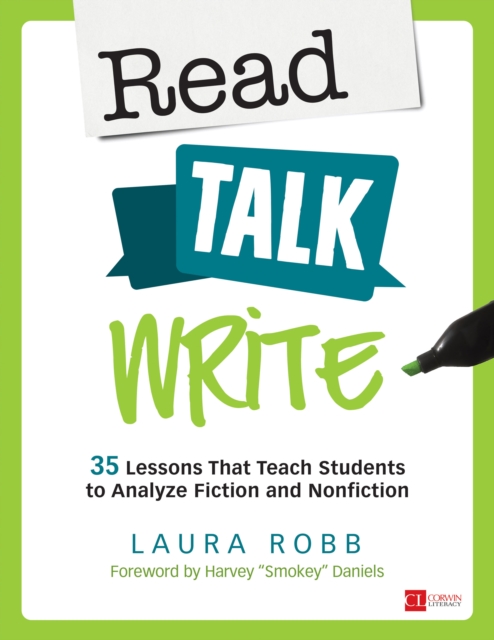
Read, Talk, Write
“This book reminds us why Laura Robb continues to be such an important voice in our field: She looks through kids’ eyes and sees into their futures. Literary conversations don’t just enrich kids days; they offer young people gifts that keep on giving: the ability to take risks, exercise creativity, build empathy, and develop the ability to negotiate.” –from the foreword by Harvey “Smokey” Daniels When you get right down to it, literacy comes down to this: read, talk, write. But as every teacher knows, it can be hard for students to see and use these three moves in concert–until now. In Read, Talk, Write, Laura Robb lays out the classroom structures that create the time and space for students to have productive talk and written discourse about texts. With Laura’s guidance you’ll • Use short texts by Seymour Simon, Kathleen Krull, Priscilla Cummings, and other popular fiction and nonfiction authors to teach students how to analyze and converse about texts • Incorporate six kinds of talk into your instruction, including turn-and-talk, partner talks, and small-group discussions • Use the wealth of in-book and online reproducibles to help students facilitate their own comprehension-building discussions • Select from 35 lessons that address literary elements and devices, text structures, and comprehension strategies, and then use them to launch student-led talk about any text you teach • Help your readers get in a read-talk-write flow, and know how to move from reading to talking to writing, to bring about deeper thinking • Achieve high levels of performance around inferring, comparing and contrasting, summarizing and synthesizing, and other key skills by way of classroom conversations that make these advanced levels the norm
eBook


Analysis of the final comments provided by a knowledgeable other in lesson study
Lesson study has been implemented in schools around the world as a method of professional development for teachers. Lesson study consists of five steps, among which the “Research Lesson” and “Post-lesson Discussion” are central. During the Post-lesson Discussion, after the teacher has commented on the lesson, all of the observers discuss the lesson, and the “knowledgeable other” (
koshi
), a specially invited expert, provides final comments. The quality of these final comments is critical to the learning of the lesson-study participants, and, consequently, the koshi plays an extremely important role. However, few studies have examined the nature and structure of the final comments that koshis provide. This study analyzed the final comments made in three elementary-school research lessons in Japan by a highly distinguished university mathematics educator with considerable teaching experience and an outstanding reputation as a koshi. We found that his final comments clustered into seven categories, which we named: (1) considering the didactical value of mathematical content; (2) use of representations; (3) fostering positive attitudes to learning; (4) incorporating students’ ideas into whole-class discussions; (5) giving attention to what students write down; (6) giving attention to the content of the board-work; and (7) teacher growth through reflection. These categories provide insight into the nature of final comments that are regarded as being particularly useful and may form the basis for less-experienced koshis to structure their final comments in lesson study.
Journal Article

Characteristics of Effective Elementary Mathematics Instruction: A Scoping Review of Experimental Studies
Considering that the teaching of mathematics in elementary school is an important prerequisite for the development of mathematically literate citizens, it is essential to identify what makes it effective. The aim of this study is to determine the characteristics of effective interventions in elementary school mathematics education. To this end, a scoping review was conducted that included 44 experimental studies published between 2014 and 2023. Through a qualitative analysis of the intervention descriptions, we identified 27 characteristics, which were categorized into nine thematic units. We found that, on average, seven characteristics were used per intervention. The results of this study suggest that effective elementary school mathematics instruction should foster students’ conceptual understanding and procedural fluency through problem-solving, active learning, and mathematical games. This can be achieved through a dynamic alternation of whole-class instruction and cooperative and individual learning with the use of manipulatives and visualizations to reach the level of abstraction. Considering that the analyzed interventions rarely addressed students’ common errors and critical thinking, future research could focus on these aspects in elementary school mathematics education.
Journal Article

Examining the Use of Talk and Writing for Students' Development of Scientific Conceptual Knowledge Through Constructing and Critiquing Arguments
This study developed an analytic framework consisting of four patterns of talk and writing that can support students' engagement in construction and critique: Talk only, writing only, use of talk and writing in sequence, and use of talk and writing simultaneously. This study aimed to examine how each pattern supports students' development of scientific knowledge through the construction and critique of arguments and what cognitive functions are associated with each pattern. To trace students' knowledge development over time using the four patterns, three students were selected as target subjects. Data were analyzed using two approaches: (1) in-depth analysis of a Knowledge Development Trajectory and (2) constant comparative method. This study highlights elementary students' capability of engaging in argumentation that promotes their scientific knowledge development when provided with proper opportunities, facilitation, and time to recognize that talk and writing can be used as epistemic tools for both constructing and critiquing arguments.
Journal Article
Preparing Prospective Mathematics Teacher Educators to Teach Mathematics Through Problem Solving
Mathematics teacher educators (MTEs) play a significant role in supporting prospective teachers (PTs) to develop the mathematical content and pedagogical knowledge they need for teaching. We examined how four novice prospective MTEs learn within a Community of Practice (CoP) and develop Mathematical Knowledge for Teaching Teachers (MKTT) and MTE identities when they are serving as interns in a mathematics content course for PTs taught through problem solving. We collected data through weekly reflections written by the novice prospective MTEs, researcher memos, and interviews with each participant at three points in the semester. We found that within the CoP, the novice prospective MTEs exhibited their growth predominately through learning as experience and learning as doing. We found that they indicated their development of MKTT most notably by noting new insights into pedagogical practices and enacting new pedagogical practices. We contribute (a) a model of how prospective MTEs can experience and learn how to teach PTs mathematics through problem solving, and (b) evidence of how this learning occurred and how their MTE identities developed through this experience.
Journal Article

Influence of a Teacher's Scaffolding Moves During Child-Led Small-Group Discussions
The influence of one teacher's scaffolding moves on children's performance in free-flowing child-led small-group discussions was investigated. Three moves were examined: prompting for and praising the use of evidence, asking for clarification, and challenging. Lag sequential analysis was applied to a corpus of over 5,300 speaking turns during 30 discussions to identify recurrent turn-by-turn patterns of teacher-child and child-child talk initiated by the teacher's moves. A complex system of influence among discussion participants was documented in which the teacher's moves had delayed effects as well as immediate effects, indirect as well as direct effects, and reciprocal instead of unidirectional effects. Some children appropriated scaffolding moves of the teacher and began to spontaneously employ the moves in later discussions.
Journal Article

Formatively assessing prospective teachers’ skills in leading mathematics discussions
Mathematics discussions are important for helping students to develop conceptual understanding and to learn disciplinary norms and practices. In recent years, there has been increased attention to teaching prospective teachers to lead discussions with students. This paper examines the possibilities of designing a formative assessment that gathers information about prospective elementary teachers’ skills with leading problem-based mathematics discussions and makes sense of such information. A decomposition of the practice of leading discussions was developed and used to design the assessment. Nine first-year teachers who graduated from a range of different teacher education programs participated in the study. The findings reveal that our formative assessment works to gather information about teachers’capabilities with leading discussions and that the associated tools support making sense of the information gathered. This suggests that such tools could be useful to support the formative assessment of the developing capabilities of prospective teachers.
Journal Article

Taiwanese elementary school English teachers' application of design thinking mindsets in their English courses
This study investigated 11 Taiwanese elementary school English teachers' designs and implementations of design thinking lessons. The analysis of qualitative data (lesson plans, observations, interviews) and quantitative data (questionnaire) reached the following major findings. Firstly, English teachers considered their design thinking instruction as effective, because they endeavoured to create authentic contexts relevant to their learners and employ group discussion and oral presentations. Secondly, English teachers regarded leading learners to discuss solutions and foster their critical thinking, learners' limited English abilities, and time constraints as the biggest challenges. Suggestions on effective designs and implementations of design thinking mindsets into English courses were provided.
Journal Article