Search Results Heading

MBRLSearchResults

mbrl.module.common.modules.added.book.to.shelf
Title added to your shelf!
View what I already have on My Shelf.
Oops! Something went wrong.
While trying to add the title to your shelf something went wrong :( Kindly try again later!
Are you sure you want to remove the book from the shelf?

Oops! Something went wrong.
While trying to remove the title from your shelf something went wrong :( Kindly try again later!
    Done
    Filters
    Reset
  • Discipline
      Discipline
      Clear All
      Discipline
  • Is Peer Reviewed
      Is Peer Reviewed
      Clear All
      Is Peer Reviewed
  • Series Title
      Series Title
      Clear All
      Series Title
  • Reading Level
      Reading Level
      Clear All
      Reading Level
  • Year
      Year
      Clear All
      From:
      -
      To:
  • More Filters
      More Filters
      Clear All
      More Filters
      Content Type
    • Item Type
    • Is Full-Text Available
    • Subject
    • Country Of Publication
    • Publisher
    • Source
    • Target Audience
    • Donor
    • Language
    • Place of Publication
    • Contributors
    • Location
15,908 result(s) for "Disinformation"
Sort by:

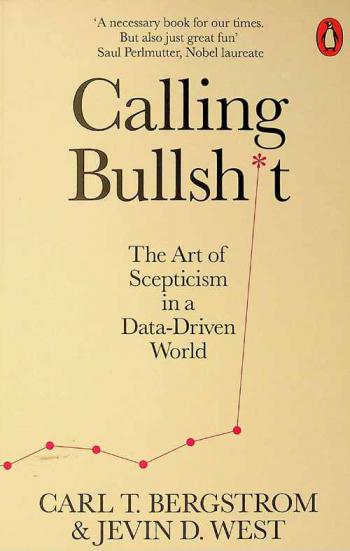
Calling bullshit : the art of scepticism in a data-driven world
The world is awash in bullshit, and we're drowning in it. Politicians are unconstrained by facts. Science is conducted by press release. Startup culture elevates bullshit to high art. These days, calling bullshit is a noble act. Based on their popular, eponymous, course at the University of Washington, professors Carl Bergstrom and Jevin West catalogue bullshit in its many forms, explaining where bullshit arose in our evolutionary past and why it is ubiquitous today. Calling Bullshit offers readers the tools to see through the obfuscations, deliberate and careless, that dominate every realm of our lives. In this lively guide Bergstrom, a computational biologist, and West, a statistician, teach us that calling bullshit is crucial to a properly functioning social group, whether it be a circle of friends, a community of academics, or the citizenry of a nation.
Integration or Absorption? Analyzing the Propagandist Narratives Generated by Russia-Backed Online Regional Media in Belarus
This article analyzes the plethora of disinformation materials that emerged during the most recent negotiations between Russia and Belarus on \"further integration\"--that is, the process of \"political and economic absorption\" of Belarus--that took place between December 2018 and April 2019. Russian media used deceptive news articles to put forward their agenda and interpellate support among Belarusian citizens. The paper uses framing theory to identify the characteristics of pro-integration discourses in resources launched by the Russian authorities in the Belarusian regions between December 2018 and April 2019. The media disguised themselves as \"objective\" regional Internet media by publishing neutral articles, but came to disseminate disinformation and materials that promoted Russia's agenda.
What Is
'Fake news' has been a topic of controversy during and following the 2016 U.S. presidential election. Much of the scholarship on it to date has focused on the 'fakeness' of fake news, illuminating the kinds of deception involved and the motivations of those who deceive. This study looks at the 'newsness' of fake news by examining the extent to which it imitates the characteristics and conventions of traditional journalism. Through a content analysis of 886 fake news articles, we find that in terms of news values, topic, and formats, articles published by fake news sites look very much like traditional-and real--news. Most of their articles included the news values of timeliness, negativity, and prominence; were about government and politics; and were written in an inverted pyramid format. However, one point of departure is in terms of objectivity, operationalized as the absence of the author's personal opinion. The analysis found that the majority of articles analyzed included the opinion of their author or authors.
What Is in Fake Stories
'Fake news' has been a topic of controversy during and following the 2016 U.S. presidential election. Much of the scholarship on it to date has focused on the 'fakeness' of fake news, illuminating the kinds of deception involved and the motivations of those who deceive. This study looks at the 'newsness' of fake news by examining the extent to which it imitates the characteristics and conventions of traditional journalism. Through a content analysis of 886 fake news articles, we find that in terms of news values, topic, and formats, articles published by fake news sites look very much like traditional-and real--news. Most of their articles included the news values of timeliness, negativity, and prominence; were about government and politics; and were written in an inverted pyramid format. However, one point of departure is in terms of objectivity, operationalized as the absence of the author's personal opinion. The analysis found that the majority of articles analyzed included the opinion of their author or authors. Keywords content analysis; disinformation; fake news; inverted pyramid; news values; objectivity; traditional news