
Catalogue Search | MBRL


Are you sure you want to remove the book from the shelf?

{{itemTitle}}
23
result(s) for
"Divination Nigeria."
Sort by:


African Rituals
This chapter contains sections titled:
The Place of Ritual in African Religions
Embodiment, Rhetoric, Performance, and Dynamics
Gender and Power
Innovation and Adaptation: Ritual and History
Book Chapter

Santería in Cuba: contested issues at a time of transition
Maha Marouan examines the prevailing social, political, and economic forces that have transformed the presence and practice of Santería in Cuba over the last fifty years.
Journal Article

Arts of Being Yoruba
There is a culturally significant way of being Yorùbá that is expressed through dress, greetings, and celebrations—no matter where in the world they take place. Adélékè Adék documents Yorùbá patterns of behavior and articulates a philosophy of how to be Yorùbá in this innovative study. As he focuses on historical writings, Ifá divination practices, the use of proverbs in contemporary speech, photography, gendered ideas of dressing well, and the formalities of ceremony and speech at celebratory occasions, Adéékó contends that being Yorùbá is indeed an art and Yorùbá-ness is a dynamic phenomenon that responds to cultural shifts as Yorùbá people inhabit an increasingly globalized world.
eBook
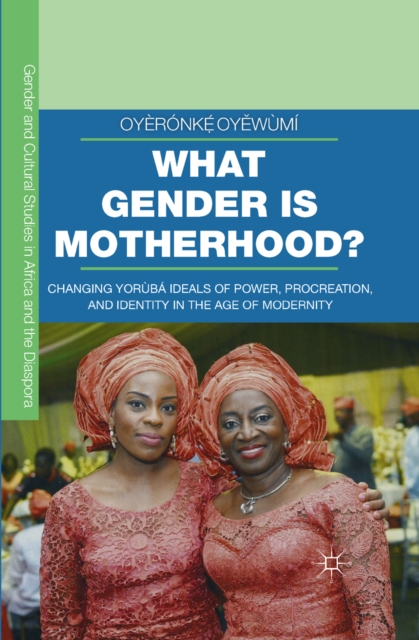
What gender is motherhood? : changing Yorùbá ideas on power, procreation, and identity in the age of modernity
There is significant religious and linguistic evidence that Yorùbá society was not gendered in its original form. In this follow-up to The Invention of Women: Making an African Sense of Western Gender Discourses , Oy?wùmí explores the intersections of gender, history, knowledge-making, and the role of intellectuals in the process.
eBook

Ifa Divination Trays from Isale-Oyo
This paper is a study of the images and patterns on ifa divination trays from Isale-Oyo. The paper also explains some ifa paraphernalia. The paper establishes that ifa trays from Isale-Oyo bear distinctive features when compared with other ifa trays in Yorubaland such as those of Ijebu and Osogbo. Central to this study is the iconographic description and interpretations of Isale-Oyo divination trays. Data were collected through direct interviews with divination tray owners. Photographs of the trays were also taken. The investigation revealed that:Divination trays from Isale-Oyo combine features found on both Ijebu and Osogbo trays.The Esu figure continues to occupy the top central position on Oyo divination trays, even though with representational variations elsewhere in Yorubaland.Some divination trays in Oyo carry no decorations on their borders, and in some recent cases, ceramic plates are now used for divination.
Journal Article

Time and timing, work and action: Aspects of rural livelihoods in northwest Nigeria
Rural West Africans confront a challenging array of circumstances in pursuit of their livelihoods, which are negotiated through repertoires of knowledge, skill, wisdom and information that are held individually, communally or as the prerogative of experts. Of some significance is timing: finding the most effective or propitious moment for action. On the farm, anticipating the beginning and progress of the rains is crucial and sought through the empirical observation of natural phenomena, or as in northwest Nigeria additionally through agricultural star calendars and almanacs by Muslim clerics. Furthermore, some clerics use divination to identify propitious moments for their clients whereby they may achieve success in non-farm jobs and businesses that are an integral part of rural livelihoods. Taking action to achieve particular outcomes on and off the farm raises issues about local people's understanding of the physical world and their place within it, and the power of religion and the supernatural. An appreciation of such matters would appear to be crucial for those from the scientific and technological North who may be attempting to transform African societies.
Journal Article

The Structure and Function of Yoruba Facial Scarification
Among the Yoruba of southwestern Nigeria, one commonly encounters people with different patterns of facial stripes produced by scarification. It has long been observed that such stripes are labels of clan identification among the Yoruba. This article considers facial stripes from a structural viewpoint, and shows that the attested patterns are rooted in Yoruba number symbolism.
Journal Article

Towards a missiological model for worldview transformation among adherents to African traditional religion in Yorubaland
Seventh-day Adventist missions in the western region of Nigeria are a century old, yet reversion to pre-Christian practices such as divination and sorcery are reported, especially during periods of personal crises. This study sought to understand the influence of the traditional worldview on the practices of divination and sorcery and to develop a model that would move the Yoruba Adventists from dependence on these practices to a biblically shaped faith and praxis. A grounded theory approach was adopted for conducting this qualitative research. Data were collected from two focus group discussions and from face-to-face interviews with five pastors, five diviners, and three members who had once consulted diviners. Concepts that emerged from the analyzed data revealed the need for a theory of worldview transformation. This theory entailed having better biblical explanations to counter existing worldview assumptions, the exigency of encountering the power of the gospel in a power-oriented context, and the importance of experiential relationships with Christ to replace the role of diviners in that context. The study culminated in a worldview transformation model that would lead Yoruba Adventists away from dependence upon pre-Christian customs to a biblically shaped worldview, and authentic faith and discipleship. Central to this worldview transformational paradigm is the Adventist doctrine of the Great Controversy.
Dissertation

Le concept du héros imprévisible
RésuméLa notion de trickster (décepteur) a été appliquée par plusieurs chercheurs à certains personnages occupant une place prépondérante, parfois marginale, dans certains systèmes complexes de croyances des sociétés ouest-africaines de la tradition. C’est à partir de la compréhension d’Èsù, médiateur et principe traducteur de la religion yorùbá (Nigeria-Bénin) que se décide la particularité des autres òrìsà. Ces derniers apparaissent différenciés l’un de l’autre par la présence d’un espace intermédiaire. Seul Èsù, vecteur du système oraculaire et interprète de la plupart des instances de culte, connaît et domine les secrets de l’univers dont il n’a reçu aucune part — le seul domaine attitré serait l’espace du marché. Figure remarquable du complexe religieux, Èsù traduit la non-fixité des valeurs et l’envers des institutions. Il introduit au sein même de l’ordonnance du système religieux une marge importante d’imprévisibilité, d’incertitude, qui « donne du jeu » au segment, grâce à la remise en cause de tout ce qui existe. Agent omniprésent et omniscient au cœur même de la religion et des traditions, il nous convie à rester attentif à deux phénomènes : le primat du sacré dans toutes les composantes du système social et politique ; la nécessité d’un principe dynamisant et créateur d’un nouvel ordre. En d’autres termes, si Èsù représente la traduction et l’instrument de conservation de l’ordre — lequel n’est jamais acquis de manière définitive — il est l’expression du désordre en tant qu’il recrée un ordre nouveau après destruction d’un ordre antérieur. Dans cette perspective dynamique de l’expérience individuelle et collective du sacré, Èsù assure d’une manière unique et continuelle la condition de sa reproduction. Ces éléments caractéristiques et fondamentaux nous amènent à reconsidérer le concept même de trickster et sa réalité factice et imprescriptible. Celui-là se retrouve de manière inaugurale comme la pierre angulaire de constructions théoriques toujours plausibles, dont les reliefs s’apparentent le plus souvent au mirage.
Journal Article