
Catalogue Search | MBRL


Are you sure you want to remove the book from the shelf?

{{itemTitle}}
1,442
result(s) for
"Dogs Evolution"
Sort by:

Once a wolf : the science behind our dogs' astonishing genetic evolution
\"An enlightening work of science that enriches our understanding of the power of human-animal cooperation, and shows how an ancient partnership with the wolf helped Homo Sapiens conquer the World.\"--Dust jacket flap.
Book

Dogs
This book traces the evolution of the dog, from its origins about 15,000 years ago up to recent times. The timing of dog domestication receives attention, with comparisons between different genetics-based models and archaeological evidence. Allometric patterns between dogs and their ancestors, wolves, shed light on the nature of the morphological changes that dogs underwent. Dog burials highlight a unifying theme of the whole book: the development of a distinctive social bond between dogs and people; the book also explores why dogs and people relate so well to each other. Though cosmopolitan in overall scope, the greatest emphasis is on the New World, with an entire chapter devoted to dogs of the arctic regions, mostly in the New World. Discussion of several distinctive modern roles of dogs underscores the social bond between dogs and people.
eBook

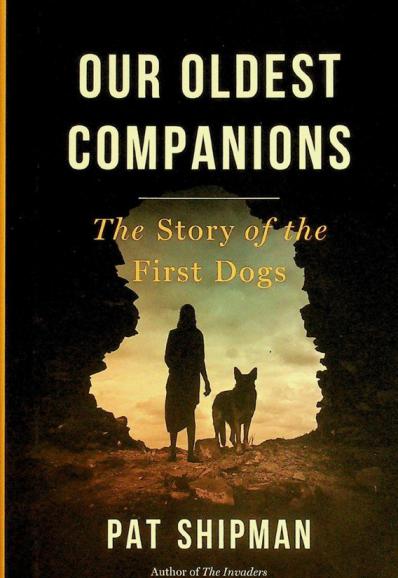
Our oldest companions : the story of the first dogs
\"The unique relationship between dogs and humans has had huge evolutionary consequences, changing the physical, behavioral, genetic, and emotional characteristics of both species. Pat Shipman looks to fossil records and new evidence to trace how the process of domestication worked and discovers how much of ourselves we owe to our canine companions\"-- Provided by publisher.
Book


The first domestication : how wolves and humans coevolved
\"Raymond Pierotti and Brandy Fogg change the narrative about how wolves became dogs and, in turn, humanity's best friend. Rather than recount how people mastered and tamed an aggressive, dangerous species, the authors describe coevolution and mutualism. Wolves, particularly ones shunned by their packs, most likely initiated the relationship with Paleolithic humans, forming bonds built on mutually recognized skills and emotional capacity. This interdisciplinary study draws on sources from evolutionary biology as well as tribal and indigenous histories to produce an intelligent, insightful, and often unexpected story of cooperative hunting, wolves protecting camps, and wolf-human companionship\"-- Dust jacket flap.
Book

Inquiry-Based Activities for Teaching about Natural Selection: Dog Evolution & the Secret Ingredient of an Amazing Experiment
Teaching evolution is one of the most difficult tasks in biology education since there are a great variety of obstacles to its understanding. The inclusion of the nature of science and scientific inquiry, the connection with aspects of daily life, work based on scientific argumentation, and the use of empirical studies from current research have been identified as important aspects to include in teaching evolution. In this work, we present a series of three activities, which were developed after considering all the recommendations of the literature described above. The sequence begins with the example of the evolution of one of the species most loved by students: dogs. Through argumentation, students make their preconceptions explicit. After this, a long-term experiment about artificial selection in the silver fox (Vulpes vulpes) is presented (see Glaze, 2018) as part of the reflection on the experimental evidence that supports evolution. Finally, students are asked to generate a hypothesis about how they think the domestication process of wolves occurred, eventually resulting in dogs. The outcomes of implementation in high school classrooms and biology teacher education are discussed.
Journal Article

The invaders : how humans and their dogs drove Neanderthals to extinction
\"The Invaders musters compelling evidence to show that the major factor in the Neanderthals' demise was direct competition with newly arriving humans. Drawing on insights from the field of invasion biology, which predicts that the species ecologically closest to the invasive predator will face the greatest competition, Pat Shipman traces the devastating impact of a growing human population: reduction of Neanderthals' geographic range, isolation into small groups, and loss of genetic diversity. But modern humans were not the only invaders who competed with Neanderthals for big game. Shipman reveals fascinating confirmation of humans' partnership with the first domesticated wolf-dogs soon after Neanderthals first began to disappear. This alliance between two predator species, she hypothesizes, made possible an unprecedented degree of success in hunting large Ice Age mammals--a distinct and ultimately decisive advantage for humans over Neanderthals at a time when climate change made both groups vulnerable.\"--Publisher's Web site.
Book

Commentary: Oxytocin-gaze positive loop and the coevolution of human–dog bonds
The sex effect on oxytocin change (female owner vs. male owner, χ2 = 3.69, df = 1, p = 0.054, proportion of pairs supporting the alternative hypothesis = 0.69) is in fact larger than the effect of the species (dog owners vs. wolf owners, χ2 = 0.19, df = 1, p = 0.662, proportion of pairs supporting the alternative hypothesis = 0.54). [...]sex differences provide an alternative explanation for the finding that oxytocin increase was significantly higher in the owners of LG dogs compared to wolves. Additionally, there was a significant difference in the baseline oxytocin values of the dog and wolf owners (χ2 = 4.67, df = 1, p = 0.031). [...]the apparent difference between dogs and wolf in inducing an oxytocin response in humans may be simply due to a ceiling effect. [...]results are hard to interpret because of the extremely low statistical power. A Bayes factor on the r = 0 for wolves indicates that due to the low sample size, the data are insensitive and do not provide evidence for the null hypothesis [BH(0, Fisher's z(0.60)) = 0.51; see (Dienes, 2014)], and that at least 26 wolves would be required for a sensitive test [BH(0, Fisher's z(0.60)) = 0.33] to provide evidence against correlation between oxytocin change in owners and duration of animal-to-owner gaze.
Journal Article