
Catalogue Search | MBRL


Are you sure you want to remove the book from the shelf?

{{itemTitle}}
8,155
result(s) for
"Dominicans"
Sort by:


The Mulatto Republic
The origins of anti-Haitian and anti-black nationalist ideologies in the Dominican Republic have long been central to debates among the historians, political scientists, and journalists who wish to understand the relationship between popular expressions of Dominican identity and official nationalism.
In The Mulatto Republic, April Mayes looks at the many ways Dominicans define themselves through race, skin color, and culture. She explores significant historical factors and events that have led the nation, for much of the twentieth century, to favor privileged European ancestry and Hispanic cultural norms such as the Spanish language and Catholicism.
Mayes seeks to discern whether contemporary Dominican identity is a product of the Trujillo regime--and, therefore, only a legacy of authoritarian rule--or is representative of a nationalism unique to an island divided into two countries long engaged with each other in ways that are sometimes cooperative and at other times conflicted. Her answers enrich and enliven an ongoing debate.
eBook

Undocumented : a Dominican boy's odyssey from a homeless shelter to the Ivy League
\"Throughout his youth, Dan-el navigated ... two worlds: the rough streets of East Harlem, where he lived with his brother and his mother and tried to make friends, and the ultra-elite halls of a Manhattan private school, where he could immerse himself in a world of books and where he soon rose to the top of his class. From Collegiate, Dan-el went to Princeton, where he thrived, and where he made the momentous decision to come out as an undocumented student in a Wall Street Journal profile a few months before he gave the salutatorian's traditional address in Latin at his commencement.\"-- Publisher description.
Book
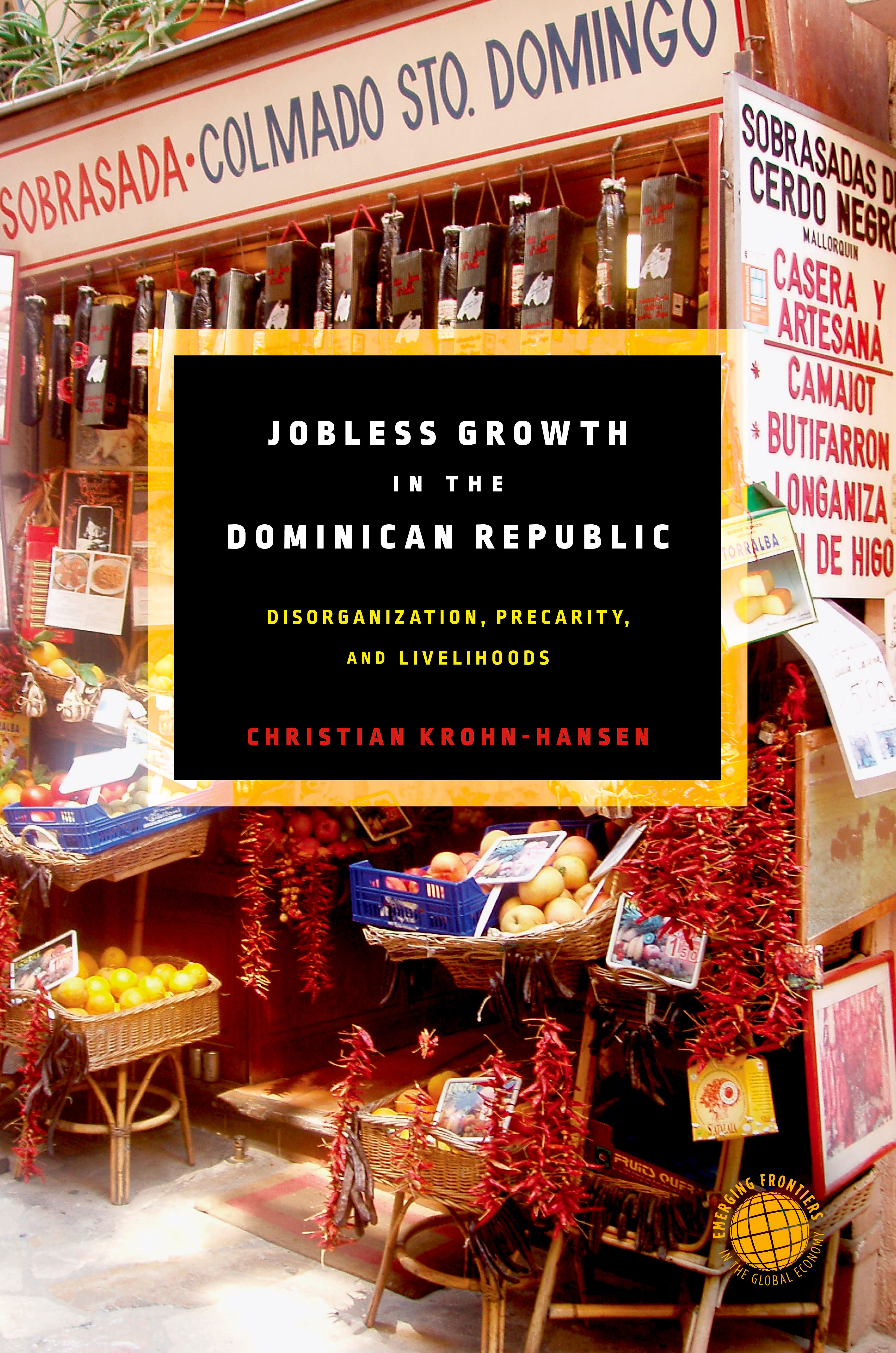
Jobless Growth in the Dominican Republic
The Dominican Republic has posted impressive economic growth
rates over the past thirty years. Despite this, the generation of
new, good jobs has been remarkably weak. How have ordinary and poor
Dominicans worked and lived in the shadow of the country's
conspicuous growth rates? This book considers this question through
an ethnographic exploration of the popular economy in the Dominican
capital. Focusing on the city's precarious small businesses,
including furniture manufacturers, food stalls, street-corner
stores, and savings and credit cooperatives, Krohn-Hansen shows how
people make a living, tackle market shifts, and the factors that
characterize their relationship to the state and pervasive
corruption.
Empirically grounded, this book examines the condition of the
urban masses in Santo Domingo, offering an original and captivating
contribution to the scholarship on popular economic practices,
urban changes, and today's Latin America and the Caribbean. This
will be essential reading for scholars and policy makers.
eBook

Masculinity after Trujillo
Any observer of Dominican political and literary discourse will quickly notice how certain notions of hyper-masculinity permeate the culture. Many critics will attribute this to an outgrowth of \"traditional\" Latin American patriarchal culture.Masculinity after Trujillo demonstrates why they are mistaken.
In this extraordinary work, Maja Horn argues that this common Dominican attitude became ingrained during the dictatorship (1930-61) of Rafael Leonidas Trujillo, as well as through the U.S. military occupation that preceded it. Where previous studies have focused mainly on Spanish colonialism and the controversial sharing of the island with Haiti, Horn emphasizes the underexamined and lasting influence of U.S. imperialism and how it prepared the terrain for Trujillo's hyperbolic language of masculinity. She also demonstrates how later attempts to emasculate the image of Trujillo often reproduced the same masculinist ideology popularized by his government.
By using the lens of gender politics, Horn enables readers to reconsider the ongoing legacy of the Trujillato, including the relatively weak social movements formed around racial and ethnic identities, sexuality, and even labor. She offers exciting new interpretations of such writers as Hilma Contreras, Rita Indiana Hernández, and Junot Díaz, revealing the ways they successfully challenge dominant political and canonical literary discourses.
eBook

From Homemakers to Breadwinners to Community Leaders
In From Homemakers to Breadwinners to Community Leaders , Norma Fuentes-Mayorga compares the immigration and integration experiences of Dominican and Mexican women in New York City, a traditional destination for Dominicans but a relatively new one for Mexicans. Her book documents the significance of women-led migration within an increasingly racialized context and underscores the contributions women make to their communities of origin and of settlement. Fuentes-Mayorga’s research is timely, especially against the backdrop of policy debates about the future of family reunification laws and the unprecedented immigration of women and minors from Latin America, many of whom seek human rights protection or to reunite with families in the US. From Homemakers to Breadwinners to Community Leaders provides a compelling look at the suffering of migrant mothers and the mourning of family separation, but also at the agency and contributions that women make with their imported human capital and remittances to the receiving and sending community. Ultimately the book contributes further understanding to the heterogeneity of Latin American immigration and highlights the social mobility of Afro-Caribbean and indigenous migrant women in New York.
eBook

Tell Me the Story of How I Conquered You
Folio 46r from Codex Telleriano-Remensis was created in the sixteenth century under the supervision of Spanish missionaries in Central Mexico. As an artifact of seismic cultural and political shifts, the manuscript painting is a singular document of indigenous response to Spanish conquest. Examining the ways in which the folio's tlacuilo (indigenous painter/writer) creates a pictorial vocabulary, this book embraces the place \"outside\" history from rich this rich document emerged.
Applying contemporary intellectual perspectives, including aspects of gender, modernity, nation, and visual representation itself, José Rabasa reveals new perspectives on colonial order. Folio 46r becomes a metaphor for reading the totality of the codex and for reflecting on the postcolonial theoretical issues now brought to bear on the past. Ambitious and innovative (such as the invention of the concepts of elsewhere and ethnosuicide, and the emphasis on intuition), Tell Me the Story of Howl Conquered You embraces the performative force of the native scribe while acknowledging the ineffable traits of 46r-traits that remain untenably foreign to the modern excavator/scholar. Posing provocative questions about the unspoken dialogues between evangelizing friars and their spiritual conquests, this book offers a theoretic-political experiment on the possibility of learning from the tlacuilo ways of seeing the world that dislocate the predominance of the West.
eBook

Dividing Hispaniola
The island of Hispaniola is split by a border that divides the Dominican Republic and Haiti. This border has been historically contested and largely porous.Dividing Hispaniolais a study of Dominican dictator Rafael Trujillo's scheme, during the mid-twentieth century, to create and reinforce a buffer zone on this border through the establishment of state institutions and an ideological campaign against what was considered an encroaching black, inferior, and bellicose Haitian state. The success of this program relied on convincing Dominicans that regardless of their actual color, whiteness was synonymous with Dominican cultural identity.Paulino examines the campaign against Haiti as the construct of a fractured urban intellectual minority, bolstered by international politics and U.S. imperialism. This minority included a diverse set of individuals and institutions that employed anti-Haitian rhetoric for their own benefit (i.e., sugar manufacturers and border officials.) Yet, in reality, these same actors had no interest in establishing an impermeable border.Paulino further demonstrates that Dominican attitudes of admiration and solidarity toward Haitians as well as extensive intermixture around the border region were commonplace. In sum his study argues against the notion that anti-Haitianism was part of a persistent and innate Dominican ethos.
eBook

Making New York Dominican
Large-scale emigration from the Dominican Republic began in the early 1960s, with most Dominicans settling in New York City. Since then the growth of the city's Dominican population has been staggering, now accounting for around 7 percent of the total populace. How have Dominicans influenced New York City? And, conversely, how has the move to New York affected their lives? InMaking New York Dominican, Christian Krohn-Hansen considers these questions through an exploration of Dominican immigrants' economic and political practices and through their constructions of identity and belonging. Krohn-Hansen focuses especially on Dominicans in the small business sector, in particular the bodega and supermarket and taxi and black car industries. While studies of immigrant business and entrepreneurship have been predominantly quantitative, using survey data or public statistics, this work employs business ethnography to demonstrate how Dominican enterprises work, how people find economic openings, and how Dominicans who own small commercial ventures have formed political associations to promote and defend their interests. The study shows convincingly how Dominican businesses over the past three decades have made a substantial mark on New York neighborhoods and the city's political economy.Making New York Dominicanis not about a Dominican enclave or a parallel sociocultural universe. It is instead about connections-between Dominican New Yorkers' economic and political practices and ways of thinking and the much larger historical, political, economic, and cultural field within which they operate. Throughout, Krohn-Hansen underscores that it is crucial to analyze four sets of processes: the immigrants' forms of work, their everyday life, their modes of participation in political life, and their negotiation and building of identities.Making New York Dominicanoffers an original and significant contribution to the scholarship on immigration, the Latinization of New York, and contemporary forms of globalization.
eBook
The devil behind the mirror
In The Devil behind the Mirror, Steven Gregory provides a compelling and intimate account of the impact that transnational processes associated with globalization are having on the lives and livelihoods of people in the Dominican Republic. Grounded in ethnographic fieldwork conducted in the adjacent towns of Boca Chica and Andrés, Gregory's study deftly demonstrates how transnational flows of capital, culture, and people are mediated by contextually specific power relations, politics, and history. He explores such topics as the informal economy, the making of a telenova, sex tourism, and racism and discrimination against Haitians, who occupy the lowest rung on the Dominican economic ladder. Innovative and beautifully written, The Devil behind the Mirror masterfully situates the analysis of global economic change in everyday lives.
eBook