
Catalogue Search | MBRL


Are you sure you want to remove the book from the shelf?

{{itemTitle}}
5,955
result(s) for
"Donne, John"
Sort by:


Comparative essays on the poetry and prose of John Donne and George Herbert : combined lights
This book brings together ten essays on John Donne and George Herbert composed by an international group of scholars. The volume represents the first collection of its kind to draw close connections between these two distinguished early modern thinkers and poets who are justly coupled because of their personal and artistic association. The contributors' distinctive new approaches and insights illuminate a variety of topics and fields while suggesting new directions that future study of Donne and Herbert might take. Some chapters explore concrete instances of collaboration or communication between Donne and Herbert, and others find fresh ways to contextualize the Donnean and Herbertian lyric, carefully setting the poetry alongside discourses of apophatic theology or early modern political theory, while still others link Herbert's verse to Donne's devotional prose. Several chapters establish specific theological and aesthetic grounds for comparison, considering Donne and Herbert's respective positions on religious assurance, comic sensibility, and virtuosity with poetic endings.
eBook


Rhetoric and the familiar in Francis Bacon and John Donne
Rhetoric and the Familiar examines the writing and oratory of Francis Bacon and John Donne from the perspective of the faculty psychology they both inherited. Both writers inherited the resources of the classical rhetorical tradition through their university education. The book traces, from within that tradition, the sources of Bacon and Donne’s ideas about the processes of mental image making, reasoning, and passionate feeling. It analyzes how knowledge about those mental processes underlies the rhetorical planning of texts by Bacon, such as New Atlantis, Essayes or Counsels, Novum Organum, and the parliamentary speeches, and of texts by Donne such as the Verse Letters, Essayes in Divinity, Holy Sonnets, and the sermons. The book argues that their rhetorical practices reflect a common appropriation of ideas about mental process from faculty psychology, and that they deploy it in divergent ways depending on their rhetorical contexts. It demonstrates the vital importance, in early modern thinking about rhetoric, of considering what familiar remembered material will occur to a given audience, how that differs according to context, and the problems the familiar entails.
eBook

John Donne in context
\"John Donne produced some of the finest writing in any language about the pleasures and mysteries of love and religion. His restless imagination and voracious intellect invested his poetry and prose with an unprecedented dramatic energy and metaphoric intensity. His work is formally inventive, aggressively pushing against the very generic boundaries it enters. Even commonplace sentiments are rendered breathtakingly vivid and witty when filtered through Donne's singular intelligence. Yet wit and intelligence sometimes come at a cost. Donne can be difficult, deliberately difficult. Even his friends and contemporaries sometimes had trouble understanding his works. Ben Jonson, the Renaissance dramatist and poet, thought \"That Donne himself, for not being understood, would perish.\"\"-- Provided by publisher.
BOOK
The Rest Is Silence
This title is part of UC Press's Voices Revived program, which commemorates University of California Press's mission to seek out and cultivate the brightest minds and give them voice, reach, and impact. Drawing on a backlist dating to 1893, Voices Revived makes high-quality, peer-reviewed scholarship accessible once again using print-on-demand technology. This title was originally published in 1994.
eBook


Bold Conscience
How the conscience in early modern England emerged as a fulcrum for public action
Bold Conscience chronicles the shifting conception of conscience in early modern England, as it evolved from a faculty of restraint—what Shakespeare labels “coward conscience”—to one of bold and forthright self-assertion. The concept of conscience played an important role in post-Reformation England, from clerical leaders to laymen, not least because of its central place in determining loyalties during the English Civil War and the regicide of King Charles I. Yet the most complex and lasting perspectives on conscience emerged from deliberately literary voices—William Shakespeare, John Donne, and John Milton.
Joshua Held argues that literary texts by these authors transform the idea of conscience as a private, shameful state to one of boldness fit for navigating both royal power and common dissent in the public realm. Held tracks the increasing political power of conscience from Shakespeare’s Hamlet and Henry VIII to Donne’s court sermons and Milton’s Areopagitica , showing finally that in Paradise Lost , Milton roots boldness in the inner paradise of a pure, common conscience.
Applying a fine-grain analysis to literary England from about 1601 to 1667, this study also looks back to the 1520s, to Luther’s theological foundations of the concept, and forward to 1689, to Locke’s transformation of the idea alongside the term “consciousness.” Ultimately, Held’s study shows how conscience emerges at once as a bulwark against absolute sovereignty and as a stronghold of personal certainty.
eBook

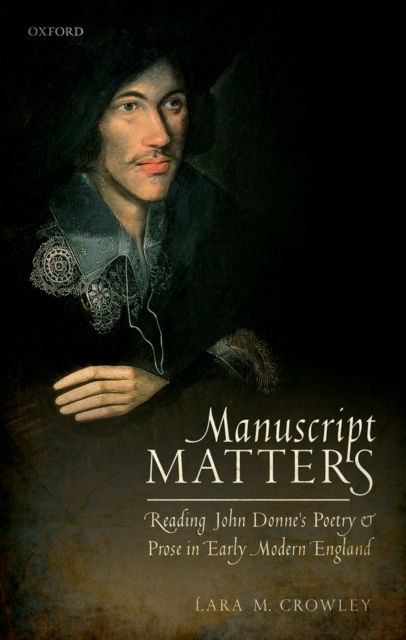
Manuscript matters : reading John Donne's poetry and prose in early modern England
Manuscript Matters illuminates responses to some of John Donne’s most elusive texts by his contemporary audiences. Since examples of seventeenth-century literary criticism prove somewhat rare and frequently ambiguous, this book emphasizes a critical framework rarely used for exhibiting early readers’ exegeses of literary texts: the complete manuscripts containing them. Many literary manuscripts that include poems by Donne and his contemporaries were compiled during their lifetimes, often by members of their circles. For this reason, and because various early modern poems and prose works satirize topical events and prominent figures in highly coded language, attempting to understand early literary interpretations proves challenging but highly valuable. Compilers, scribes, owners, and other readers—men and women who shared in Donne’s political, religious, and social contexts—offer clues to their literary responses within a range of features related to the construction and subsequent use of the manuscripts. This study’s findings call us to investigate more extensively and systematically how certain early manuscripts were constructed through analysis of such features as scripts, titles, sequence of contents, ascriptions, and variant diction. While such studies can throw light on many early modern texts, exploring artifacts containing Donne’s works proves particularly useful because more of his poetry circulated in manuscript than did that of any other early modern poet. Manuscript Matters engages Donne’s satiric, lyric, and religious poetry, as well as his prose paradoxes and problems—refocusing modern interpretation through an early modern lens.
eBook