
Catalogue Search | MBRL


Are you sure you want to remove the book from the shelf?

{{itemTitle}}
56
result(s) for
"Doo-wop"
Sort by:


Banding together
Why do some music styles gain mass popularity while others thrive in small niches?Banding Togetherexplores this question and reveals the attributes that together explain the growth of twentieth-century American popular music. Drawing on a vast array of examples from sixty musical styles--ranging from rap and bluegrass to death metal and South Texas polka, and including several created outside the United States--Jennifer Lena uncovers the shared grammar that allows us to understand the cultural language and evolution of popular music.
What are the common economic, organizational, ideological, and aesthetic traits among contemporary genres? Do genres follow patterns in their development? Lena discovers four dominant forms--Avant-garde, Scene-based, Industry-based, and Traditionalist--and two dominant trajectories that describe how American pop music genres develop. Outside the United States there exists a fifth form: the Government-purposed genre, which she examines in the music of China, Serbia, Nigeria, and Chile. Offering a rare analysis of how music communities operate, she looks at the shared obstacles and opportunities creative people face and reveals the ways in which people collaborate around ideas, artworks, individuals, and organizations that support their work.
eBook
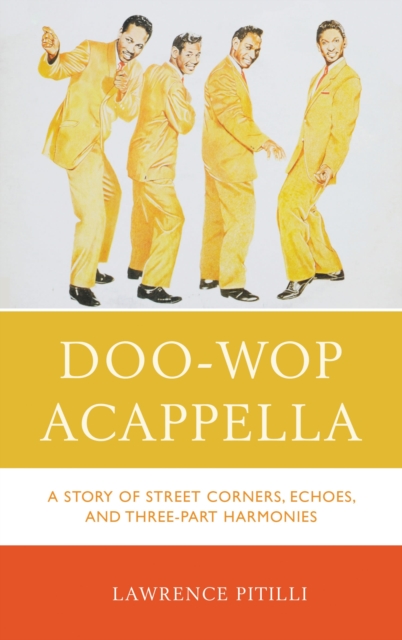
Doo-wop acappella
Scholar and singer Lawrence Pitilli explores doo-wop acapella groups as manifestations of urban change, mass migrations, ethnic acculturation and changing radio and recording industries. He reveals how groups displayed the dynamics of cultural change in the \"sounds\"--sonic and linguistic--that every generation seeks to make and remake for themselves.
eBook

Nonsense in Public Places: Songs of Black Vocal Rhythm and Blues or Doo-Wop
Goldblatt shows how the doo-wop genre is distinctively determined in both structure and content by its social origin and physical setting, which was singing on urban street corners. Conceptually, this places doo-wop at the intersection of popular and folk music, if one assumes the traditional definition of folk music as music that has evolved primarily through a community's creative impulse and its process of selection. Goldblatt stresses the point that the musical genre was created by young singers in neighborhood street corner settings, a cappella groups, not bands, prior to being pulled into the domain of commercial music. He praises doo-wop, suggesting that the genre should be evaluated by different aesthetic criteria than those derived from the classical music tradition
Journal Article


elvis costello, the empire of the e chord, and a magic moment or two
the phrase ‘this magic moment’ recurs throughout elvis costello's ‘it’s time' (1996). an allusion to pop history – the drifter's ‘this magic moment’ (1960) – is thus used in the service of a fatalistic narrative that manages to evoke both the ‘revenge and guilt’ famously associated with costello's early career and the early 1960's romanticism of brill building pop. the musical ‘magic moment’ of the song arrives in a ringing e major chord at the end of the chorus, played in open position on the electric guitar. the use of this e major chord references another line of pop music history, one that stretches back to the formation of ‘folk-rock’ in the mid-1960s. this paper serves as an example of how one song creates a series of magic moments that resonate densely with simultaneous histories.
Journal Article

The Place of Counterfeits in Regimes of Value: An Anthropological Approach
This article argues that, in order fully to understand the effect of reproduction copies on the value of `original' objects, we must acknowledge the prior importance of myths of origins ascribed to them. By examining four distinct `regimes of value' in which illegally produced copies of rare and collectable phonograph records are produced and distributed, I demonstrate that an analysis of myths of origin shows that prestige objects are imbued with one of two distinct properties, which I call here `charisma' and `sacredness'. Those understood to be imbued with charisma become devalued following the appearance of copies or reproductions; those considered sacred, however, resist devaluation in similar circumstances.
Journal Article

A history of Doowop Fanzines
Provides an extensive history of music periodicals called doowop fanzines which are described to have been devoted to the \"history and remembrance of the vocal style of rock and roll/rhythm and blues called doowop.\" Explains that the doowop fanzines met a need for the fans of this music which was not being met by the mainstream press. Covers the years 1969-74 and the rock and roll revival as well as the years following up to 1995. Includes a list of 35 works cited.
Journal Article

DJs rock with not-so-golden oldies
Another part-time disc jockey who is trying to revive the rare oldies is Ken Schreiber, a mild-mannered government employee and host of a three-hour doo-wop show, \"Echoes Of The Past,\" at noon each Saturday on WTMD-FM (89.7). Mr. Schreiber, 51, doesn't have a name like Dr. [Doo-Wop], but his secret life is just as important to him. Yesterday's show found him hunched over a turntable, tapping his feet and unleashing an occasional \"woo woo.\" Off the air, of course. COLOR PHOTO PHOTO; [Anthony Ferrell] -- Dr. Doo-Wop -- wants to make his audience feel 16 again when he plays vintage rock. Ken Schreiber says that being host of a doo-wop show is \"a fantasy come true.\"/STAFF PHOTO
Newspaper Article

Doo-Wop and Late-Twentieth-Century Vocal Pop
The last two chapters outlined several formsa cappellaharmony took in the United States in the nineteenth and early twentieth centuries and looked closely at one particular manifestation of it, the Yale University Whiffenpoofs. The kind of music the Whiffenpoofs made in their early years was both similar to and different from the kinds of vocal harmony that would develop and become popular in the mid-and late twentieth century. This chapter discusses three of those forms: vocal harmony in the swing era, doo-wop around midcentury, and vocal pop closer to its end. These brief glimpses reveal musics that achieved
Book Chapter