
Catalogue Search | MBRL


Are you sure you want to remove the book from the shelf?

{{itemTitle}}
222
result(s) for
"Dracula."
Sort by:
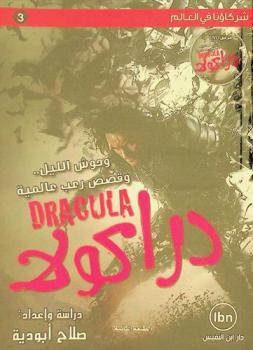
Dracula
The vampire novel that defined a genre by tapping into our deepest fears and darkest fantasies A junior solicitor travels to Transylvania to meet with an important client, the mysterious Count Dracula.Ignoring the dire warnings of local townsfolk, he allows himself to be seduced by the count's courtly manners and erudite charm.
eBook


Post/modern Dracula : from Victorian themes to postmodern praxis
Post/modern Dracula explores the postmodern in Bram Stokers Victorian novel and the Victorian in Francis Ford Coppolas postmodern film to demonstrate how the century that separates the two artists binds them more than it divides them. What are the postmodern elements of Stokers novel? Where are the Victorian traits in Coppolas film? Is there a postmodern gloss on those Victorian traits? And can there be a Victorian directive behind postmodernism in general? The nine essays compiled in t.
eBook
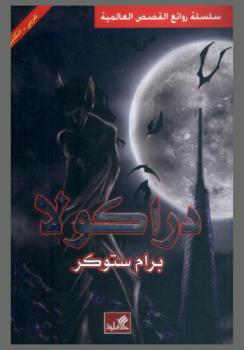
دراكولا
عاش الكونت دراكولا في قصره في البلقان لمئات السنين دون أن يموت. إن دماء المئات من ضحاياه كانت الغذاء الذي أمده بسر البقاء. خلق دراكولا حوله مجموعة من مصاصي الدماء، فكان يحول النساء الجميلات إلى كائنات ملعونة تعيش على الدماء. تبدأ القصة بمحامي شاب يستدعيه دراكولا إلى قصره لكن الأحداث المثيرة تستمر لاحقا في لندن وتنتهي مجددا في قلعة دراكولا الرهيبة.
BOOK

Disentangling visual and olfactory signals in mushroom-mimicking Dracula orchids using realistic three-dimensional printed flowers
Flowers use olfactory and visual signals to communicate with pollinators. Disentangling the relative contributions and potential synergies between signals remains a challenge. Understanding the perceptual biases exploited by floral mimicry illuminates the evolution of these signals. Here, we disentangle the olfactory and visual components of Dracula lafleurii, which mimics mushrooms in size, shape, color and scent, and is pollinated by mushroom-associated flies.
To decouple signals, we used three-dimensional printing to produce realistic artificial flower molds that were color matched and cast using scent-free surgical silicone, to which we could add scent. We used GC-MS to measure scents in co-occurring mushrooms, and related orchids, and used these scents in field experiments.
By combining silicone flower parts with real floral organs, we created chimeras that identified the mushroom-like labellum as a source of volatile attraction. In addition, we showed remarkable overlap in the volatile chemistry between D. lafleurii and co-occurring mushrooms.
The characters defining the genus Dracula– a mushroom-like, ‘gilled’ labellum and a showy, patterned calyx – enhance pollinator attraction by exploiting the visual and chemosensory perceptual biases of drosophilid flies. Our techniques for the manipulation of complex traits in a nonmodel system not conducive to gene silencing or selective breeding are useful for other systems.
Journal Article


A new Pseudolepanthes (Pleurothallidinae: Orchidaceae) from Northwest Ecuador
A new species of the genus Pseudolepanthes discovered in Carchi province, northwest Ecuador, is described here. The new species is compared with P. zunagensis from which it is distinguished by a longer inflorescence with successive vinaceous or pale-yellow flowers, an elongate arcuate column, and a lip with an erect, thick, widely rectangular central callus. Keywords: Dracula Reserve, EcoMinga, Trichosalpinx, Trichosalpinx pseudolepanthes
Journal Article


Anti-Ottoman Cruelty and Christian Rite: The Deeds of the “Repenting” Vlad III of Wallachia
When Byzantium fell, Western attitude towards Greek rite Christians began to change, whether they were ‘schismatics’ or in union with Rome, following the troublesome enactment of the Council of Florence (1439). The modification, noted for Balkan Christians, crossed the Lower Danube. There laid the mostly Greek rite zones that stayed outside of Ottoman direct authority, even after Mehmed II’s victories in Serbia (1459), in Bosnia (1463) or in the Crimea (1475). These zones formed two (divided) states: Wallachia and Moldavia. The change of attitude towards Greek rite Christians was visible also in the Kingdom of Hungary, the traditional suzerain of Wallachia and Moldavia, and, by definition, Christendom’s anti-Ottoman ‘bulwark’. The realm had been shielded by a series of “buffer states”. These lands had largely collapsed by the early 1470s.No ruler of Wallachia or of Moldavia was “blacklisted” in the realm (and by its representatives) as ‘schismatic’ after the Ottoman conquest of Byzantium, as well as after “the miracle of Belgrade”, in 1456. The long and predominantly tolerant reign of Sigismund of Luxemburg had certainly altered the “so-to-say” Angevine rhetoric of the 1300s (that is, the Wallachians, and their lords, were ‘schismatic’ “lowlife” to be crushed). Still, the documentary (at least) change, in favour of Greek rite Wallachians appears dramatic.In this framework we turn to the controversial figure of Vlad III Dracula of Wallachia. The ‘Germans’ may have been correct: Vlad was the monster of one – single- Christian faith. This may explain why his deeds did not lead to a collapse of the unstable Christian compromise at the Danube borders of the Ottoman Empire. Vlad was a Greek-Latin Golem (officially by calling, not by making), whose death was later lamented by both King Matthias Corvinus and Stephen III of Moldavia, the Greek rite athleta of the Papacy, Vlad’s relatives.
Journal Article