
Catalogue Search | MBRL


Are you sure you want to remove the book from the shelf?

{{itemTitle}}
1,075
result(s) for
"Drawing Philosophy."
Sort by:

A theory of narrative drawing
This book offers an original new conception of visual story telling, proposing that drawing, depictive drawing and narrative drawing are produced in an encompassing dialogic system of embodied social behavior. It refigures the existing descriptions of visual story-telling that pause with theorizations of perception and the articulation of form. The book identifies and examines key issues in the field, including: the relationships between vision, visualization and imagination; the theoretical remediation of linguistic and narratological concepts; the systematization of discourse; the production of the subject; idea and institution; and the significance of resources of the body in depiction, representation and narrative. It then tests this new conception in practice: two original visual demonstrations clarify the particular dialectic relationships between subjects and media, in an examination of drawing style and genre, social consensus and self-conscious constraint. The book's originality derives from its clear articulation of a wide range of sources in proposing a conception of narrative drawing, and the extrapolation of this new conception in two new visual demonstrations.
Book
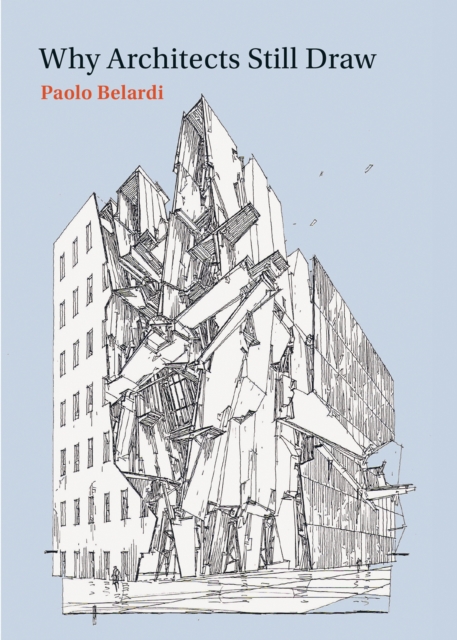
Why architects still draw : two lectures on architectural drawing
An architect's defense of drawing as a way of thinking, even in an age of electronic media.Why would an architect reach for a pencil when drawing software and AutoCAD are a click away? Use a ruler when 3D-scanners and GPS devices are close at hand? In Why Architects Still Draw, Paolo Belardi offers an elegant and ardent defense of drawing by hand as a way of thinking. Belardi is no Luddite; he doesn't urge architects to give up digital devices for watercolors and a measuring tape. Rather, he makes a case for drawing as the interface between the idea and the work itself.A drawing, Belardi argues, holds within it the entire final design. It is the paradox of the acorn: a project emerges from a drawing-even from a sketch, rough and inchoate-just as an oak tree emerges from an acorn. Citing examples not just from architecture but also from literature, chemistry, music, archaeology, and art, Belardi shows how drawing is not a passive recording but a moment of invention pregnant with creative possibilities.Moving from the sketch to the survey, Belardi explores the meaning of measurement in a digital era. A survey of a site should go beyond width, height, and depth; it must include two more dimensions: history and culture. Belardi shows the sterility of techniques that value metric exactitude over cultural appropriateness, arguing for an \"informed drawing\" that takes into consideration more than meters or feet, stone or steel. Even in the age of electronic media, Belardi writes, drawing can maintain its role as a cornerstone of architecture.
eBook

The architecture concept book
\"Inspired by the complexity and heterogeneity of the world around us, and by the rise of new technologies and their associated behaviors, The Architecture Concept Book seeks to stimulate young architects and students to think outside of what is often a rather conservative and self-perpetuating professional domain and to be influenced by everything around them. Organized thematically, the book explores thirty- five architectural concepts, which cover wide- ranging topics not always typically included in the study of architecture. James Tait traces the connections between concepts such as familiarity, control, and memory and basic architectural components such as the entrance, arch, columns, and services, to social phenomena such as gathering and reveling, before concluding with texts on shelter, relaxing, and working. Even in this digital age, Tait insists that we must always think before we design. We must always have a reason to build.\"--Publisher's description.
Book
Drawing
In an era which has seen many forms of artistic creation becoming digitized, the practice of drawing, in the traditional sense, has remained constant.However, many publications about the relationship between drawing and thinking rely on discipline-dependent distinctions to discuss the activity's function.
eBook

Impossible heights : skyscrapers, flight, and the master builder
\" The advent of the airplane and skyscraper in 1920s and '30s America offered the population an entirely new way to look at the world: from above. The captivating image of an airplane flying over the rising metropolis led many Americans to believe a new civilization had dawned. In Impossible Heights, Adnan Morshed examines the aesthetics that emerged from this valorization of heights and their impact on the built environment. The lofty vantage point from the sky ushered in a modernist impulse to cleanse crowded twentieth-century cities in anticipation of an ideal world of tomorrow. Inspired by great new heights, American architects became central to this endeavor and were regarded as heroic aviators. Combining close readings of a broad range of archival sources, Morshed offers new interpretations of works such as Hugh Ferriss's Metropolis drawings, Buckminster Fuller's Dymaxion houses, and Norman Bel Geddes's Futurama exhibit at the 1939 New York World's Fair. Transformed by the populist imagination into \"master builders,\" these designers helped produce a new form of visuality: the aesthetics of ascension. By demonstrating how aerial movement and height intersect with popular \"superman\" discourses of the time, Morshed reveals the relationship between architecture, art, science, and interwar pop culture. Featuring a marvelous array of never before published illustrations, this richly textured study of utopian imaginings illustrates America's propulsion into a new cultural consciousness. \"-- Provided by publisher.
Book
Writing on drawing
This book presents essays that reveal a provocative agenda for drawing research, analysing the latest work on creativity, education and thinking from a variety of perspectives. Bringing together contributions by leading artists and researchers, this volume offers consolidation, discussion and guidance for a previously fragmented discipline.
eBook

Sichtbarkeiten 3
Der Band fragt, ausgehend von konkreten Praktiken, nach den Eigenwegen der Zeichnung, die sich zwischen etablierten epistemischen und ästhetischen Praktiken und Randphänomenen der Zeichnung bahnen können.
eBook
Drawing Difference
Drawing has been growing in recognition and stature within contemporary fine art since the mid-1970s. Simultaneously, feminist activism has been widespread, leading to the increased prominence of women artists, scholars, critics and curators and the wide acknowledgement of the crucial role played by gender and sexual difference in constituting the subject. Drawing Difference argues that these developments did not occur in parallel simply by coincidence. Rather, the intimate interplay between drawing and feminism is best characterised as allotropic a term originating in chemistry that describes a single pure element which nevertheless assumes varied physical structures, denoting the fundamental affinities which underlie apparently differing material forms. The book takes as its starting point three works from the 1970s by Annette Messager, Dorothea Rockburne and Carolee Schneeman, that are used to exemplify critical developments in feminist art history and key moments for drawing as a means of expression.
Throughout the chapters, these works are further explored in relation to the contemporary drawing practices of Marco Maggi, Sian Bowen, Susan Hauptmann, Cornelia Parker, Christoph Fink and Toba Kheedori. Their works are shown to be (re)iterative sites where mark-making differs with each appearance yet retains certain essential features. Dividing its analysis into the themes Approaching, Tropes and Coinciding, the book analyses how both drawing and feminist discourse emphasise dialogue, matter and openness. It demonstrates how sexual difference, subjectivity and drawing are connected at an elemental level and thus how drawing has played a vital role in the articulation of the material and conceptual dynamics of feminism.\"
eBook
Hyperdrawing
In hyperdrawing: beyond the lines of contemporary art, authors and artists come together to explore the potential of what drawing in contemporary art theory and practice might become. In this follow-up to 2007's drawing now: between the lines of contemporary art, Phil Sawdon and Russell Marshall, two of the current directors of TRACEY, curate contemporary drawing within fine art practice from 2006 through to 2010. Four essays and images from 33 international artists collectively explore the boundaries of the hyperdrawing space, investigating in essence what lies beyond drawing - images that use traditional materials or subjects whilst also pushing beyond the traditional, employing sound, light, time, space and technology.Over and above traditional views and practices, the authors and artists in this book recognise and embrace the opportunities inherent in the essential ambiguity of drawing. Practitioners of hyperreal works, 2D3D4D pieces and installations that push beyond photorealism all find their place within this new conception of hyperdrawing as techné, a productive space no longer limited by spatial boundaries. Artists including Catherine Bertola, Layla Curtis, Garrett Phelan, Suzanne Treister and Ulrich Vogl alongside the essays of Emma Cocker, Siún Hanrahan and Marsha Meskimmon provide a contemporary view in both visual and written form of how ambiguity can be used as a strategic approach in drawing research and practice.A gallery in book form, hyperdrawing takes drawing beyond the interaction of pencil and paper and traces contemporary adventures in multiple dimensions and alternate realities.
eBook
Entwurf und Entgrenzung
Kontradispositive beschreibt eine dekonstruktivistische Zeichenpraxis, die an den Paradigmen ihrer eigenen Geschichte und Technik ansetzt, indem sie die Theorie der Zeichnung zu Ende denkt und so an ihren Grenzen fortschreibt. Es handelt sich bei diesen Randgängen der Zeichnung nicht mehr nur um neue oder andersartige Dispositive, wie diese von Pisanello bis Picasso verschiedentlich wirksam wurden, sondern um ›anti-klassische‹ Gegendispositive, die damit auch den Voraussetzungsreichtum eines scheinbar voraussetzungslosen Mediums in Frage stellen. Sechs Strategien dieser Entgrenzung werden insgesamt betrachtet, dazu gehören u.a. Geste und Automatismus bei Hartung und Pollock, Reflexion über den Topos der Blindheit bei Robert Morris, mit Derrida und Davidson sowie der konzeptuelle Nominalismus Daniel Burens, der letztlich zu einer Aufhebung der Zeichnung führt und damit im strengen Sinne kein Kontra-Dispositiv mehr entwirft.
eBook