
Catalogue Search | MBRL


Are you sure you want to remove the book from the shelf?

{{itemTitle}}
28,499
result(s) for
"Driver education"
Sort by:

Mirror, shoulder, signal : a novel
Sonja is ready to get on with her life. She's over forty now, and the Swedish crime novels she translates are losing their fascination. She sees a masseuse, tries to reconnect with her sister, and is finally learning to drive. But under the overbearing gaze of her driving instructor, Sonja is unable to shift gears for herself. And her vertigo, which she has always carefully hidden, has begun to manifest at the worst possible moments. Sonja hoped her move to Copenhagen years ago would have left rural Jutland in the rearview mirror. Yet she keeps remembering the dramatic landscapes of her childhood-- the endless sky, the whooper swans, the rye fields --and longs to go back. But how can she return to a place that she no longer recognizes? And how can she escape the alienating streets of Copenhagen?
Book

The Multisensory Driver
This book is dedicated to furthering the design of ergonomic multisensory interfaces by highlighting recent evidence in this area emerging from the fast-growing field of cognitive neuroscience. It focuses primarily on two aspects of driver information-processing: multisensory interactions and the spatial distribution of attention in driving.
eBook

Safe Mobility: Challenges, Methodology and Solutions
This book increases the level of knowledge on road safety contexts, issues and challenges; shares what can currently be done to address the variety of issues; and points to what needs to be done to make further gains in road safety.
eBook


Police-led, school-based driver education: a pre- and post-comparison of young driver self-reported behaviour and intentions including gender differences
This study examined the effects of a police-led, school-based young driver education program on the future driving intentions of young, novice drivers. The participants were 294 final-year high school students from the Sunshine Coast region of Queensland (Australia). The study employed a pre- and post-survey design that measured self-reported driving behaviour, sensation seeking, and self-reported future driving intentions of young drivers. T-tests between pre- and post-responses identified statistically significant positive changes in young driver intentions after the program when compared to their previously self-reported behaviours. Further analysis of the changes between the pre- and post-surveys demonstrate that the LAW program has a greater effect on female participants and those with higher levels of sensation seeking. The findings of this study indicate that police-led, school-based driver education programs may be an effective way of altering the driving intentions of young novice drivers and in turn promoting greater road safety.
Journal Article
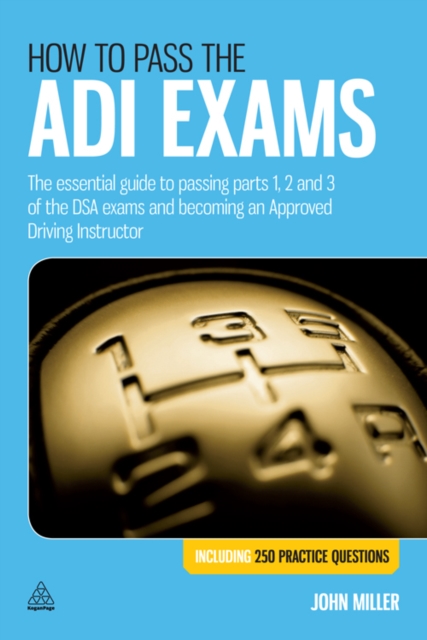
How to pass the ADI exams : the essential guide to passing parts 1, 2 and 3 of the DSA exams and becoming an approved driving instructor
How to Pass the ADI Exams provides all trainee ADIs with an indispensable guide to understanding and passing all three stages of the ADI exam process. Packed with practice questions, the book outlines the overall exam structure, before looking in detail at the three key areas - the theory test (Part 1), the driving exam (Part 2) and the instructional ability test (Part 3). With additional information on pre-entry requirements, criminal records checks, ADI registration, and the responsibilities and codes of practice relating to ADIs, the book can underpin your training programme and offers practical help and advice to guide you through the exam procedures.
eBook

Multimodal Analysis of Hazard Perception Learning in Novice Drivers with Autism Using a Simulation-Based Training Environment
Simulation-based driver training has shown promise for improving hazard perception in novice drivers; however, how learners with autism adapt behaviorally, visually, and physiologically during such training remains poorly understood. This study examined the effects of a game-based, hazard-focused driving simulation on hazard detection accuracy, gaze behavior, and heart rate in novice drivers with autism using a single-case, multi-phase design. Five participants completed repeated trials across baseline, treatment, and withdrawal phases while behavioral performance, eye movements, and physiological response were recorded. Across outcome domains, participants demonstrated highly individualized learning trajectories with substantial variability in both the direction and magnitude of change. Improvements in hazard detection accuracy were not consistently accompanied by changes in gaze organization or physiological response. While one participant exhibited a canonical pattern of coordinated improvement across behavioral, visual, and physiological measures, others showed dissociation between modalities, including reduced physiological arousal without performance gains or modest accuracy improvements despite sustained physiological engagement. Exploratory peri-hazard analyses further revealed participant-specific heart rate responses aligned to hazard detection, with no uniform temporal signature associated with learning. These findings suggest that hazard perception learning in drivers with autism does not follow a single pathway and cannot be inferred from any single performance or physiological metric. Instead, multimodal, within-participant analysis is critical for capturing meaningful individual adaptation during simulation-based training. The results have implications for the design and evaluation of driver training systems, supporting flexible, learner-specific assessment frameworks and adaptive approaches that accommodate diverse patterns of engagement and learning.
Journal Article

Exploring the Determinants of School Bus Crash Severity
Although the school bus is considered a safe form of transportation, school bus crashes are a major safety concern. School bus crashes are a result of driver error of either the at-fault school bus or another at-fault vehicle (where the school bus is not at fault). To examine the risk factors associated with school bus related crashes and crash outcomes, this study segments and develops two binary logit models for each school bus crash type. A total of 1702 school bus related crashes recorded between 2009 and 2016 were used to estimate the model. According to the model results, sideswipe collisions were less likely to result in injury outcomes for at-fault school buses than rear-end and side-impact collisions. Speeding, driving impaired or under the influence, and negotiating a curve all have significant positive associations with injury outcomes in not-at-fault school bus crashes. This study’s practical implications include enforcing the school bus safe driving guidelines, training programs for school bus drivers that include elements of nonroutine trips, training for crossing guards, and awareness programs for drivers of other vehicles to instill safe driving practices around school buses.
Journal Article

Handbook of traffic psychology
The Handbook of Traffic Psychology covers all key areas of research in this field including theory, applications, methodology and analyses, variables that affect traffic, driver problem behaviors, and countermeasures to reduce risk on roadways. Comprehensive in scope, the methodology section includes case-control studies, self-report instruments.
eBook
Practical teaching skills for driving instructors
Written for both existing and trainee driving instructors in the UK, Practical Teaching Skills for Driving Instructors shows how to develop and improve the ability to teach driving as a lifetime skill. The companion title to the popular best-seller The Driving Instructor's Handbook, it offers advice on teaching, communication and coaching skills. Fully revised, it investigates how and why people learn and the different teaching and learning processes involved. With sections on structuring a lesson and problem solving, it also looks at the reasons why people learn to drive and the motivation involved in seeing it through, from early stage lessons to the final practical test. Listed by the DSA as essential reading for the ADI exams, it is an indispensable guide for all new and established driving instructors, providing all the necessary advice for the conscientious instructor keen to communicate effectively with their pupils.
eBook