
Catalogue Search | MBRL


Are you sure you want to remove the book from the shelf?

{{itemTitle}}
292
result(s) for
"Droit européen "
Sort by:

European Law on Unfair Commercial Practices and Contract Law
The book examines the ambiguous relationship between the European law on unfair commercial practices and contract law. In particular, the manuscript demonstrates that the Directive 2005/29/EC on unfair commercial practices (‘UCPD’) has had a major impact on contract law, despite the declaration concerning the formal independence between the two branches of law established by Article 3(2) UCPD. The insights and conclusions identified in the book contribute to a better understanding of European private law and the general process of Europeanisation of private law in the European Union, and in particular of contract law. Volume 62 in the Series Modern Studies in European Law
eBook

Law and New Governance in the EU and the US
New approaches to governance have attracted significant scholarly attention in recent years. Commentators on both sides of the Atlantic have identified, charted and evaluated the rise and spread of forms of governance, forms which seem to differ from previous regulatory and legal paradigms. In Europe, the emergence of the Open Method of Coordination has provided a focal point for new governance studies.
eBook

Contentieux Européen (2 Volumes)
Le present ouvrage decrit l'architecture juridictionnelle de l'Union europeenne et analyse en profondeur tous les types de recours qui peuvent etre introduits devant les trois juridictions qui composent la Cour de justice de l'Union europeenne (la Cour de justice, le Tribunal et le Tribunal de la fonction publique), sans oublier le role important du juge national dans l'application quotidienne du droit de l'Union europeenne.Si la premiere edition integrait deja les modifications apportees par le Traite de Lisbonne, sa recente entree en vigueur laissait un nombre important de questions en suspens. Cette nouvelle edition permet de repondre a plusieurs d'entre elles (comme l'etendue de la nouvelle possibilite d'agir en annulation pour le particulier sur la base de l'article 263 du traite sur le fonctionnement de l'Union europeenne par exemple). Elle integre egalement les modifications apportees au statut de la Cour de justice et le nouveau reglement de procedure de la Cour entierement refondu en octobre 2012.Comme pour la premiere edition, les auteurs ont par ailleurs adopte une methodologie originale en fondant leur propos et leur analyse sur la jurisprudence produite par les juridictions de la Cour de justice de l'Union europeenne jusqu'au 31 janvier 2014. Ce sont ainsi pres de 1900 decisions de jurisprudence qui sont commentees dans l'ouvrage (soit pres de 600 supplementaires par rapport a la premiere edition). Elles sont inventoriees minutieusement dans un index mis a disposition des praticiens.Les principaux textes de procedure propres aux juridictions europeennes sont quant a eux desormais compiles dans un second volume, permettant ainsi leur utilisation plus aisee par les praticiens.
eBook

The Lisbon Treaty
Given the controversies and difficulties which preceded the coming into force of the Lisbon Treaty, it is easy to forget that the Treaty is a complex legal document in need of detailed analysis for its impact to be fully understood. Jean-Claude Piris, the Director General of the Legal Service of the Council of the European Union, provides such an analysis, looking at the historical and political contexts of the Treaty, its impact on the democratic framework of the EU and its provisions in relation to substantive law. Impartial legal analysis of the EU's functions, its powers and the treaties which govern it make this the seminal text on the most significant recent development in EU law.
eBook

Homosexuality and the European Court of Human Rights
Homosexuality and the European Court of Human Rights is the first book-length study of the Court's jurisprudence in respect of sexual orientation. It offers a socio-legal analysis of the substantial number of decisions and judgments of the Strasbourg organs on the wide range of complaints brought by gay men and lesbians under the European Convention on Human Rights. Providing a systematic analysis of Strasbourg case law since 1955 and examining decades of decisions that have hitherto remained obscure, the book considers the evolution of the Court's interpretation of the Convention and how this has fashioned lesbian and gay rights in Europe. Going beyond doctrinal analysis by employing a nuanced sociological consideration of Strasbourg jurisprudence, Paul Johnson shows how the Court is a site at which homosexuality is both socially constructed and regulated. He argues that although the Convention is conceived as a 'living instrument' to be interpreted 'in the light of present-day conditions' the Court's judgments have frequently forged and advanced new social conditions in respect of homosexuality. Johnson argues that the Court's jurisprudence has an extra-legal importance because it provides an authoritative and powerful discursive resource that can be mobilized by lesbians and gay men to challenge homophobic and heteronormative social relations in contemporary societies. As such, the book considers how the Court's interpretation of the Convention might be evolved in the future to better protect lesbian and gay rights and lives.
eBook

Sovereignty in Transition
Sovereignty in Transition brings together a group of leading scholars from law and cognate disciplines to assess contemporary developments in the framework of ideas and the variety of institutional forms associated with the concept of sovereignty. Sovereignty has been described as the main organising concept of the international society of states - one which is traditionally central to the discipline and practice of both constitutional law and of international law.
eBook

Constitutional Pluralism in the European Union and Beyond
Constitutional pluralism has become immensely popular among scholars who study European integration and issues of global governance. Some of them believe that constitutionalism, traditionally thought to be bound to a nation state, can emerge beyond state borders–most importantly in the process of European integration, but also beyond that, for example, in international regulatory regimes such as the WTO, or international systems of fundamental rights protection, such as the European Convention. At the same time, the idea of constitutional pluralism has not gone unchallenged. Some have questioned its compatibility with the very nature of law and the values which law brings to constitutionalism. The critiques have come from both sides: from those who believe in the ‘traditional’ European constitutionalism based on a hierarchically superior authority of the European Union as well as from scholars focusing on constitutions of particular states. The book collects contributions taking opposing perspectives on constitutional pluralism–some defending and promoting the concept of constitutional pluralism, some criticising and opposing it. While some authors can be called ‘the founding fathers of constitutional pluralism’, others are young academics who have recently entered the field. Together they offer fresh perspectives on both theoretical and practical aspects of constitutional pluralism, enriching our existing understanding of the concept in current scholarship.
eBook
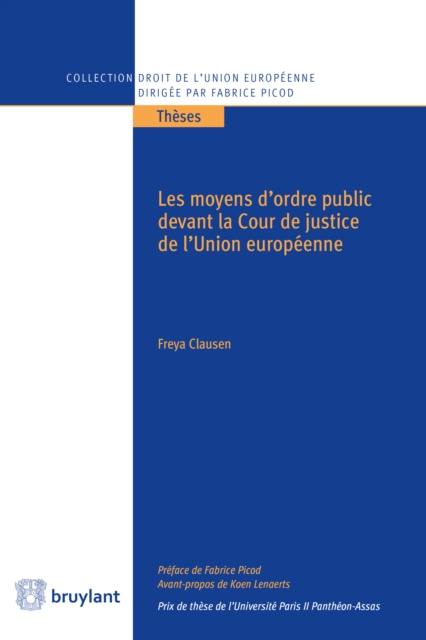
Les Moyens d'ordre Public Devant la Cour de Justice de l'Union Européenne
Inspire des notions analogues connues des contentieux internes, le moyen d'ordre public fut consacre, dans le contentieux de l'Union europeenne, des 1954 par la Cour de justice de la CECA. Dans une jurisprudence abondante, les juridictions de l'Union ont, depuis lors, progressivement etendu son champ et construit son regime contentieux. Tendant a la garantie des regles et valeurs essentielles de l'ordre juridique europeen, le moyen d'ordre public poursuit une fonction objective de garantie des equilibres constitutionnels inherents a la construction europeenne et n'oeuvre qu'exceptionnellement dans l'interet subjectif des justiciables. Il joue de maniere variable dans l'ensemble des procedures contentieuses.Il est imperatif et s'impose tant au juge, qui doit en principe l'examiner d'office, qu'aux parties, qui peuvent l'invoquer a tout moment et ne sauraient y renoncer. Un courant jurisprudentiel recent tend a subjectiviser son regime au vu des exigences du proces equitable en imposant sa soumission au debat contradictoire.Le present ouvrage fournit la premiere analyse des moyens d'ordre public en droit du contentieux de l'Union europeenne. Sont examines successivement la notion et le regime de ces moyens, grace a une analyse systematique et fournie de la jurisprudence de la Cour de justice, du Tribunal et du Tribunal de la fonction publique. En passant en revue tous les moyens d'ordre public, leur releve d'office par le juge, leur invocation par les parties et leur soumission au debat contradictoire, l'ouvrage renseigne egalement sur les caracteristiques et les principes directeurs des procedures contentieuses relevant des juridictions de l'Union.Cet ouvrage se destine a un public universitaire specialise en droit et en contentieux de l'Union europeenne et, plus generalement, en droit processuel. Il interessera par ailleurs tous les praticiens specialises dans les contentieux relevant des juridictions de l'Union.
eBook

Balancing Human Rights, Environmental Protection and International Trade
This book explores the means by which economic liberalisation can be reconciled with human rights and environmental protection in the regulation of international trade. It is primarily concerned with identifying the lessons the international community can learn, specifically in the context of the WTO, from decades of European Community and Union experience in facing this question. The book demonstrates first that it is possible to reconcile the pursuit of economic and non-economic interests, that the EU has found a mechanism by which to do so, and that the application of the principle of proportionality is fundamental to the realisation of this. It is argued that the EU approach can be characterised as a practical application of the principle of sustainable development. Secondly, from the analysis of the EU experience, this book identifies fundamental conditions crucial to achieving this ‘reconciliation’. Thirdly, the book explores the implications of lessons from the EU experience for the international Community. In so doing it assesses both the potential and limits of the existing international regulatory framework for such reconciliation. The book develops a deeper understanding of the inter-relationship between the legal regulation of economic and non-economic development, adding clarity to the debate in a controversial area. It argues that a more holistic approach to the consideration of ‘development’, encompassing economic and non-economic concerns - ‘sustainable’ development - is not only desirable in principle but realisable in practice.
eBook