
Catalogue Search | MBRL


Are you sure you want to remove the book from the shelf?

{{itemTitle}}
534
result(s) for
"Drugs, Essential - supply "
Sort by:

Study protocol for a cluster-randomised controlled trial of an NCD access to medicines initiative: evaluation of Novartis Access in Kenya
IntroductionNovartis recently launched Novartis Access, an initiative to provide a basket of reduced price medicines for non-communicable diseases (NCDs) to be sold through the public and private non-profit sectors in programme countries. This study will evaluate the impact of Novartis Access on the availability and price of NCD medicines at health facilities and households in Kenya, the first country to receive the programme.Methods and analysisThis study will be a cluster-randomised controlled trial. 8 counties in Kenya will be randomly assigned to the intervention or control group using a covariate constrained randomisation method to maximise balance on demographic and health characteristics. In intervention counties, public and private non-profit health facilities will be able to order Novartis Access NCD medicines from the Mission for Essential Drugs and Supplies (MEDS). Data will be collected from a random sample of 384 health facilities and 800 households at baseline, midline after 1-year of intervention, and end-line after 2 years. Quarterly surveillance data will also be collected from health facilities and a subsample of households through phone-based interviews. Households will be eligible if at least one resident has been previously diagnosed and prescribed a medicine for an NCD addressed by Novartis Access, including hypertension and diabetes. The primary outcomes will be availability and price of NCD medicines at health facilities, and availability, price, and expenditures on NCD medicines at households. Impacts will be estimated using intention-to-treat analysis.Ethics and disseminationThis protocol was approved by the Institutional Review Boards at Strathmore University and at Boston University. Informed consent will be obtained from all participants at the start of the trial. The findings of the trial will be disseminated through peer-reviewed journals, international conferences, and meetings and events organised with local stakeholders.Trial registration numberNCT02773095.
Journal Article
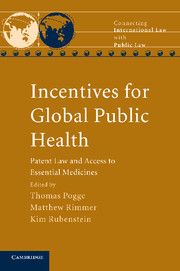
Incentives for Global Public Health
This portrait of the global debate over patent law and access to essential medicines focuses on public health concerns about HIV/AIDS, malaria, tuberculosis, the SARS virus, influenza, and diseases of poverty. The essays explore the diplomatic negotiations and disputes in key international fora, such as the World Trade Organization, the World Health Organization and the World Intellectual Property Organization. Drawing upon international trade law, innovation policy, intellectual property law, health law, human rights and philosophy, the authors seek to canvass policy solutions which encourage and reward worthwhile pharmaceutical innovation while ensuring affordable access to advanced medicines. A number of creative policy options are critically assessed, including the development of a Health Impact Fund, prizes for medical innovation, the use of patent pools, open-source drug development and forms of 'creative capitalism'.
eBook

Essential medicines for universal health coverage
Essential medicines satisfy the priority health-care needs of the population. Essential medicines policies are crucial to promoting health and achieving sustainable development. Sustainable Development Goal 3.8 specifically mentions the importance of \"access to safe, effective, quality and affordable essential medicines and vaccines for all\" as a central component of Universal Health Coverage (UHC), and Sustainable Development Goal 3.b emphasises the need to develop medicines to address persistent treatment gaps.
Journal Article

Access to cancer medicines deemed essential by oncologists in 82 countries: an international, cross-sectional survey
The WHO Essential Medicines List (EML) identifies priority medicines that are most important to public health. Over time, the EML has included an increasing number of cancer medicines. We aimed to investigate whether the cancer medicines in the EML are aligned with the priority medicines of frontline oncologists worldwide, and the extent to which these medicines are accessible in routine clinical practice.
This international, cross-sectional survey was developed by investigators from a range of clinical practice settings across low-income to high-income countries, including members of the WHO Essential Medicines Cancer Working Group. A 28-question electronic survey was developed and disseminated to a global network of oncologists in 89 countries and regions by use of a hierarchical snowball method; each primary contact distributed the survey through their national and regional oncology associations or personal networks. The survey was open from Oct 15 to Dec 7, 2020. Fully qualified physicians who prescribe systemic anticancer therapy to adults were eligible to participate in the survey. The primary question asked respondents to select the ten cancer medicines that would provide the greatest public health benefit to their country; subsequent questions explored availability and cost of cancer medicines. Descriptive statistics were used to compare access to medicines between low-income and lower-middle-income countries, upper-middle-income countries, and high-income countries.
87 country-level contacts and two regional networks were invited to participate in the survey; 46 (52%) accepted the invitation and distributed the survey. 1697 respondents opened the survey link; 423 were excluded as they did not answer the primary study question and 326 were excluded because of ineligibility. 948 eligible oncologists from 82 countries completed the survey (165 [17%] in low-income and lower-middle-income countries, 165 [17%] in upper-middle-income countries, and 618 [65%] in high-income countries). The most commonly selected medicines were doxorubicin (by 499 [53%] of 948 respondents), cisplatin (by 470 [50%]), paclitaxel (by 423 [45%]), pembrolizumab (by 414 [44%]), trastuzumab (by 402 [42%]), carboplatin (by 390 [41%]), and 5-fluorouracil (by 386 [41%]). Of the 20 most frequently selected high-priority cancer medicines, 19 (95%) are currently on the WHO EML; 12 (60%) were cytotoxic agents and 13 (65%) were granted US Food and Drug Administration regulatory approval before 2000. The proportion of respondents indicating universal availability of each top 20 medication was 9–54% in low-income and lower-middle-income countries, 13–90% in upper-middle-income countries, and 68–94% in high-income countries. The risk of catastrophic expenditure (spending >40% of total consumption net of spending on food) was more common in low-income and lower-middle-income countries, with 13–68% of respondents indicating a substantial risk of catastrophic expenditures for each of the top 20 medications in lower-middle-income countries versus 2–41% of respondents in upper-middle-income countries and 0–9% in high-income countries.
These data demonstrate major barriers in access to core cancer medicines worldwide. These findings challenge the feasibility of adding additional expensive cancer medicines to the EML. There is an urgent need for global and country-level policy action to ensure patients with cancer globally have access to high priority medicines.
None.
Journal Article

The Pandemic and the Supply Chain: Gaps in Pharmaceutical Production and Distribution
The acute stress of the COVID-19 pandemic has laid bare a series of long-term weaknesses in the US public health system, including the fragility of our supply of essential medications.1 The virus produced unprecedented shifts in demand for old as well as new drugs, while simultaneously introducing new uncertainties about the production and distribution of pharmaceutical products. COVID-19-related shortages extended beyond antivirals to include a range of drugs broadly used in intensive care and in general hospital management (Table 1). These shortages point to serious vulnerabilities in the pharmaceutical supply chain that compromise readiness for new waves of the current pandemic and crises that are yet to come.
Journal Article

WHO Model list of essential medicines: visions for the future
The first version of the
contained 186 medicines in 1977 and has evolved to include 502 medicines in 2023. Over time, different articles criticized the methods and process for decisions; however, the list holds global relevance as a model list to over 150 national lists. Given the global use of the model list, reflecting on its future role is imperative to understand how the list should evolve and respond to the needs of Member States. In 2023, the model list Expert Committee recommended the World Health Organization (WHO) to initiate a process to revise the procedures for updating the model list and the criteria guiding decisions. Here, we offer an agenda outlining priority areas and a vision for an authoritative model list. The main areas include improving transparency and trustworthiness of the recommendations; strengthening connection to national lists; and continuing the debate on the principles that should guide the model list, in particular the role of cost and price of essential medicines. These reflections are intended to support efforts ensuring the continued impact of this policy tool.
Journal Article

Availability, cost and affordability of essential medicines for chronic respiratory diseases in low-income and middle-income countries: a cross-sectional study
Contemporary data on the availability, cost and affordability of essential medicines for chronic respiratory diseases (CRDs) across low-income and middle-income countries (LMICs) are missing, despite most people with CRDs living in LMICs. Cross-sectional data for seven CRD medicines in pharmacies, healthcare facilities and central medicine stores were collected from 60 LMICs in 2022–2023. Medicines for symptomatic relief were widely available and affordable, while preventative treatments varied widely in cost, were less available and largely unaffordable. There is an urgent need to address these issues if the Sustainable Development Goal 3 is to be achieved for people with asthma by 2030.
Journal Article

Medicine prices, availability, and affordability in 36 developing and middle-income countries: a secondary analysis
WHO and Health Action International (HAI) have developed a standardised method for surveying medicine prices, availability, affordability, and price components in low-income and middle-income countries. Here, we present a secondary analysis of medicine availability in 45 national and subnational surveys done using the WHO/HAI methodology.
Data from 45 WHO/HAI surveys in 36 countries were adjusted for inflation or deflation and purchasing power parity. International reference prices from open international procurements for generic products were used as comparators. Results are presented for 15 medicines included in at least 80% of surveys and four individual medicines.
Average public sector availability of generic medicines ranged from 29·4% to 54·4% across WHO regions. Median government procurement prices for 15 generic medicines were 1·11 times corresponding international reference prices, although purchasing efficiency ranged from 0·09 to 5·37 times international reference prices. Low procurement prices did not always translate into low patient prices. Private sector patients paid 9–25 times international reference prices for lowest-priced generic products and over 20 times international reference prices for originator products across WHO regions. Treatments for acute and chronic illness were largely unaffordable in many countries. In the private sector, wholesale mark-ups ranged from 2% to 380%, whereas retail mark-ups ranged from 10% to 552%. In countries where value added tax was applied to medicines, the amount charged varied from 4% to 15%.
Overall, public and private sector prices for originator and generic medicines were substantially higher than would be expected if purchasing and distribution were efficient and mark-ups were reasonable. Policy options such as promoting generic medicines and alternative financing mechanisms are needed to increase availability, reduce prices, and improve affordability.
None.
Journal Article

Access to medicines through health systems in low- and middle-income countries
Abstract
Nearly 2 billion people globally have no access to essential medicines. This means essential medicines are unavailable, unaffordable, inaccessible, unacceptable or of low quality for more than a quarter of the population worldwide. This supplement demonstrates the implications of poor medicine access and highlights recent innovations to improve access to essential medicines by presenting new research findings from low- and middle-income countries (LMICs). These studies answer key questions such as: Can performance-based financing improve availability of essential medicines? How affordable are cardiovascular treatments for children? Which countries’ legal frameworks promote universal access to medicines? How appropriately are people using medicines? Do poor-quality medicines impact equity? Answers to these questions are important as essential medicines are vital to the Sustainable Development Goals and are central to the goal of achieving Universal Health Coverage. Access to affordable, quality-assured essential medicines is crucial to reducing the financial burden of care, preventing greater pain and suffering, shortening the duration of illness, and averting needless disabilities and deaths worldwide. This supplement was organized by the Medicines in Health Systems Thematic Working Group of Health Systems Global, a membership organization dedicated to promoting health systems research and knowledge translation. The five studies in the supplement further our understanding by showcasing recent successes and challenges of improving access to quality-assured medicines through health systems in LMICs.
Journal Article

Availability, price and affordability of essential medicines for managing cardiovascular disease in Addis Ababa, Ethiopia
Access to health care is a fundamental human right. However, nearly one-third of the global population have no access to it. This magnitude is even much worse in low- and middle-income countries. A cross-sectional study was conducted from April 12 to June 5, 2024 to determine availability, price and affordability of essential medicines for managing cardiovascular diseases using WHO/HAI methodology in Addis Ababa, Ethiopia. Data on the availability and price of the lowest priced generic medicines were collected from five public, ten private and eight other sectors in Addis Ababa, Ethiopia. The availability was assessed as the percentage of health facilities that stocked the listed medicines. The prices of these medicines were evaluated across all sectors. Price variations were calculated to identify differences among these settings. Additionally, medicine prices were compared against the management sciences for health (MSH) International Reference Prices to calculate the Median Price Ratio (MPR), providing a standardized measure of price affordability and accessibility. The data was analyzed using WHO/HAI work book Excel sheet V 15. The overall availability of generic drugs in all sectors was found to be 34.52%. The availability was 33.73, 40.58, 29.8 and 33.99% in Public, Private, Kenema and Red Cross pharmacies, respectively. The median price ratios for the medications used to treat cardiovascular disease were 3.49, 7.24, 2.84 and 5.2 at Public, Private, Kenema, and Red Cross Pharmacies, respectively. Majority of the medicines were found to be unaffordable, costing up to 352.44 days’ wage of the lowest paid government employee to cover a one-month standard treatment. In conclusion, the study underscores significant challenges in the availability, pricing, and affordability of LPG medications to treat CVDs in Ethiopia.
Journal Article