
Catalogue Search | MBRL


Are you sure you want to remove the book from the shelf?

{{itemTitle}}
6,076
result(s) for
"Dual enrollment"
Sort by:

The Role of Student Beliefs in Dual-Enrollment Courses
Access to dual-enrollment courses, which allow high school students to earn college credit, is stratified by race/ethnicity, class, and geography. States and colleges have begun using multiple measures of readiness, including non-cognitive measures of student preparedness, in lieu of strict reliance on test scores in an attempt to expand and equalize access. This practice was accelerated by COVID-19 due to disruptions in standardized testing. However, limited research has examined how non-cognitive beliefs shape students’ experiences and outcomes in dual-enrollment courses. We study a large dual-enrollment program created by a university in the Southwest to examine these patterns. We find that mathematics self-efficacy and educational expectations predict performance in dual-enrollment courses, even when controlling for students’ academic preparedness, while factors such as high school belonging, college belonging, and self-efficacy in other academic domains are unrelated to academic performance. However, we find that students of color and first-generation students have lower self-efficacy and educational expectations before enrolling in dual-enrollment courses, in addition to having lower levels of academic preparation. These findings suggest that using non-cognitive measures to determine student eligibility for dual-enrollment courses could exacerbate, rather than ameliorate, inequitable patterns of participation. Students from historically marginalized populations may benefit from social-psychological as well as academic supports in order to receive maximum benefits from early postsecondary opportunities such as dual-enrollment. Our findings have implications for how states and dual-enrollment programs determine eligibility for dual-enrollment as well as how dual-enrollment programs should be designed and delivered in order to promote equity in college preparedness.
Journal Article

BUILDING A BILINGUAL TEACHER PATHWAY
New Jersey’s Vineland Public Schools formed a partnership with Rowan University’s College of Education, in Glassboro, New Jersey, to create a dual-enrollment program in teacher education specifically designed for students in the bilingual program. This program provides Spanish-speaking students with coursework in their native language that leads to a teaching degree with a specialization in bilingual education. It has twin goals of offering a pathway to a college degree for multilingual learners (MLs) and producing future bilingual education teachers. Authors JoAnne Negrin, Catherine Michener, and Brooke Hoffman write about the pilot program’s first year and its goals for the future.
Journal Article

Examination of Community College Counselors' Perceptions Regarding the Relationship Between Dual Enrollment, Advanced Placement, and International Baccalaureate Programs and Transfer of Credits
The purpose of this qualitative phenomenological study was to focus on community college counselors' perspectives and insights when transferring credits from dual enrollment, advanced placement, and International Baccalaureate programs and the impact on at-promise students groups in
California. Through the analysis of the data, three themes were developed from the significant statements and formulated meanings by the counselors. The overarching themes included implementation of practices, feeder school policies, and transferable credits. Together, these themes highlight
the three college credit-bearing programs and the need for strong and consistent communication between feeder high schools, community colleges, and universities with strong discussion on transfer credit alignment. Campuses need to actively encourage consistency and support counselor endeavors
to align their knowledge, policies, and expectations for the college credit-bearing programs.
Journal Article

Growth In Medicare Advantage Greatest Among Black And Hispanic Enrollees
Expansion of the Medicare Advantage program during 2009-18 saw greater enrollment among racial/ethnic minorities and other traditionally marginalized groups. Growth was more rapid among Black, Hispanic, and dually enrolled beneficiaries than among White and nondual beneficiaries. The implications of greater heterogeneity in the program for enrollee outcomes are uncertain.
Journal Article

LA DIVISIÓN ES NUESTRA FUERZA: Escuela, Estado-nación y poder étnico en un pueblo migrante de Oaxaca
Con el presente libro postumo de María Bertely Busquets, intitulado La división es nuestra fuerza: escuela, Estadonación y poder étnico en un pueblo migrante de Oaxaca, sin duda estamos ante una de estas grandes obras de la antropología social mexicana y más específicamente de la antropología de la educación y del Estado. Para lograr este objetivo, la autora integra magistralmente una perspectiva etnohistórica y diacronica con una perspectiva etnográfica y sincrónica. El análisis de los procesos de escolarización en la comunidad de origen, de migración rural-urbana, de usos estratégicos de la literacidad adquirida, de etnogénesis y rearticulación identitaria en la diáspora a través de nuevos proyectos étnicos urbanos se obtiene mediante una \"descripción densa\" que la autora realiza recuperando las voces de los actores entrevistados, los testimonios documentales sistematizados, las observaciones propias y la reconstrucción retrospectiva de sus vivencias etnográficas. Esta conjugación de diferentes procesos etnohistóricos y etnográficos desemboca en un análisis que, a lo largo de siete capítulos, oscila no únicamente entre una perspectiva diacrónica y otra sincrónica, sino entre una visión emic, propia del actor, y una visión etic, propia de la observadora, así como entre explicaciones estructurales a nivel macro-social y comprensiones actorales a nivel micro, familiar y comunitario. Tras una introducción extensa que sitúa y reconstruye la génesis de la temática y del libro en su conjunto, contextualizándolo en las tendencias principales del estado del arte, y una explicitación de la \"ruta metodológica\" seguida, en la primera parte, que comprende los capítulos 1 a 4, la autora inicia desplegando los debates teóricos con los que dialoga y a los que aporta su investigación, debates sobre etnogénesis, escolarización y construcción del Estado-nación que son retomados al final en el capítulo de conclusiones. La segunda parte del libro inicia con un capítulo-clave de tipo autoetnográfico y autobiográfico. Este capítulo por sí solo constituye una \"joya\" para la antropología social, ya que en escasas ocasiones logramos este nivel de reflexividad y autorreflexividad, prerrequisito para comprender e interpretar adecuadamente el análisis etnográfico que sigue. Ello contribuye a ampliar las metodologías predominantes de la etnografía escolar hacia otras fuentes, otros actores y otros contextos que son extra-escolares, pero que son imprescindibles para entender el locus de la escuela y su papel en una determinada constelación social local. En palabras de María: [...] en este libro la autonomía de facto y el control étnico y ciudadano sobre el proceso de escolarización evidenció, más que una reacción comunitarista y solidaria frente a las políticas educativas oficiales, la emergencia de conflictos y luchas internas en torno al control de los bienes materiales y simbólicos provistos por los dispositivos escolares nacionales y oficiales.
Journal Article
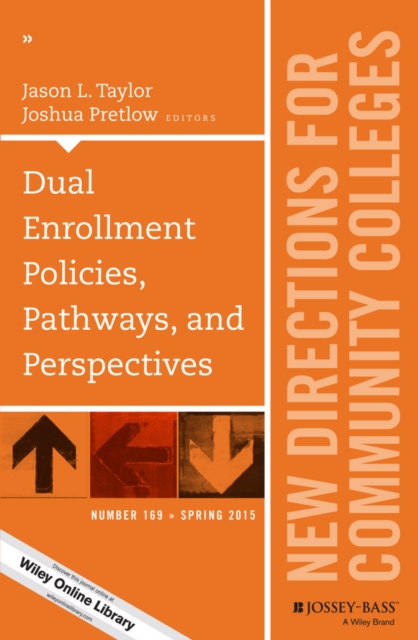
Dual enrollment policies, pathways, and perspectives
Looking to develop new dual enrollment programs or adapt and revamp an existing dual enrollment programs at a community college? This volume addresses the critical issues and topics of dual enrollment practices and policies, including: state policies that regulate dual enrollment practice and the influence of state policy on local practice, the usage of dual enrollment programs as a pathway for different populations of students such as career and technical education students and students historically underrepresented in higher education, and chapters that surface student, faculty, and high school stakeholder perspectives and that examine institutional and partnership performance and quality. This is the 169th volume of this Jossey-Bass quarterly report series. Essential to the professional libraries of presidents, vice presidents, deans, and other leaders in today's open-door institutions, New Directions for Community Colleges provides expert guidance in meeting the challenges of their distinctive and expanding educational mission.
eBook

Generation times in wild chimpanzees and gorillas suggest earlier divergence times in great ape and human evolution
Fossils and molecular data are two independent sources of information that should in principle provide consistent inferences of when evolutionary lineages diverged. Here we use an alternative approach to genetic inference of species split times in recent human and ape evolution that is independent of the fossil record. We first use genetic parentage information on a large number of wild chimpanzees and mountain gorillas to directly infer their average generation times. We then compare these generation time estimates with those of humans and apply recent estimates of the human mutation rate per generation to derive estimates of split times of great apes and humans that are independent of fossil calibration. We date the human–chimpanzee split to at least 7–8 million years and the population split between Neanderthals and modern humans to 400,000–800,000 y ago. This suggests that molecular divergence dates may not be in conflict with the attribution of 6- to 7-million-y-old fossils to the human lineage and 400,000-y-old fossils to the Neanderthal lineage.
Journal Article


College Acceleration for All? Mapping Racial Gaps in Advanced Placement and Dual Enrollment Participation
This article documents the patterns of White-Black and White-Hispanic enrollment gaps in Advanced Placement (AP) and Dual Enrollment (DE) programs across thousands of school districts in the United States by merging several data sources. We show that the vast majority of districts have racial enrollment gaps in both programs, with wider gaps in AP than DE. Results from fractional regression models indicate that geographic variations in these gaps can be by both local and state factors. We also find that district-level resources and state policies that provide greater access to AP and DE are also associated with wider racial enrollment gaps, implying that greater resources may engender racial disparity without adequate efforts to provide equitable access and support for minority students.
Journal Article
