
Catalogue Search | MBRL


Are you sure you want to remove the book from the shelf?

{{itemTitle}}
34
result(s) for
"Durango (State)"
Sort by:
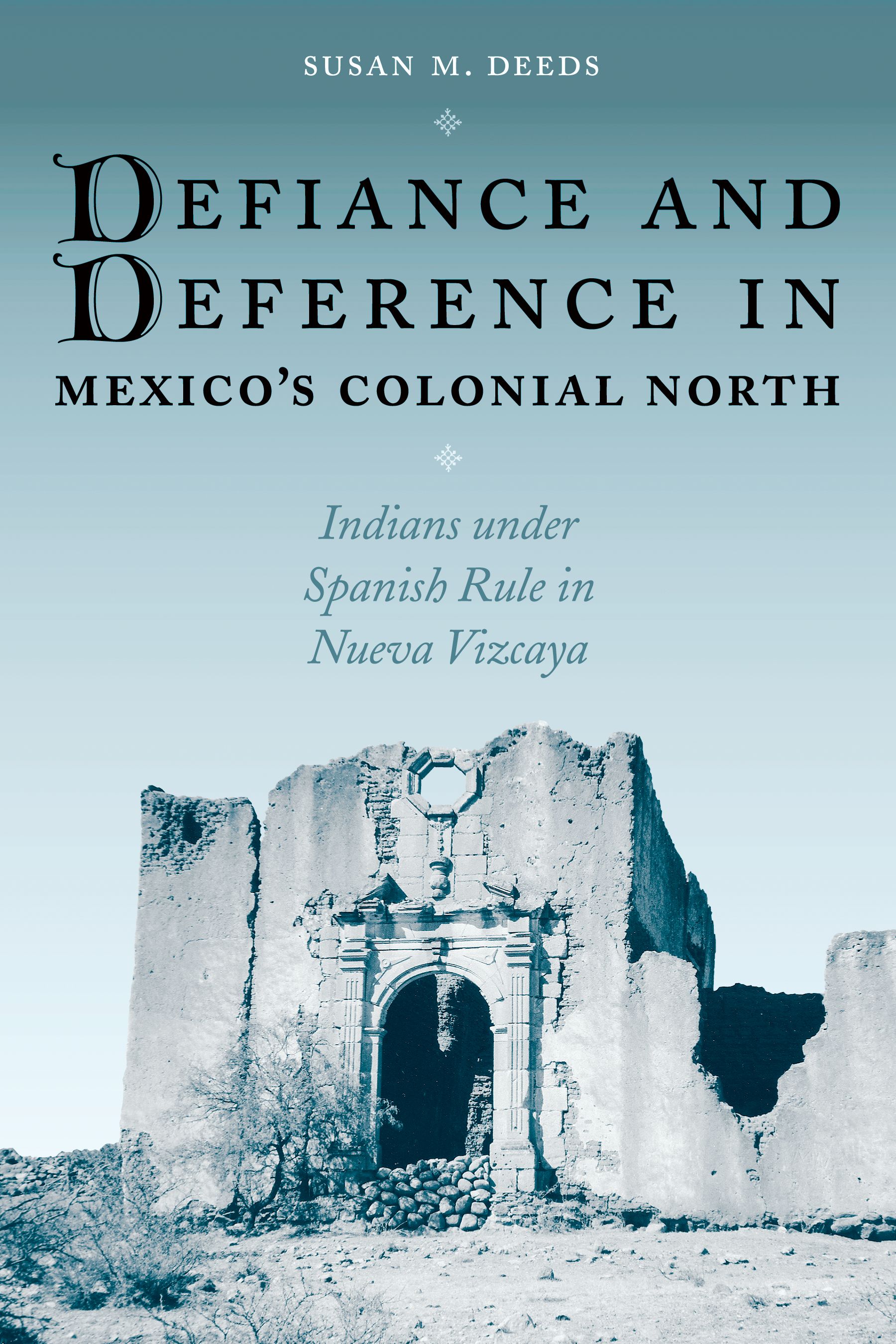
Defiance and Deference in Mexico's Colonial North
Thomas F. McGann Memorial Prize, Rocky Mountain Council on Latin American Studies, 2004 Southwest Book Award, Border Regional Library Association, 2003 In their efforts to impose colonial rule on Nueva Vizcaya from the sixteenth century to the middle of the seventeenth, Spaniards established missions among the principal Indian groups of present-day eastern Sinaloa, northern Durango, and southern Chihuahua, Mexico—the Xiximes, Acaxees, Conchos, Tepehuanes, and Tarahumaras. Yet, when the colonial era ended two centuries later, only the Tepehuanes and Tarahumaras remained as distinct peoples, the other groups having disappeared or blended into the emerging mestizo culture of the northern frontier. Why were these two indigenous peoples able to maintain their group identity under conditions of conquest, while the others could not? In this book, Susan Deeds constructs authoritative ethnohistories of the Xiximes, Acaxees, Conchos, Tepehuanes, and Tarahumaras to explain why only two of the five groups successfully resisted Spanish conquest and colonization. Drawing on extensive research in colonial-era archives, Deeds provides a multifaceted analysis of each group's past from the time the Spaniards first attempted to settle them in missions up to the middle of the eighteenth century, when secular pressures had wrought momentous changes. Her masterful explanations of how ethnic identities, subsistence patterns, cultural beliefs, and gender relations were forged and changed over time on Mexico's northern frontier offer important new ways of understanding the struggle between resistance and adaptation in which Mexico's indigenous peoples are still engaged, five centuries after the \"Spanish Conquest.\"
eBook

Defiance and deference in Mexico's colonial north : Indians under Spanish rule in Nueva Vizcaya
No detailed description available for \"Defiance and Deference in Mexico's Colonial North\".
eBook

First Record of Psorophora ferox In Durango State, Mexico
During August–November of 2018, mosquito collections were conducted with the intention of monitoring the presence of arboviruses in Durango State, Mexico. Species collected included Psorophora ( Janthinosoma ) ferox . In Mexico, 24 species of the genus Psorophora have been previously reported, whereas in the state of Durango, only 2 species have been reported: Psorophora ( Grabhamia ) columbiae and Ps . ( Gra .) signipennis . This is the 1st record of Ps. ferox and the subgenus Janthinosoma in Durango. With the addition of Ps. ferox to the list of mosquito species found in Durango, the number of mosquito species occurring in the state stands at 31.
Journal Article
Driving Factors for Forest Fire Occurrence in Durango State of Mexico:A Geospatial Perspective
Forest fire is one of the major causes of forest loss and therefore one of the main constraints for sustainable forest management worldwide.Identifying the driving factors and understanding the contribution of each factor are essential for the management of forest fire occurrence.The objective of this study is to identify variables that are spatially related to the occurrence and incidence of the forest fire in the State of Durango,Mexico.For this purpose,data from forest fire records for a five-year period were analyzed.The spatial correlations between forest fire occurrence and intensity of land use,susceptibility of vegetation,temperature,precipitation and slope were tested by Geographically Weighted Regression(GWR) method,under an Ordinary Least Square estimator.Results show that the spatial pattern of the forest fire in the study area is closely correlated with the intensity of land use,and land use change is one of the main explanatory variables.In addition,vegetation type and precipitation are also the main driving factors.The fitting model indicates obvious link between the variables.Forest fire was found to be the consequence of a particular combination of the environmental factors,and when these factors coexist with human activities,there is high probability of forest fire occurrence.Mandatory regulation of human activities is a key strategy for forest fire prevention.
Journal Article

Defiance and Deference in Mexico's Colonial North
In their efforts to impose colonial rule on Nueva Vizcaya from the sixteenth century to the middle of the seventeenth, Spaniards established missions among the principal Indian groups of present-day eastern Sinaloa, northern Durango, and southern Chihuahua, Mexico-the Xiximes, Acaxees, Conchos, Tepehuanes, and Tarahumaras. Yet, when the colonial era ended two centuries later, only the Tepehuanes and Tarahumaras remained as distinct peoples, the other groups having disappeared or blended into the emerging mestizo culture of the northern frontier. Why were these two indigenous peoples able to maintain their group identity under conditions of conquest, while the others could not?
In this book, Susan Deeds constructs authoritative ethnohistories of the Xiximes, Acaxees, Conchos, Tepehuanes, and Tarahumaras to explain why only two of the five groups successfully resisted Spanish conquest and colonization. Drawing on extensive research in colonial-era archives, Deeds provides a multifaceted analysis of each group's past from the time the Spaniards first attempted to settle them in missions up to the middle of the eighteenth century, when secular pressures had wrought momentous changes. Her masterful explanations of how ethnic identities, subsistence patterns, cultural beliefs, and gender relations were forged and changed over time on Mexico's northern frontier offer important new ways of understanding the struggle between resistance and adaptation in which Mexico's indigenous peoples are still engaged, five centuries after the \"Spanish Conquest.\"
eBook

Mejora de variables psicológicas en Adultos Mayores mediante Pilates (Improvement of psychological variables in Older Adults through Pilates)
En México, como en muchos países, ha aumentado considerablemente la población adulta mayor. Este incremento se puede explicar debido a mejores condiciones de vida en general, como una mejor alimentación y nuevos tipos de medicamentos. Por tal motivo, se cuenta con una población adulta mayor que es indispensable estudiar para ofrecerle una mayor independencia, autocuidado y mejor calidad de vida. El objetivo de esta investigación fue determinar el efecto de un programa de Pilates sobre variables psicológicas en adultos mayores del Estado de Durango, México. La metodología del estudio presenta un grupo experimental (GE) n=10 y un grupo control (GC) n=10, mediciones Pre-test y Post-test, la edad de los participantes estuvo entre 60 y 80 años. La duración del programa fue de 12 semanas, con una periodicidad de 3 veces por semana con sesiones de 50 min. Para evaluación de la variable dependiente se utilizó el instrumento WHOQOL BREF, y para el análisis se realizó ANOVA de 2 x 2. Como principales resultados se encontró una interacción significativa (p < 0.05) entre mediciones y grupos en las dimensiones de salud físicas, relaciones sociales, y aspectos psicológicos. Concluyendo que un programa de acondicionamiento físico de 12 semanas de duración basado en el método Pilates permite mejorar variables psicológicas, las cuales son relevantes para el logro de la buena salud en el adulto mayor. Abstract. In Mexico, as in many countries, the elderly population has increased considerably. This increase can be explained by better living conditions, such as better nutrition and new medications. The purpose of the study was to determine the effect of a Pilates program on psychological variables in older adults in the State of Durango, Mexico. The methodology included an experimental group (GE n=10) and a control group (GC n=10), and Pre- to Post-test measurements. The participant’s age was between 60 and 80 years. The program length was 12 weeks, where participants attended 50-min sessions, three times per week. Two-by two ANOVA was used to analyze data. The main results were a significant interaction (p < 0.05) between measurements and groups in physical health dimensions, social relationships, and psychological aspects. In conclusion, a 12-week fitness program based on the Pilates method elicits improvements on psychological variables, which are relevant for the achievement of good health in the elderly. Abstract. In Mexico, as in many countries, the elderly population has increased considerably. This increase can be explained by better living conditions, such as better nutrition and new medications. The purpose of the study was to determine the effect of a Pilates program on psychological variables in older adults in the State of Durango, Mexico. The methodology included an experimental group (GE n=10) and a control group (GC n=10), and Pre- to Post-test measurements. The participant’s age was between 60 and 80 years. The program length was 12 weeks, where participants attended 50-min sessions, three times per week. Two-by two ANOVA was used to analyze data. The main results were a significant interaction (p < 0.05) between measurements and groups in physical health dimensions, social relationships, and psychological aspects. In conclusion, a 12-week fitness program based on the Pilates method elicits improvements on psychological variables, which are relevant for the achievement of good health in the elderly. Resumo: No México, como em muitos países, a população idosa aumentou consideravelmente. Esse aumento pode ser explicado por melhores condições de vida em geral, como melhor alimentação e novos tipos de medicamentos. Por esse motivo, existe uma população idosa que é fundamental estudar para lhes oferecer maior independência, autocuidado e uma melhor qualidade de vida. O objetivo desta pesquisa foi determinar o efeito de um programa de Pilates sobre as variáveis psicológicas em idosos no estado de Durango, México. A metodologia do estudo apresenta um grupo experimental (GE) n = 10 e um grupo controle (GC) n = 10, medidas de pré-teste e pós-teste, a idade dos participantes estava entre 60 e 80 anos. A duração do programa foi de 12 semanas, com periodicidade de 3 vezes por semana com sessões de 50 min. Para avaliação da variável dependente foi utilizado o instrumento WHOQOL BREF, e para análise foi realizada ANOVA 2 x 2. Os principais resultados foram uma interação significativa (p <0,05) entre medidas e grupos nas dimensões saúde física, relações aspectos sociais e psicológicos. Concluindo que um programa de condicionamento físico de 12 semanas baseado no método Pilates permite melhorar variáveis psicológicas relevantes para o alcance de uma boa saúde do idoso.
Journal Article

Producing More with Less? Community Forestry in Durango, Mexico in an Era of Trade Liberalization
Through a qualitative case study of peasant‐organized forestry in Durango, Mexico, this paper examines how neoliberal policy reform is reshaping the community forestry sector. Post‐1992 agrarian and forestry laws facilitate the emergence of new forms of association in ejidos (collective property communities created by agrarian reform) and agrarian communities, and reorganize the delivery of forestry technical services. These developments indirectly undermine peasants' capacity to deal with the sector's long‐standing internal problems, putting at risk their ability to provide themselves with the services they need for sustainable community livelihoods and forest exploitation. Nevertheless, this study of a forest peasant federation shows that institutional change is a process peopled by groups of social agents who respond creatively to external structure from local organizational and community contexts. Ethnographic methods can be used fruitfully to study complex interactions between multiple levels of political‐economic structure and local action, which both constrain and provide opportunities for the organization of common‐pool resource management regimes.
Journal Article
Durango Locals Becoming Accustomed to Rampant Drug Cartel Violence Document Obtained from WikiLeaks
Reports on increasing drug-related violence in state of Durango, Mexico, including fighting between drug cartels and with police in streets and in prisons.
Government Document
Cartels Wrestle For Control of Durango Document Obtained from WikiLeaks
Reports on growing drug-related violence in state of Durango, Mexico, which local law-enforcement is not able to control, and on calls for military presence in region.
Government Document
Operation Condor I: Mexican Military's Anti-narcotics Campaign Latin America: Regional and Political Analysis; Attached to Cover Page and Table of Contents
Reports on difficulties faced by Mexico's Operation Condor military campaign to reduce drug trafficking in northwestern Mexico.
Government Document