
Catalogue Search | MBRL


Are you sure you want to remove the book from the shelf?

{{itemTitle}}
475
result(s) for
"Durrell, Lawrence"
Sort by:
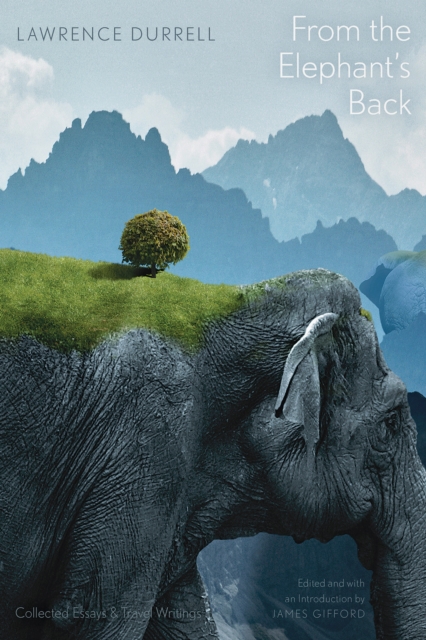
From the elephant's back : collected essays & travel writings
\".the proverb says that whoever sees the world from the back of an elephant learns the secrets of the jungle and becomes a seer. I had to be content to become a poet.\"-Lawrence DurrellBest known for his novels and travel writing, Lawrence Durrell defied easy classification within twentieth-century Modernism. His anti-authoritarian tendencies put him at odds with many contemporaries-aesthetically and politically. However, thanks to a compelling recontextualization by editor James Gifford, these thirty-eight previously unpublished and out-of-print essays and letters reveal that Durrell's maturation as an artist was rich, complex, and subtle. Durrell fans will treasure this selection of rare nonfiction, while scholars of Durrell, Modernist literature, anti-authoritarian artists, and the Personalist movement will also appreciate Gifford's fine editorial work.\"Gifford's scholarly command of the archives shows-especially his working intimacy with the unpublished archived words of Durrell's editors, publishers, and collaborators. I have no doubt that this collection will serve as a starting point for any number of new critical ventures into the life and writing of Lawrence Durrell.\"-Charles Sligh, University of Tennessee at Chattanooga
eBook

The Making of a Counter-Culture Icon
At first glance, the works of Fedor Dostoevsky (1821–1881) do not appear to have much in common with those of the controversial American writer Henry Miller (1891–1980). However, the influencer of Dostoevsky on Miller was, in fact, enormous and shaped the latter’s view of the world, of literature, and of his own writing. The Making of a Counter-Culture Icon examines the obsession that Miller and his contemporaries, the so-called Villa Seurat circle, had with Dostoevsky, and the impact that this obsession had on their own work.
Renowned for his psychological treatment of characters, Dostoevsky became a model for Miller, Lawrence Durrell, and Anais Nin, interested as they were in developing a new kind of writing that would move beyond staid literary conventions. Maria Bloshteyn argues that, as Dostoevsky was concerned with representing the individual’s perception of the self and the world, he became an archetype for Miller and the other members of the Villa Seurat circle, writers who were interested in precise psychological characterizations as well as intriguing narratives. Tracing the cross-cultural appropriation and (mis)interpretation of Dostoevsky’s methods and philosophies by Miller, Durrell, and Nin, The Making of a Counter-Culture Icon gives invaluable insight into the early careers of the Villa Seurat writers and testifies to Dostoevsky’s influence on twentieth-century literature.
eBook
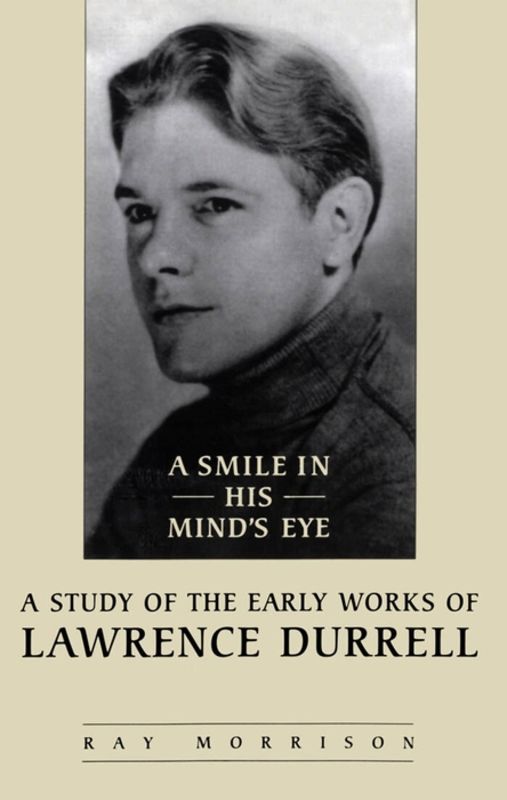
A Smile in His Mind's Eye
Lawrence Durrell (1912-1990), author ofThe Alexandra Quartet, was a writer with a foot in two worlds. His childhood in India and life in France and Greece provided him with an ability to absorb many traditions, all of which are evident in his work. Proficient in several forms of the written word - novels, poetry, travel writing, essays, drama - Durrell's best-known work fused Western notions of time and space with Eastern metaphysics.
Very little has been written about Durrell's work before the Second World War. WithA Smile in His Mind's Eye, Ray Morrison seeks to redress this neglect. While French symbolism and the writings of Remy de Gourmont and Arthur Schopenhauer were important to the development of Durrell's writing, it was his embrace of Taoism that truly illustrated a shift from a Western, patriarchal consciousness to that of an Eastern, feminine-centred one and marked Durrell's coming into his own as a writer.
In the years before Durrell's death, Morrison became a close acquaintance of the writer, givingA Smile in His Mind's Eyea personal element unseen in most other scholarly analyses. The work is essential to understanding one of the twentieth century's most original and eclectic minds.
eBook
Durrell re-read
Reading the twelve major novels of Lawrence Durrell, this study argues for their consideration as a single major project, an opus, marked by themes of liminality and betweenness. As major texts of mid-twentieth-century literature, repeatedly earning nominations for the Nobel Prize, Durrell's work has attracted renewed critical attention since his centenary in 2012. This study shows the thematic unity of the opus in five areas. First, by disrupting expectations of love and death and by fashioning plural narrators, works in the opus blend notions of the subject and the object. Second, in their use of metafictional elements, the texts present themselves as neither fiction nor reality. Third, their approach to place and identity offers something between the naturalistic and the human-centric. Fourth, though the texts' initial concerns are engaged with understanding the past and preparing for a future, they all resolve in something like the present. And fifth, though the novels reject many aspects of modernism, they reside nevertheless between the poles of modernism and postmodernism. Shared with other writers, including T.S. Eliot and Henry Miller, as early as the 1940s, Durrell's plans for his major works of fiction remained consistent through the publication of the last novel in 1985, and these plans show the need to consider the twelve major works as a unitary whole.
eBook
The stronger sex
The Stronger Sex, a study of the women in the fiction of Lawrence Durrell, argues that Lawrence Durrell envisioned a new woman, self-confident, free of male domination, and able to serve, direct, and protect her dependent man. Durrell's modern twentieth- /twenty-first-century woman is the center of what Durrell envisions as the new \"couple\"-woman dependent upon man for completion and man dependent upon the centrality of woman for the essential wisdom and direction and meaning in his life. Far from being a mere follower of D. H. Lawrence, as many have claimed, Durrell came to insist that man must first cede to woman both the personal and social power and freedom which he has throughout history denied her. Only in this way, suggests Durrell, can modern man both find himself and save himself and so discover and fulfill his own being. Thus, all of Durrell's women are the saviors of the lost men who must come to them for human completion. From the women of the early works, such as Panic Spring, The Pied Piper of Lovers, The Black Book, and The Dark Labyrinth, to the Justines, Melissas and Cleas of the Alexandria Quartet, the Benedictas and Iolanthes of The Revolt of Aphrodite, the Constances and Livias of The Avignon Quintet, and Cunegonde of Caesar's Vast Ghost-all of Durrell's lost and ever inadequate men must ultimately find themselves and the meaning of their lives in the women who complete them. Then, paradoxically, and only then, can these same men provide the security, direction, and protection for which their women so desperately search. Thus, in the \"couple\" both man and woman are completed in their mutual dependence and final self-discovery. The study refers often to the works of previous biographers of Lawrence Durrell: Ian MacNiven, Richard Pine, and Gordon Bowker.
eBook
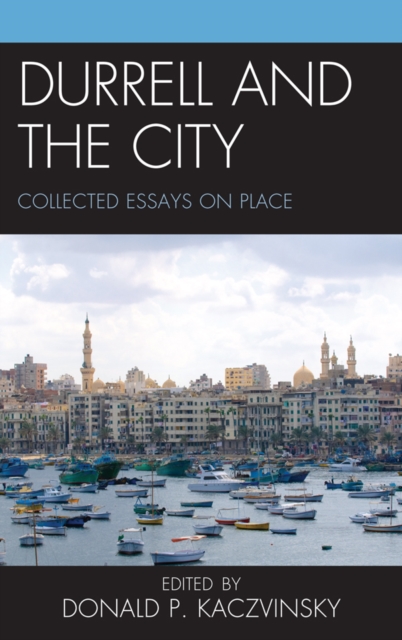
Durrell and the city
Durrell and the City commemorates the fiftieth anniversary of the publication of The Alexandria Quartet with a collection of fourteen new essays by a group of international scholars and critics. The collection provides a critical consideration of Durrell's urban landscapes, from the London of his early novels to Avignon during World War II in his last great series, while focusing on the place that made him famous—the city of Alexandria—in order to provide a reassessment of his career and achievement.
eBook

LAYERS OF THE PRIVATE EPITEXT: LAWRENCE DURRELL AND PATRICK LEIGH FERMOR'S CORRESPONDENCE
The paper aims at highlighting significant episodes from the lives of Lawrence Durrel and Patrick Leigh Fermor, as reflected in their correspondence. With a focus on their concern for the craft of writing, the paper also touches some of the major political issues of the time, in the years after WWII. The Cold War period is reffered to with letters from behind the Iron Curtain, from Patrick Leigh Fermor's first great love, the Romanian princess Balasha Cantacuzene.
Journal Article

Anarchist Transformations of English Surrealism: The Villa Seurat Network
This article traces the Villa Seurat's literary network and its neglected anarchist background in Henry Miller's influence and Lawrence Durrell's unrecognized anarchist affiliations. Miller and Durrell influenced an anarchist revision of the socialist and communist orthodoxy of Surrealism. Their anarchist views, which retained surrealist aesthetics, played a major role in the international development of English language Surrealism prior to and during World War II. It had an impact on poets as diverse as David Gascoyne, Henry Treece, Robert Duncan and Kenneth Rexroth.
Journal Article

CONSORTING WITH FAUST
Baldwin remembers Lawrence Durrell. Tunc was the first of Durrell's novels he bought. He read it during a woman-less long weekend staying in Lyme Regis and the psychologically and emotionally lonely Charlock struck a chord with him. Not content with a nearly complete set, at the suggestion of a friend, he wrote to Durrell asking him if he would let him have something to publish. And his dream come true. Durrell signed two special copies of the book he was publishing in a limited edition.
Journal Article