
Catalogue Search | MBRL


Are you sure you want to remove the book from the shelf?

{{itemTitle}}
12,125
result(s) for
"Dutch language"
Sort by:


Language, Literature and the Construction of a Dutch National Identity (1780-1830)
The final decades of the eighteenth and the first decades of the nineteenth century show the birth of a Dutch national identity. In this time of political upheavel (the battle between Patriots and Orangists, the French occupation years and the period of the United Kingdom of the Netherlands), the study of Dutch language and literature received an important impulse. Many scholars, such as Matthijs Siegenbeek, Johannes Henricus van der Palm, Johannes Kinker and Jan Frans Willems, made an effort to promote the study of Dutch language and culture, by writing studies, anthologies and essays. The study of the national language and literature was considered to be significant, not only for the Dutch sense of self-worth, but also for the recovery of the country, which was - according to many contemporaries declining. - Language, Literature and the Construction of a Dutch National Identity (1780-1830) discusses twelve founding fathers of newly developed cultural nationalism and their various efforts in the creation of a new national identity.
eBook

The syntax of Dutch
\"Dutch is a West-Germanic language closely related to English and German, but its special properties have long aroused interest and debate among students of syntax. This is an informative guide to the syntax of Dutch, offering an extensive survey of both the phenomena of Dutch syntax and their theoretical analyses over the years. In particular the book discusses those aspects of Dutch syntax that have played an important role in the development of syntactic theory in recent decades. Presupposing only a basic knowledge of syntax and complete with an extensive bibliography, this survey will be an important tool for students and linguists of all theoretical persuasions, and for anyone working in Germanic linguistics, linguistic typology and linguistic theory\"-- Provided by publisher.
Book

Qualitative-Quantitative Analyses of Dutch and Afrikaans Grammar and Lexicon
Sharing certain assumptions but differing in theory and practice, both Columbia School linguistics (CS) and Cognitive Grammar (CG) have increasingly supported their analyses with quantitative evidence. Citation of individual sentences, in isolation or in context, has been supplemented with counts of linguistic forms in texts, informant questionnaires, and perception tests. The present volume, continuing a dialogue between CS and CG, offers six such qualitative-quantitative studies, one on Afrikaans and five on Dutch. Topics include (a) demonstratives, (b) pragmatic particles and imperatives, (c) a puzzling \"dismissive\" idiom, (d) progressive aspect, and (e) indirect objects. While CS is better suited for analyzing relatively closed systems (e.g. tense, pronouns), CG provides more insight into the vagaries of the amorphous lexicon. The author also offers personal remarks on \"linguistics as a path\" and discusses how in one case a wrong prediction reflects his dual role as both linguist and student of Dutch as a foreign language.
eBook

The morphology of Dutch
This volume provides a detailed and comprehensive description of the morphological system of Dutch, and contributes to multiple current debates in linguistic theory. This second edition has been fully revised and updated throughout with expanded coverage, new results, and a new chapter on separable complex verbs.
Book
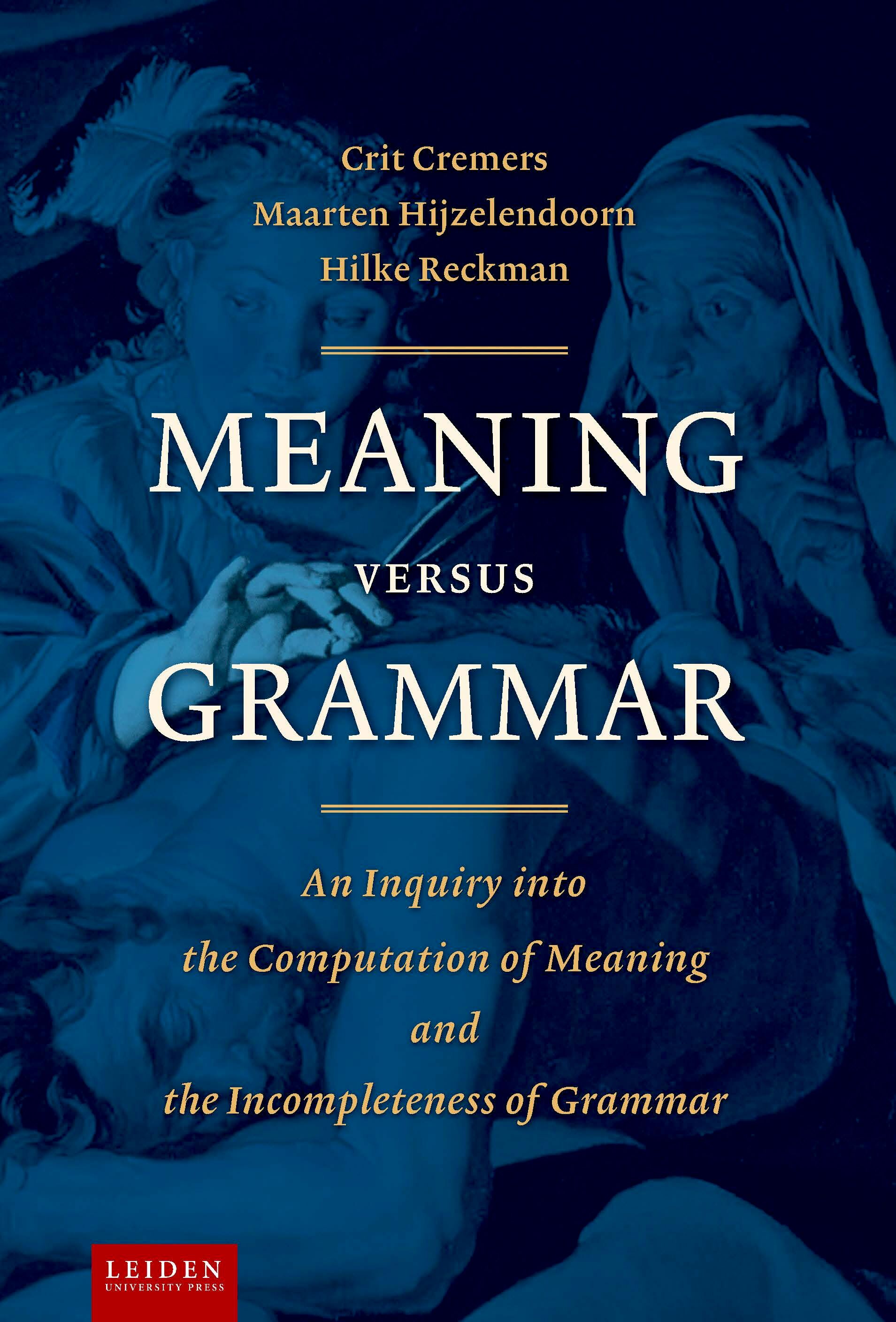
Meaning Versus Grammar
Meaning versus Grammar investigates the complicated relationship between grammar, computation, and meaning in natural languages. It details conditions under which meaning-driven processing of natural language is feasible, discusses an operational and accessible implementation of the grammatical cycle for Dutch, and offers analyses of a number of further conjectures about constituency and entailment in natural language.
eBook

The Dutch Language in Britain (1550-1702)
In The Dutch Language in Britain (1550-1702) Christopher Joby offers an account of the knowledge and use of Dutch in early modern Britain. Using extensive archive material from Britain and the Low Countries, Chris Joby demonstrates that Dutch was both written and spoken in a range of social domains including the church, work, learning, the home, diplomacy, the military and navy, and the court. Those who used the language included artisans and their families fleeing religious and economic turmoil on the continent; the Anglo-Dutch King, William III; and Englishmen such as the scientist Robert Hooke. Joby's account adds both to our knowledge of the use of Dutch in the early modern period and multilingualism in Britain at this time.
eBook


The phonetics of English and Dutch
This book provides a complete introductory course on the phonetics of English and Dutch based on an essentially practical approach to the subject. No previous knowledge of phonetics is assumed and all terms are explained in straightforward English as they are introduced. Theoretical and practical aspects of the subject are clarified for the student by means of numerous self-study exercises in articulation and transcription.The book contains a detailed contrastive description of British RP English and of Dutch (in both the Netherlands and Belgian standard varieties). In addition to a full description of the individual vowels and consonants, full attention is paid to features of connected speech, e.g. intonation, assimilation and elision, stress and articulatory setting. There are sections on sound-spelling relationships in English and an analysis of the commonest pronunciations errors in the English of Dutch-speakers. A guide to the technique of phonemic transcription is also provided, with numerous transcription passages for which correction keys are available.One chapter is devoted to differences between British and American pronunciation. Another section provides a survey of a range of British regional accents (e.g. Scottish, Irish, Welsh, Northern, London, Midlands, West Country).Now available with corrections incorporating the reactions of Dutch and Belgian users.
eBook