
Catalogue Search | MBRL


Are you sure you want to remove the book from the shelf?

{{itemTitle}}
939,349
result(s) for
"ECONOMIC STUDIES"
Sort by:

Southern engines of global growth
The volume explores how the southern engines, China, India, Brazil, and South Africa are reshaping the world economy. It looks at their development experiences, and examines how these could provide useful lessons to the developing world.
Book

Street vending in the neoliberal city
Examining street vending as a global, urban, and informalized practice found both in the Global North and Global South, this volume presents contributions from international scholars working in cities as diverse as Berlin, Dhaka, New York City, Los Angeles, Calcutta, Rio de Janeiro, and Mexico City. The aim of this global approach is to repudiate the assumption that street vending is usually carried out in the Southern hemisphere and to reveal how it also represents an essential—and constantly growing—economic practice in urban centers of the Global North. Although street vending activities vary due to local specificities, this anthology illustrates how these urban practices can also reveal global ties and developments.
eBook


Conflict, Crime, and the State in Postcommunist Eurasia
In the years after the collapse of the Soviet Union and its zone of influence, few insurgent groups had the resources necessary to confront regular armies. At the same time, state-sponsored financial support for insurgencies dramatically decreased. The pressing need to raise funds for war and the weakness of law enforcement in conflict zones create fertile conditions for organized crime; indeed, there is a mounting body of evidence correlating armed conflict and illicit economy, though the nature of this link and its impact on regional politics has not been well understood.Conflict, Crime, and the State in Postcommunist Eurasiaexplores the relationship between ideologically motivated insurgents, profit-motivated crime, and state institutions in eight conflict zones. Through detailed case studies, the contributors demonstrate how the operations and incentives of insurgents may emerge and shift over time: for some armed groups, crime can become an end in itself beyond a financial means, but not all armed groups equally adapt to illicit commerce. They also show how the criminalization of state institutions is a lingering concerns even after armed conflicts end.Conflict, Crime, and the State in Postcommunist Eurasiaplaces the case studies along a continuum of political and criminal behavior, examining the factors that motivate insurgents to seek out criminal alliance, how this connection affects the dynamics of conflict, and what risks remain during postconflict transition. These findings will provide a better understanding of the types of challenges likely to confront peacekeeping and statebuilding endeavors in other parts of the world.Contributors:Jana Arsovska, Svante Cornell, Johan Engvall, Michael Jonsson, Alexandru Molcean, Niklas Nilsson, Murad Batal al-Shishani, Natalie Verständig.
eBook


Anthropology, Economics, and Choice
In the midst of global recession, angry citizens and media pundits often offer simplistic theories about how bad decisions lead to crises. Many economists, however, base their analyses on rational choice theory, which assumes that decisions are made by well-informed, intelligent people who weigh risks, costs, and benefits. Taking a more realistic approach, the field of anthropology carefully looks at the underlying causes of choices at different times and places.
Using case studies of choices by farmers, artisans, and bureaucrats drawn from Michael Chibnik's research in Mexico, Peru, Belize, and the United States,Anthropology, Economics, and Choicepresents a clear-eyed perspective on human actions and their economic consequences. Five key issues are explored in-depth: choices between paid and unpaid work; ways people deal with risk and uncertainty; how individuals decide whether to cooperate; the extent to which households can be regarded as decision-making units; and the \"tragedy of the commons,\" the theory that social chaos may result from unrestricted access to commonly owned property.
Both an accessible primer and an innovative exploration of economic anthropology, this interdisciplinary work brings fresh insight to a timely topic.
eBook


Why some development works
An essential framework for assessing success in international development, challenging how we view fragile states, conflict zones, and the ability of international agencies to take effective action.
Book

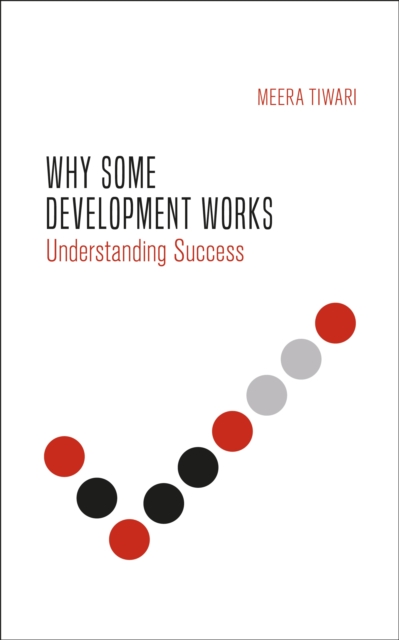
Why Some Development Works
Why do some development projects succeed where others fail? This book looks at some macro and some less known micro success stories and considers what enabled them to bring change in some of the world's most deprived communities. Using case studies from ten countries across Latin America, Africa, and Asia, Tiwari's innovative approach offers a multi-layered understanding of poverty which provides insights into causal, enabling and impeding factors. While a macro level analysis of development is a common feature of the current literature, there has been little attempt to develop a micro level understanding of development at the grassroots.Tiwari's work fills this important gap while drawing attention to the importance of engaging local actors at an individual, collective, and state level, demonstrating how achieving a \"convergence\" of goals among all actors is a crucial component to a development project's success.Looking beyond the case studies to consider how this unique \"convergence framework\" might be usefully applied to other contexts, the book has profound implications for how we view fragile states and conflict zones, and the ability of the international agencies to take effective action. A unique study based on extensive empirical research, Why Some Development Works will make essential reading for students and researchers studying international development across the social sciences, as well as humanitarian and development practitioners and policy makers.
eBook