
Catalogue Search | MBRL


Are you sure you want to remove the book from the shelf?

{{itemTitle}}
356
result(s) for
"ECONOMICSnetBASE"
Sort by:
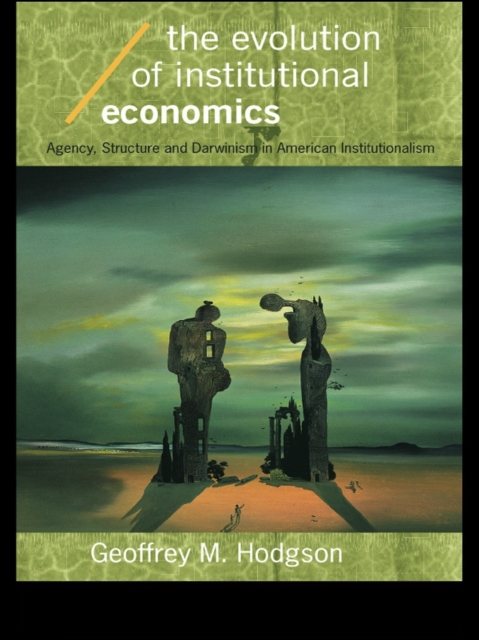
The Evolution of Institutional Economics
This exciting new book from Geoffrey Hodgson is eagerly awaited by social scientists from many different backgrounds. This book charts the rise, fall and renewal of institutional economics in the critical, analytical and readable style that Hodgson's fans have come to know and love, and that a new generation of readers will surely come to appreciate.
eBook
Foundations of Entrepreneurship and Economic Development
This well-written book is the first to deal with entrepreneurship in all its aspects. It considers the economic, psychological, political, legal and cultural dimensions of entrepreneurship from a market-process perspective. David A Harper has produced a volume that analyses why some people are quicker than others in discovering profit opportunities. Importantly, the book also covers the issue of how cultural value systems orient entrepreneurial vision and, in contrast to conventional wisdom, the book argues that individualist cultural values are not categorically superior to group oriented values in terms of their consequences for entrepreneurial discovery.
1. Introduction 2. The Theory of Entrepreneurial Discovery 3. Psychological Determinants of Entrepreneurial Alertness 4. Institutions I: Rule of Law, Property and Contract 5. Institutions II: Money, Political and Legal Decentralisation and Freedom 6. Cultures and Alertness 7. The Market-Process Approach to Public Policy 8. Empirical Testing and Conceptual Development 9. Concluding Remarks
David A. Harper is Associate Professor in the Department of Economics, New York University, USA
eBook

Involuntary Unemployment
The Great Depression of the 1930s with its dramatic unemployment rates was one of the most striking economic events of the past century. It shook economists' beliefs in the existence of self-adjusting forces and prompted Keynes to write his masterwork, The General Theory of Employment, Interest and Money.
Involuntary unemployment was the central concept of Keynes' book. However, after having been considered the sine qua non of economics for decades, it has gradually disappeared from textbooks and research. This book recounts and ponders this demise, asking whether the abandonment of the concept of involuntary unemployment is the manifestation of some inner defect of recent economic theory or is rather due to some intrinsic weakness of the concept itself, which makes it of little use when it comes to economic theorising.
In order to disentangle these issues, the author critically reviews the different explanations of involuntary unemployment that have been offered from Keynes up to the end of the 1980s. After consideringThe General Theory, the author studies the works of pioneering macroeconomists such as Hicks, Modigliani, Lange, Leontief, Tobin, Klein and Hansen. An examination of the 're-appraisal of Keynes' and of the so-called disequilibrium school is followed by a discussion of Friedman's and Lucas' anti-Keynesian attack. The final part of the book investigates a series of models purporting to revive the Keynesian project, namely implicit contract, efficiency wages, insider-outsider, coordination failures, and imperfect competition.
Michel De Vroey is Professor of Economics at the Université catholique de Louvain (Belgium). His main research interest is the history of macroeconomics. He has held visiting positions at the Université de Paris, Panthéon-Sorbonne, Duke University and the Université de Montréal. He has published articles in Economics and Philosophy, The Cambridge Journal of Economics and in the main history of economic thought journals.
eBook

Beyond Positivism
Since its publication in 1982, Beyond Positivism has become established as one of the definitive statements on economic methodology. The book’s rejection of positivism and its advocacy of pluralism were to have a profound influence in the flowering of work methodology that has taken place in economics in the decade since its publication. This edition contains a new preface outlining the major developments in the area since the book’s first appearance.
The book provides the first comprehensive treatment of twentieth century philosophy of science which emphasizes the issues relevant to economics. It proceeds to demonstrate this relevance by reviewing some of the key debates in the area. Having concluded that positivism has to be rejected, the author examines possible alternative bases for economic methodology. Arguing that there is no best method, he advocates methodological pluralism.
Bruce Caldwell is Research professor of Economics and Director of the Centre for the History of Political Economy, duke University, USA
eBook

Capitalism, Socialism and Democracy
Capitalism, Socialism and Democracy remains one of the greatest works of social theory written this century. When it first appeared the New English Weekly predicted that `for the next five to ten years it will cetainly remain a work with which no one who professes any degree of information on sociology or economics can afford to be unacquainted.' Fifty years on, this prediction seems a little understated.Why has the work endured so well? Schumpeter's contention that the seeds of capitalism's decline were internal, and his equal and opposite hostility to centralist socialism have perplexed, engaged and infuriated readers since the book's publication. By refusing to become an advocate for either position Schumpeter was able both to make his own great and original contribution and to clear the way for a more balanced consideration of the most important social movements of his and our time.
eBook

The Political Economy of Global Sports Organisations
At the global level, sport is ruled by a set of organizations including giants such as the IOC (Olympics), FIFA (soccer), and the IAAF (athletics) as well as sporting minnows such as the World Armsport Federation (armwrestling). Many of these bodies have been surrounded by controversy during their histories, after having to adjust to the realities of commercial sport. This important book analyzes the evolution of modern sport, examining the ways in which sporting organisations have adapted over the years to accommodate changing environments. Themes covered in this impressive volume include: * sources of sports revenue * organising global sporting events such as the Rugby World Cup * differences and similarities between global sporting organisations Forster and Pope have created an important book, which seriously analyzes sports organizations from a political economy vantage point for the first time. Of interest to students and academics studying the economics of sport, the book is also written in a style that makes it accessible for those with a general interest as well as for global sporting bodies themselves.
1. Global Sport Organisations: Ringmasters or Alphabet Boys? 2. A Product of History: The Creation and Evolution of Global Sports Organisations 3. The Economic Approach to Sport 4. Sources of Sport Revenue 5. Going for Gold: Global Sport Events 6. Architectures of Control: Structure and Process in the GSOs 7. For the Good of the Game: GSO Opacity and a Public Interest 8. Getting on with the Neighbours: The External Relationships of Global Sports Organisations by osvaldo Croci 9. Yielding Place to the New 10. Postscript
John Forster is Senior Lecturer in the School of Economics at Griffith University, Australia. Nigel K.L. Pope is Senior Lecturer in the School of Marketing at Griffith University, Australia.
eBook

Working time around the world : trends in working hours, laws and policies in a global comparative perspective
First Published in 2007.Lee, McCann and Messenger trace the theoretical background of the concept of working time before examining recent trends in working time laws in developing countries and countries in transition.
eBook

Knut Wicksell
Knut Wicksell made enormous contributions to capital theory, monetary theory and fiscal policy. However whilst his books are widely available in English, few of his more than 800 articles have ever been translated. This volume includes new translations of Wicksell's contributions to marginalism and capital theory; public economics and unemployment.
eBook
The Changing Capital Markets of East Asia
In recent years much attention has been given to the unparalleled economic development of East Asia. In The Changing Capital Markets of East Asia the contributors look at the growing sophistication of capital markets in this area and discuss the possible economic and political consequences. The theme of the book is more strategic than technical and the work does not confine itself to a basic market analysis. The Changing Capital Markets of East Asia presents a valuable guide for all those interested in what causes and determines change in the private and public finance spheres.
eBook

From Political Economy to Economics
Economics has become a monolithic science, variously described as formalistic and autistic with neoclassical orthodoxy reigning supreme. So argue Dimitris Milonakis and Ben Fine in this new major work of critical recollection. The authors show how economics was once rich, diverse, multidimensional and pluralistic, and unravel the processes that lead to orthodoxy's current predicament. The book details how political economy became economics through the desocialisation and the dehistoricisation of the dismal science, accompanied by the separation of economics from the other social sciences, especially economic history and sociology. It is argued that recent attempts from within economics to address the social and the historical have failed to acknowledge long standing debates amongst economists, historians and other social scientists. This has resulted in an impoverished historical and social content within mainstream economics.
The book ranges over the shifting role of the historical and the social in economic theory, the shifting boundaries between the economic and the non-economic, all within a methodological context. Schools of thought and individuals, that have been neglected or marginalised, are treated in full, including classical political economy and Marx, the German and British historical schools, American institutionalism, Weber and Schumpeter and their programme of Socialökonomik, and the Austrian school. At the same time, developments within the mainstream tradition from marginalism through Marshall and Keynes to general equilibrium theory are also scrutinised, and the clashes between the various camps from the famous Methodenstreit to the fierce debates of the 1930s and beyond brought to the fore.
The prime rationale underpinning this account drawn from the past is to put the case for political economy back on the agenda. This is done by treating economics as a social science once again, rather than as a posit
eBook