
Catalogue Search | MBRL


Are you sure you want to remove the book from the shelf?

{{itemTitle}}
1,257
result(s) for
"ECOSISTEMA"
Sort by:

Ecosystem Services as a Common Language for Coastal Ecosystem-Based Management
Ecosystem-based management is logistically and politically challenging because ecosystems are inherently complex and management decisions affect a multitude of groups. Coastal ecosystems, which lie at the interface between marine and terrestrial ecosystems and provide an array of ecosystem services to different groups, aptly illustrate these challenges. Successful ecosystem-based management of coastal ecosystems requires incorporating scientific information and the knowledge and views of interested parties into the decision-making process. Estimating the provision of ecosystem services under alternative management schemes offers a systematic way to incorporate biogeophysical and socioeconomic information and the views of individuals and groups in the policy and management process. Employing ecosystem services as a common language to improve the process of ecosystem-based management presents both benefits and difficulties. Benefits include a transparent method for assessing trade-offs associated with management alternatives, a common set of facts and common currency on which to base negotiations, and improved communication among groups with competing interests or differing worldviews. Yet challenges to this approach remain, including predicting how human interventions will affect ecosystems, how such changes will affect the provision of ecosystem services, and how changes in service provision will affect the welfare of different groups in society. In a case study from Puget Sound, Washington, we illustrate the potential of applying ecosystem services as a common language for ecosystem-based management.
Journal Article
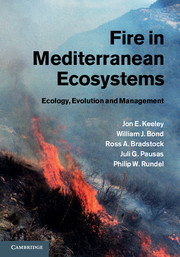
Fire in Mediterranean Ecosystems
Exploring the role of fire in each of the five Mediterranean-type climate ecosystems, this book offers a unique view of the evolution of fire-adapted traits and the role of fire in shaping Earth's ecosystems. Analyzing these geographically separate but ecologically convergent ecosystems provides key tools for understanding fire regime diversity and its role in the assembly and evolutionary convergence of ecosystems. Topics covered include regional patterns, the ecological role of wildfires, the evolution of species within those systems, and the ways in which societies have adapted to living in fire-prone environments. Outlining complex processes clearly and methodically, the discussion challenges the belief that climate and soils alone can explain the global distribution and assembly of plant communities. An ideal research tool for graduates and researchers, this study provides valuable insights into fire management and the requirements for regionally tailored approaches to fire management across the globe.
eBook
Evaluating and Ranking the Vulnerability of Global Marine Ecosystems to Anthropogenic Threats
Marine ecosystems are threatened by a suite of anthropogenic stressors. Mitigating multiple threats is a daunting task, particularly when funding constraints limit the number of threats that can be addressed. Threats are typically assessed and prioritized via expert opinion workshops that often leave no record of the rationale for decisions, making it difficult to update recommendations with new information. We devised a transparent, repeatable, and modifiable method for collecting expert opinion that describes and documents how threats affect marine ecosystems. Experts were asked to assess the functional impact, scale, and frequency of a threat to an ecosystem; the resistance and recovery time of an ecosystem to a threat; and the certainty of these estimates. To quantify impacts of 38 distinct anthropogenic threats on 23 marine ecosystems, we surveyed 135 experts from 19 different countries. Survey results showed that all ecosystems are threatened by at least nine threats and that nine ecosystems are threatened by >90% of existing threats. The greatest threats (highest impact scores) were increasing sea temperature, demersal destructive fishing, and point-source organic pollution. Rocky reef, coral reef, hard-shelf, mangrove, and offshore epipelagic ecosystems were identified as the most threatened. These general results, however, may be partly influenced by the specific expertise and geography of respondents, and should be interpreted with caution. This approach to threat analysis can identify the greatest threats (globally or locally), most widespread threats, most (or least) sensitive ecosystems, most (or least) threatened ecosystems, and other metrics of conservation value. Additionally, it can be easily modified, updated as new data become available, and scaled to local or regional settings, which would facilitate informed and transparent conservation priority setting.
Journal Article
Summoning compassion to address the challenges of conservation
Conservation practice is informed by science, but it also reflects ethical beliefs about how humanity ought to value and interact with Earth's biota. As human activities continue to drive extinctions and diminish critical life-sustaining ecosystem processes, achieving conservation goals becomes increasingly urgent. However, the determination to react decisively can drive conservationists to handle complex challenges without due deliberation, particularly when wildlife individuals are sacrificedfor the so-called greater good of wildlife collectives (populations, species, ecosystems). With growing recognition of the widespread sentience and sapience of many nonhuman animals, standard conservation practices that categorically prioritize collectives without due consideration for the well-being of individuals are ethically untenable. Here we highlight 3 overarching ethical orientations characterizing current and historical practices in conservation that suppress compassion: instrumentalism, collectivism, and nativism. We examine how establishing a commitment to compassion could reorient conservation in more ethically expansive directions that incorporate recognition of the intrinsic value of wildlife, the sentience of nonhuman animals, and the values of novel ecosystems, introduced species, and their members. A compassionate conservation approach allays practices that intentionally and unnecessarily harm wildlife individuals, while aligning with critical conservation goals. Although the urgency of achieving effective outcomes for solving major conservation problems may enhance the appeal of quick and harsh measures, the costs are too high. Continuing to justify moral indifference when causing the suffering of wildlife individuals, particularly those who possess sophisticated capacities for emotion, consciousness, and sociality, risks estranging conservation practice from prevailing, and appropriate, social values. As conservationists and compassionate beings, we must demonstrate concern for both the long-term persistence of collectives and the well-being of individuals by prioritizing strategies that do both. La práctica de la conservación recibe información por parte de la ciencia, pero también refleja las creencias éticas sobre cómo la humanidad debe de valorar e interactuar con la biota de la Tierra. Conforme las actividades humanas continúan causando las extinciones y disminuyendo los procesos ambientales de suma importancia para el soporte de la vida, alcanzar los objetivos de conservación se vuelve cada vez más urgente. Sin embargo, la determinación para reaccionar de manera decisiva puede llevar a los conservacionistas a tratar con retos complejos sin la deliberación apropiada, particularmente cuando se sacrifican ejemplares faunísticospor el llamado bien mayor de los colectivos faunísticos (poblaciones, especies, ecosistemas). Con el creciente reconocimiento de la gran sensibilidad y sapiencia de muchos animales no humanos, las prácticas estandarizadas de conservación que priorizan categóricamente los colectivos sin la consideración debida para el bienestar de los individuos son insostenibles éticamente. En este artículo resaltamos tres orientaciones dominantes que caracterizan las prácticas actuales e históricas dentro de la conservación que suprimen la compasión: el instrumentalismo, el colectivismo y el nativismo. Examinamos cómo el establecimiento de un compromiso con la compasión puede reorientar a la conservación hacia direcciones más expansivas éticamente que incorporen el reconocimiento del valor intrínseco de la fauna, la sensibilidad de los animales no humanos y los valores de los ecosistemas novedosos, las especies introducidas y sus integrantes. Una estrategia compasiva de conservación apacigua lasprácticas que dañan intencionalmente e innecesariamente a los ejemplares faunísticos, mientras se alinea con los objetivos críticos de conservación. Aunque la urgencia por alcanzar los resultados efectivos para la resolución de los problemas de conservación más importantes puede aumentar el atractivo de las medidas rápidas y rigurosas, los costos son muy elevados. Si se continúa justificando la indiferencia moral cuando se causa sufrimiento a los ejemplares faunísticos, particularmente a aquellos que poseen capacidades sofisticadas para las emociones, la conciencia, y la sociabilidad, se corre el riesgo de distanciar la práctica de la conservación de los valores sociales persistentes y apropiados. Como conservacionistas y seres compasivos, debemos mostrar preocupación tanto por la persistencia a largo plazo de los colectivos como por el bienestar de los individuos alpriorizar estrategias que permitan cumplir ambos objetivos. 保护实践建立在科学知识上,但也反映着人类如何看待地球上的生物并与之相处的伦理观念。随着人类 活动不断导致物种灭绝以及维持生命的重要生态系统过程减少,实现保护目标越来越迫在 睫。然而,果断行 动的决心可能使保护主义者在考虑不周的情况下处理复杂的挑故,特别是当面临野生生物 体要为所谓的集合 体麵ヽ物# 、生态系统> 的利益而牺牲个体利益的情况时。现在已有越来越多的人意识到 多非人动物也 普遍具有感知能力和智慧,因此对个体福祉不加考虑而优先保护集合体的传统标准的保护 践在伦理上是站不 住脚的。本文重点讨论了当下和历史上漠视个体福祉的保护实践中三种主要的伦理取向: 工 主义、集体主义 和本土主义。我们研究了同情心的投入如何将保护重新导向到更具有伦理价值的方向,它 含了对野生生物内 在价值、非人动物的感知能力以及新生生态系统、引入种及其成员的价值的认识。富有同 心的保护方法可 以减少有意或不必要地伤害野生生物个体的行为,同时也与关键保护目标一致。尽管取得 决重大保护问题的 有效成果的紧迫性加强了人们对采取快速、严厉的措施的诉求,但这样做的代价过高。继 为伤害野生动物个 体(特別是那些富有情感、意识、社会性的个体) 的道德冷漠开脱,就要承担使保护实践背离主流的、恰当的社 会价值观的风险。作为保护主义者和具有同情心的人类,我们必须同时关心集合体的长期 存和个体的福祉,采 取兼顾二者的保护策略。
Journal Article
Establishing IUCN Red List Criteria for Threatened Ecosystems
The potential for conservation of individual species has been greatly advanced by the International Union for Conservation of Nature's (IUCN) development of objective, repeatable, and transparent criteria for assessing extinction risk that explicitly separate risk assessment from priority setting. At the IV World Conservation Congress in 2008, the process began to develop and implement comparable global standards for ecosystems. A working group established by the IUCN has begun formulating a system of quantitative categories and criteria, analogous to those used for species, for assigning levels of threat to ecosystems at local, regional, and global levels. A final system will require definitions of ecosystems; quantification of ecosystem status; identification of the stages of degradation and loss of ecosystems; proxy measures of risk (criteria); classification thresholds for these criteria; and standardized methods for performing assessments. The system will need to reflect the degree and rate of change in an ecosystem's extent, composition, structure, and function, and have its conceptual roots in ecological theory and empirical research. On the basis of these requirements and the hypothesis that ecosystem risk is a function of the risk of its component species, we propose a set of four criteria: recent declines in distribution or ecological function, historical total loss in distribution or ecological function, small distribution combined with decline, or very small distribution. Most work has focused on terrestrial ecosystems, but comparable thresholds and criteria for freshwater and marine ecosystems are also needed. These are the first steps in an international consultation process that will lead to a unified proposal to be presented at the next World Conservation Congress in 2012.
Journal Article

Natural Capital
In 2005, The Millennium Ecosystem Assessment provided the first global assessment of the world’s ecosystems and ecosystem services. It concluded that recent trends in ecosystem change threatened human well-being due to declining ecosystem services, a bleak prophecy which has galvanized conservation organizations, ecologists, and economists to work towards rigorous valuations of ecosystem services at a spatial scale and with a resolution that can inform public policy. This book provides an intensive and technical analysis of ecosystem services to date. A key idea which guides the science is that the modelling and valuation approaches being developed should use data which are readily available around the world. In addition, the book documents a toolbox of ecosystem service mapping, modelling, and valuation models that both The Nature Conservancy and the World Wide Fund for Nature are beginning to apply around the world as they transform conservation from a biodiversity-only to a people and ecosystem services agenda. The book addresses land, freshwater, and marine systems at a variety of spatial scales, and includes discussion of how to treat both climate change and cultural values when examining tradeoffs among ecosystem services.
eBook

Proposta de um modelo teórico para oportunidades de pesquisa e inovação em ensino de empreendedorismo
Entrepreneurship education has drawn the attention of many researchers, who aim to better understand and explain the phenomenon in universities and their innovation ecosystems. Although the research field of entrepreneurship education has advanced, there are still many aspects to be explored, such as the outcomes from university initiatives, evaluating the effectiveness of teaching and learning methods and practices, access and results of Entrepreneurship Support, development of the entrepreneurial ecosystem, professor qualification, classroom and experimental learning, and students’ view. This paper brings a new perspective, both for research and management of entrepreneurial initiatives, showing the need for a more holistic and integrated view of entrepreneurship education with other areas, such as entrepreneurship support at the university, entrepreneurship ecosystem, and the entrepreneurial process. From an extensive literature review, we suggest a theoretical framework for research on entrepreneurship education and entrepreneurial university.
O ensino do empreendedorismo tem atraído a atenção de diversos pesquisadores, com o objetivo de compreender e explicar esse fenômeno nas universidades e seus ecossistemas de inovação. Embora o campo de pesquisa em ensino de empreendedorismo tenha avançado, ainda há muitos aspectos que precisam ser explorados, como os resultados gerados pelas iniciativas universitárias, avaliação da eficácia dos métodos e práticas de ensino e aprendizagem, acesso e resultados do apoio ao empreendedorismo, desenvolvimento do ecossistema empreendedor, formação de professores, aprendizado em sala de aula e experiencial, e perspectivas dos estudantes. Este trabalho tem como objetivo trazer uma nova perspectiva, tanto para a pesquisa quanto para a gestão de iniciativas empreendedoras, apontando a necessidade de uma visão mais holística e integrada do ensino de empreendedorismo com outras áreas, como apoio ao empreendedorismo, ecossistema e processo empreendedor. O resultado da revisão da literatura é uma proposta de modelo teórico para a pesquisa em ensino de empreendedorismo e universidade empreendedora.
La enseñanza para el emprendimiento ha atraído la atención de diversos investigadores, que buscan comprender y explicar el fenómeno en las universidades y sus ecosistemas de innovación. Aunque el campo de investigación de la enseñanza para el emprendimiento ha avanzado, todavía hay muchos aspectos que deben ser explorados, como los resultados de las iniciativas universitarias, la evaluación de la efectividad de los métodos y prácticas de enseñanza y aprendizaje, el acceso y los resultados del apoyo al emprendimiento, el desarrollo del ecosistema emprendedor, la formación de docentes, el aprendizaje en el aula y experiencial, y las perspectivas de los estudiantes. Este artículo aporta una nueva perspectiva, tanto para la investigación como para la gestión de iniciativas emprendedoras, señalando la necesidad de una visión más holística e integrada de la enseñanza emprendedora con otras áreas, como apoyo al emprendimiento, y ecosistema y proceso emprendedores. El resultado de la revisión de la literatura es una propuesta de marco teórico para la investigación sobre enseñanza para el emprendimiento y universidad emprendedora.
Journal Article
China's endemic vertebrates sheltering under the protective umbrella of the giant panda
The giant panda attracts disproportionate conservation resources. How well does this emphasis protect other endemic species? Detailed data on geographical ranges are not available for plants or invertebrates, so we restrict our analyses to 3 vertebrate taxa: birds, mammals, and amphibians. There are gaps in their protection, and we recommend practical actions to fill them. We identified patterns of species richness, then identified which species are endemic to China, and then which, like the panda, live in forests. After refining each species' range by its known elevational range and remaining forest habitats as determined from remote sensing, we identified the top 5% richest areas as the centers of endemism. Southern mountains, especially the eastern Hengduan Mountains, were centers for all 3 taxa. Over 96% of the panda habitat overlapped the endemic centers. Thus, investing in almost any panda habitat will benefit many other endemics. Existing panda national nature reserves cover all but one of the endemic species that overlap with the panda's distribution. Of particular interest are 14 mammal, 20 bird, and 82 amphibian species that are inadequately protected. Most of these species the International Union for Conservation of Nature currently deems threatened. But 7 mammal, 3 bird, and 20 amphibian species are currently nonthreatened, yet their geographical ranges are <20,000 km² after accounting for elevational restriction and remaining habitats. These species concentrate mainly in Sichuan, Yunnan, Nan Mountains, and Hainan. There is a high concentration in the east Daxiang and Xiaoxiang Mountains of Sichuan, where pandas are absent and where there are no national nature reserves. The others concentrate in Yunnan, Nan Mountains, and Hainan. Here, 10 prefectures might establish new protected areas or upgrade local nature reserves to national status.
Journal Article

Ciencias sociales y comunicación en diálogo: transformaciones y retos desde la experiencia mexicana
El artículo examina la transformación contemporánea de las ciencias de la comunicación desde una perspectiva histórica, posdisciplinar e interseccional; reconstruye el campo articulando los aportes clásicos de Jürgen Habermas sobre la esfera pública, los estudios funcionalistas y de audiencia de Paul Lazarsfeld, la crítica cultural de la Escuela de Birmingham y la semiótica estructural, para mostrar cómo la comunicación siempre ha sido un espacio de tensiones teóricas más que una disciplina cerrada. Retoma la propuesta de Silvio Waisbord sobre la comunicación como “postdisciplina” y dialoga con las nociones de mediación y cultura híbrida desarrolladas por Jesús Martín-Barbero y Néstor García Canclini. A partir de los informes globales del usc Annenberg y del Reuters Institute, analiza fenómenos como la convergencia mediática, la inteligencia artificial, la desinformación y la polarización digital. Finalmente, vincula estas tendencias con la producción académica reciente de la fcpys de la unam, destacando que sus líneas de investigación —desde industrias culturales hasta juventudes digitales— reflejan los desafíos de un ecosistema comunicativo algorítmico, fragmentado y profundamente desigual. This article offers a comprehensive examination of the contemporary transformation of communication studies from a historical, post-disciplinary, and interdisciplinary perspective. It traces the evolution of the field by weaving together Jürgen Habermas’s reflections on the public sphere, Paul Lazarsfeld’s audience research, the cultural analyses of the Birmingham School, and structuralist approaches to meaning-making. Drawing on Silvio Waisbord’s notion of communication as a “post-discipline” and the concepts of mediation and cultural hybridization formulated by Jesús Martín-Barbero and Néstor García Canclini, the article positions communication as a field defined by epistemological tensions rather than by disciplinary closure. Engaging with global assessments from usc Annenberg and the Reuters Institute, it highlights the centrality of technological convergence, artificial intelligence, disinformation, and digital polarization. The article concludes by mapping these global dynamics onto the academic production of the fcpys, arguing that its research agendas—ranging from digital cultures to creative industries—reflect the challenges of an increasingly algorithmic, fragmented, and unequal communication ecosystem.
Journal Article

Linking human well-being and jellyfish: ecosystem services, impacts, and societal responses
Jellyfish are usually perceived as harmful to humans and are seen as \"pests\". This negative perception has hindered knowledge regarding their value in terms of ecosystem services. As humans increasingly modify and interact with coastal ecosystems, it is important to evaluate the benefits and costs of jellyfish, given that jellyfish bloom size, frequency, duration, and extent are apparently increasing in some regions of the world. Here we explore those benefits and costs as categorized by regulating, supporting, cultural, and provisioning ecosystem services. A geographical perspective of human vulnerability to jellyfish over four categories of human well-being (health care, food, energy, and freshwater production) is also discussed in the context of thresholds and trade-offs to enable social adaptation. Whereas beneficial services provided by jellyfish likely scale linearly with biomass (perhaps peaking at a saturation point), non-linear thresholds exist for negative impacts to ecosystem services. We suggest that costly adaptive strategies will outpace the beneficial services if jellyfish populations continue to increase in the future.
Journal Article