
Catalogue Search | MBRL


Are you sure you want to remove the book from the shelf?

{{itemTitle}}
13,572
result(s) for
"EDUCATION / Experimental Methods."
Sort by:

Ecologizing Education
Ecologizing Education explores
how we can reenvision education to meet the demands of an unjust
and rapidly changing world. Going beyond \"green\" schooling
programs that aim only to shape behavior, Sean Blenkinsop and
Estella Kuchta advance a pedagogical approach that seeks to
instills eco-conscious and socially just change at the cultural
level. Ecologizing education, as this approach is called, involves
identifying and working to overcome anti-ecological features of
contemporary education. This approach, called ecologizing
education, aims to develop a classroom culture in sync with the
more-than-human world where diversity and interdependency are
intrinsic.
Blenkinsop and Kuchta illustrate this educational paradigm shift
through the real-world stories of two public elementary schools
located in British Columbia. They show that this approach to
learning starts with recognizing the environmental and social
injustices that pervade our industrialized societies. By
documenting how ecologizing education helps children create new
relationships with the natural world and move toward mutual
healing, Blenkinsop and Kuchta offer a roadmap for what may be the
most potent chance we have at meaningful change in the face of
myriad climate crises.
Timely, practical, and ultimately inspirational, Ecologizing
Education is vital reading for any parent, caregiver,
environmentalist, or educator looking for wholistic education that
places nature and the environment front and center.
eBook
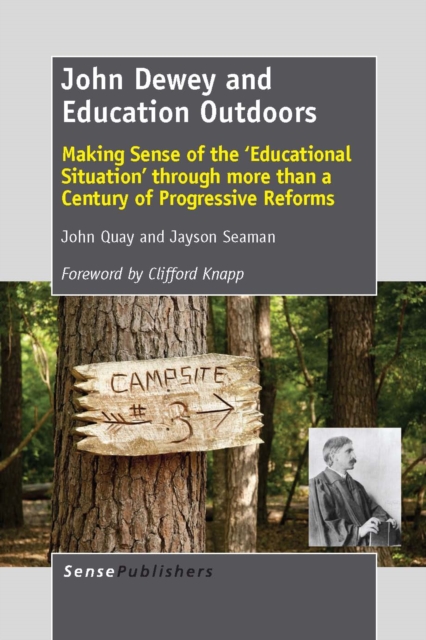
John Dewey and education outdoors : making sense of the 'Educational situation' through more than a century of progressive reforms
In this book we take the reader on a journey through the various curriculum reforms that have emerged in the USA around the idea of conducting education outdoors--through initiatives such as nature-study, camping education, adventure education, environmental education, experiential education and place based education.
eBook
Collaborative Knowledge Creation
This book presents perspectives on the knowledge creation metaphor of learning, and elaborates the trialogical approach to learning. The knowledge creation metaphor differs from both the acquisition and the participation metaphors.
eBook
Cooperative learning
Although cooperative learning is widely endorsed as a pedagogical practice that promotes learning and socialization among students, teachers still struggle with how to introduce it into their classrooms. This book aims to overcome the challenges by: - detailing how teachers can establish cooperative learning in their classrooms to promote student engagement and learning - elaborating on how teachers′ discourse can challenge children′s thinking and scaffold their learning - outlining how to promote student discourse during small group experiences - providing explicit examples of the link between theory, research, and practice.
eBook
Deeper learning : how eight innovative public schools are transforming education in the twenty-first century
The acclaimed exploration of how public education can cultivate innovators--with a foreword by Russlynn Ali, a leading advocate for remaking schools Dime-a-dozen ideas for reforming education seem to be everywhere these days but few actually transform the everyday experience of the 50-million-plus students who are regularly subjected to.
eBook

Adaptive Education
Adaptive Educationexplains how schools and universities can incorporate research processes into their activities, institutionalize a policy of inquiry and experimentation, and make teaching an evidence-based profession.
eBook

Virtual Literacies
The growth of interest in virtual worlds and other online spaces for children and young people raises important issues for literacy educators and researchers. This book is a timely and much-needed collection of current research in the area. It provides a synthesis of knowledge and understanding and will be a key resource for scholars, students and teachers, particularly those interested in digital literacies. The work presents a coherent vision of current knowledge, and some of the most engaging, empirical research being undertaken on virtual worlds and online spaces in and beyond educational institutions. It contains international studies from the UK, North America and Australasia.
This is an important time for those researching virtual worlds, videogaming and Web 2.0 technologies, since there is growing professional interest in their significance in the education and development of children and young people. Whether these technologies are solely associated with informal learning or whether they should be incorporated into classroom contexts is hotly debated. This book provides a principled evaluation and appreciation of the learning, teaching and instruction that can occur in digital environments, showing children, young people and those who work with them as active agents with possibilities to navigate new paths.
Guy Merchant is Professor of Literacy in Education at Sheffield Hallam University.
Julia Gillen is Senior Lecturer in Digital Literacies at the Literacy Research Centre, Lancaster University.
Jackie Marsh is Professor of Education at the University of Sheffield, UK.
Julia Davies is Senior Lecturer in Education at the University of Sheffield, UK. She is a director of the Centre for the Study of New Literacies at Sheffield, and directs the EdD in Literacy and Language and the MA in New Literacies.
Introduction Part I: Exploring Virtuality 1. From Virtual Histories to Virtual Literacies Julia Gillen and Guy Merchant 2. A Sociocultural Approach to Exploring Virtual Worlds Rebecca W. Black and Stephanie M. Reich 3. Barbies and Chimps: Text and Childhoods in Virtual Worlds Victoria Carrington Part II: Virtual Literacies in Everyday Life 4. Multiliteracies in the Wild: Learning from Computer Games Catherine Beavis 5. Countering Chaos in Club Penguin: Young Children’s Literacy Practices in a Virtual World Jackie Marsh 6. Telling Stories Out of School: Young Male Gamers Talk About Literacies Alex Kendall and Julian McDougall Part III: School Innovations 7. ‘What is the MFC?’ Making and Shaping Meaning in Alternate Reality Games Angela Colvert 8. More Than Tweets: Developing the 'New' and 'Old' Through Online Social Networking Martin Waller 9. Children as Game Designers: New Narrative Opportunities Cathrin Howells and Judy Robertson 10. \"I Oversee What the Children Are Doing\": Challenging Literacy Pedagogy in Virtual Worlds Guy Merchant Part IV: Aspects of Participation 11. Scientific Literacy in a Social Networking Application Christine Greenhow 12. Seeking Planning Permission to Build a Gothic Cathedral on a Virtual Island Julia Gillen, Rebecca Ferguson, Anna Peachey and Peter Twining 13. Learning from Adventure Rock Lizzie Jackson 14. Playing Together Separately: Mapping Out Literacy and Social Synchronicity Crystle Martin, Caroline C. Williams, Amanda Ochsner, Shannon Harris, Elizabeth King, Gabriella Anton, Jonathon Elmergreen and Constance Steinkuehler. Virtual Literacies and Beyond: Some Concluding Comments
eBook
Learning-Through-Touring
Learning-through-Touring uncovers ways in which people interact with the built environment by exploring the spaces around, between and within buildings. The key idea embodied in the book is that learning through touring is haptic--the learner is a physical, cognitive and emotional participant in the process.
eBook
Wild curiosity
Wild Curiosity brings together cutting-edge neuroscience and psychology research with simple, effective advice for parents and teachers on how to ignite the fire of curiosity in children. The author offers a new way to think about parenting and teaching—one that values autonomy, creativity, and celebrates the spontaneous and unexpected joys of learning. Following the groundbreaking work of researchers like Peter Gray and thought-leaders like Richard Louv, the book offers justification for the de-institutionalization of learning and a roadmap for how to create engaging, inspiring, and exciting experiences to nurture curiosity for children of all ages.
eBook

Learning and Teaching in the Chinese Classroom
A major concern of all education authorities around the world is the challenge that schools face in catering for learner diversity. That this concern is shared by authorities in East Asia, including the Education Bureau (EDB) of Hong Kong, is surprising given the high academic achievement of students from this part of the world. This book helps to meet this challenge for teachers in East Asia by focusing on specific research that helps explain the basis for diversity in the Chinese learner. Although there are many textbooks that cover the basic principles of educational psychology, few do not focus on the Chinese learner. This book makes the link between the broad field of educational psychology and how these theories contribute to our understanding of the Chinese learner. This book is unique in that it draws on recent research to illustrate the application of these theories, thereby helping teachers and students in teacher education progammes understand the variability in student achievement. Our book is based on the idea that the Chinese context is in many ways different to other cultural contexts, and that teachers can make a difference to the outcomes of student learning. We also draw on our many years of experience in educating future teachers where our students want us to focus on the Chinese classroom. Our student-teachers also want to be educated by professors who are themselves researchers. In drawing on research about the Chinese learner we also bring to our student-teachers the richness and value of educational research. We also encourage our student-teachers to think of themselves as “professional researchers” in terms of developing an understanding of the research literature and in finding solutions to their classroom problems.
eBook