
Catalogue Search | MBRL


Are you sure you want to remove the book from the shelf?

{{itemTitle}}
266,022
result(s) for
"EDUCATION - Organizations "
Sort by:

Constructivist education in an age of accountability
This book constrasts authentic approaches to education with classroom practices based primarily on standards external to the individuals who are supposed to learn. While other books tend to promote either a desperate scramble for meeting standards or determined resistance to neoliberal reforms, this book fills that gap in ways that will inspire practitioners, prospective teachers, and teacher educators. Mandates pay only lip service to constructivist and social constructivist principles while thwarting the value of both students and teachers actively creating understandings. Contributors assert the central importance of a range of constructivist approaches to teaching, learning, and thinking, inviting careful reflection on the goals and values of education--back cover.
Book

Fall rates in hospital rehabilitation units after individualised patient and staff education programmes: a pragmatic, stepped-wedge, cluster-randomised controlled trial
Falls are the most frequent adverse events that are reported in hospitals. We examined the effectiveness of individualised falls-prevention education for patients, supported by training and feedback for staff, delivered as a ward-level programme.
Eight rehabilitation units in general hospitals in Australia participated in this stepped-wedge, cluster-randomised study, undertaken during a 50 week period. Units were randomly assigned to intervention or control groups by use of computer-generated, random allocation sequences. We included patients admitted to the unit during the study with a Mini-Mental State Examination (MMSE) score of more than 23/30 to receive individualised education that was based on principles of changes in health behaviour from a trained health professional, in addition to usual care. We provided information about patients' goals, feedback about the ward environment, and perceived barriers to engagement in falls-prevention strategies to staff who were trained to support the uptake of strategies by patients. The coprimary outcome measures were patient rate of falls per 1000 patient-days and the proportion of patients who were fallers. All analyses were by intention to treat. This trial is registered with the Australian New Zealand Clinical Trials registry, number ACTRN12612000877886).
Between Jan 13, and Dec 27, 2013, 3606 patients were admitted to the eight units (n=1983 control period; n=1623 intervention period). There were fewer falls (n=196, 7·80/1000 patient-days vs n=380, 13·78/1000 patient-days, adjusted rate ratio 0·60 [robust 95% CI 0·42–0·94], p=0·003), injurious falls (n=66, 2·63/1000 patient-days vs 131, 4·75/1000 patient-days, 0·65 [robust 95% CI 0·42–0·88], p=0·006), and fallers (n=136 [8·38%] vs n=248 [12·51%] adjusted odds ratio 0·55 [robust 95% CI 0·38 to 0·81], p=0·003) in the intervention compared with the control group. There was no significant difference in length of stay (intervention median 11 days [IQR 7–19], control 10 days [6–18]).
Individualised patient education programmes combined with training and feedback to staff added to usual care reduces the rates of falls and injurious falls in older patients in rehabilitation hospital-units.
State Health Research Advisory Council, Department of Health, Government of Western Australia.
Journal Article

International education and schools : moving beyond the first 40 years
\"Over the last forty years, the estimated number of international schools worldwide has increased from under 300 to over 3000 in 2012. This explosion is a response to the needs of a world in which borders are being traversed with ever greater ease and children increasingly need to be prepared for the global opportunities that await them. In this book, international school specialists reflect on where the movement has come from, how it stands and where developments are heading, offering insightful observations on these unique institutions. This is a comprehensive resource for students, researchers and professionals with an interest in the future of education in a globalized world\"-- Provided by publisher.
Book

The Crisis of Race in Higher Education: A Day of Discovery and Dialogue
The compendium of writings in this edited volume sheds light on the event \"Race & Ethnicity: A Day of Discovery and Dialogue\" at Washington University in St. Louis and the work current students, faculty, and staff are doing to improve inclusivity on campus and in St. Louis.
eBook
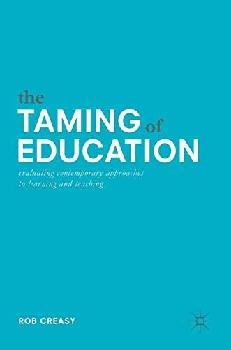
The taming of education : evaluating contemporary approaches to learning and teaching
This book evaluates contemporary approaches to education, with a particular focus on the ways in which assessment shapes the educational experience and influences pupils and students. It adopts a critical approach, arguing that there is a need for students to develop critical thinking skills, be flexible and have the capacity for originality. Education has increasingly come to be seen as a process with qualifications as the output; however, as economies change, attaining advantage increasingly relies on creativity and originality. Unfortunately, in the quest to remove uncertainty from education, creativity and originality are often overlooked; and the result is that education is impoverished. Creasy argues here that there is no single factor that has shaped education and led to this situation; rather, developments within education can be seen as having been shaped by a range of forces such as neoliberalism, New Public Management, standardization and internationalization. This is not to claim any deliberate undermining of education, but the cumulative effect is that education is less and less fit for purpose. Written for anyone involved in education, student, teacher or manager, this book draws upon Educations Studies, Sociology and Social Policy to offer a compelling critique of contemporary education. -- Back cover.
Book

Development of a framework for the co-production and prototyping of public health interventions
Background
Existing guidance for developing public health interventions does not provide information for researchers about how to work with intervention providers to co-produce and prototype the content and delivery of new interventions prior to evaluation. The ASSIST + Frank study aimed to adapt an existing effective peer-led smoking prevention intervention (ASSIST), integrating new content from the UK drug education resource Talk to Frank (
www.talktofrank.com
) to co-produce two new school-based peer-led drug prevention interventions. A three-stage framework was tested to adapt and develop intervention content and delivery methods in collaboration with key stakeholders to facilitate implementation.
Methods
The three stages of the framework were: 1) Evidence review and stakeholder consultation; 2) Co-production; 3) Prototyping. During stage 1, six focus groups, 12 consultations, five interviews, and nine observations of intervention delivery were conducted with key stakeholders (e.g. Public Health Wales [PHW] ASSIST delivery team, teachers, school students, health professionals). During stage 2, an intervention development group consisting of members of the research team and the PHW ASSIST delivery team was established to adapt existing, and co-produce new, intervention activities. In stage 3, intervention training and content were iteratively prototyped using process data on fidelity and acceptability to key stakeholders. Stages 2 and 3 took the form of an action-research process involving a series of face-to-face meetings, email exchanges, observations, and training sessions.
Results
Utilising the three-stage framework, we co-produced and tested intervention content and delivery methods for the two interventions over a period of 18 months involving external partners. New and adapted intervention activities, as well as refinements in content, the format of delivery, timing and sequencing of activities, and training manuals resulted from this process. The involvement of intervention delivery staff, participants and teachers shaped the content and format of the interventions, as well as supporting rapid prototyping in context at the final stage.
Conclusions
This three-stage framework extends current guidance on intervention development by providing step-by-step instructions for co-producing and prototyping an intervention’s content and delivery processes prior to piloting and formal evaluation. This framework enhances existing guidance and could be transferred to co-produce and prototype other public health interventions.
Trial registration
ISRCTN14415936
, registered retrospectively on 05 November 2014.
Journal Article

Education, narrative technologies and digital learning : designing storytelling for creativity with computing
This book examines and illustrates the potential of narrative technology, the integration and synthesis of storytelling and digital media in education. Storytelling is a foundational and powerful process in all learning and teaching, and technology is becoming ever more ubiquitous and sophisticated, particularly in its capabilities to mediate and augment creative storytelling. The book begins with a foundational analysis of narrative use in education today, and provides a history of the emergence of narrative technology. It explores how the convergence of high-potential computing and storytelling practices and techniques can be used to enhance education, in particular the design of bespoke, interactive physical learning environments. The contemporary importance of educational design is highlighted throughout the book, which concludes with the SCâEAL design-based research framework as a proposed systematic approach to the design of narrative technology in education. The book will be a valuable resource for educational designers, technologists, teachers and policymakers, especially those with an interest in the design and use of narrative technology in education. -- Back cover.
Book

Parent-Implemented Enhanced Milieu Teaching With Preschool Children Who Have Intellectual Disabilities
Purpose: The purpose of this study was to compare the effects of enhanced milieu teaching (EMT) implemented by parents and therapists versus therapists only on the language skills of preschool children with intellectual disabilities (IDs), including children with Down syndrome and children with autism spectrum disorders. Method: Seventy-seven children were randomly assigned to 2 treatments (parent + therapist EMT or therapist-only EMT) and received 36 intervention sessions. Children were assessed before, immediately after, 6 months after, and 12 months after intervention. Separate linear regressions were conducted for each standardized and observational measure at each time point. Results: Parents in the parent + therapist group demonstrated greater use of EMT strategies at home than untrained parents in the therapist-only group, and these effects maintained over time. Effect sizes for observational measures ranged from d = 0.10 to d = 1.32 favoring the parent + therapist group, with the largest effect sizes found 12 months after intervention. Conclusion: Findings from this study indicate generally that there are benefits to training parents to implement naturalistic language intervention strategies with preschool children who have ID and significant language impairments.
Journal Article

Creative dimensions of teaching and learning in the 21st century
In a rapidly changing world the importance of creativity is more apparent than ever. As a result, creativity is now essential in education. 'Creative Dimensions of Teaching and Learning in the 21st Century' appeals to educators across disciplines teaching at every age level who are challenged daily to develop creative practices that promote innovation, critical thinking and problem solving. The thirty-five original chapters written by educators from different disciplines focus on theoretical and practical strategies for teaching creatively in contexts ranging from mathematics to music, art education to second language learning, aboriginal wisdom to technology and STEM. They explore and illustrate deep learning that is connected to issues vital in education -- innovation, identity, engagement, relevance, interaction, collaboration, on-line learning, dynamic assessment, learner autonomy, sensory awareness, social justice, aesthetics, critical thinking, digital media, multi-modal literacy and more. The editors and authors share their passion for creativity, teaching, learning, curriculum, and teacher education in this collection that critically examines creative practices that are appearing in today's public schools, post-secondary institutions and adult and community learning centres. Creativity is transforming education in the 21st century. -- Back cover.
Book

Culture and online learning
Culture plays an overarching role that impacts investment, planning, design, development, delivery, and the learning outcomes of online education. This groundbreaking book remedies a dearth of empirical research on how digital cultures and teaching and learning cultures intersect, and offers grounded theory and practical guidance on how to integrate cultural needs and sensibilities with the innovative opportunities offered by online learning. (HRK / Abstract übernommen).
eBook