
Catalogue Search | MBRL


Are you sure you want to remove the book from the shelf?

{{itemTitle}}
95,935
result(s) for
"EDUCATION INSTITUTIONS"
Sort by:

Constructivist education in an age of accountability
This book constrasts authentic approaches to education with classroom practices based primarily on standards external to the individuals who are supposed to learn. While other books tend to promote either a desperate scramble for meeting standards or determined resistance to neoliberal reforms, this book fills that gap in ways that will inspire practitioners, prospective teachers, and teacher educators. Mandates pay only lip service to constructivist and social constructivist principles while thwarting the value of both students and teachers actively creating understandings. Contributors assert the central importance of a range of constructivist approaches to teaching, learning, and thinking, inviting careful reflection on the goals and values of education--back cover.
Book
Artificial intelligence applications in Latin American higher education: a systematic review
Over the last decade, there has been great research interest in the application of artificial intelligence (AI) in various fields, such as medicine, finance, and law. Recently, there has been a research focus on the application of AI in education, where it has great potential. Therefore, a systematic review of the literature on AI in education is therefore necessary. This article considers its usage and applications in Latin American higher education institutions. After identifying the studies dedicated to educational innovations brought about by the application of AI techniques, this review examines AI applications in three educational processes: learning, teaching, and administration. Each study is analyzed for the AI techniques used, such as machine learning, deep learning, and natural language processing, the AI tools and algorithms that are applied, and the main education topic. The results reveal that the main AI applications in education are: predictive modelling, intelligent analytics, assistive technology, automatic content analysis, and image analytics. It is further demonstrated that AI applications help to address important education issues (e.g., detecting students at risk of dropping out) and thereby contribute to ensuring quality education. Finally, the article presents the lessons learned from the review concerning the application of AI technologies in higher education in the Latin American context.
Journal Article

International education and schools : moving beyond the first 40 years
\"Over the last forty years, the estimated number of international schools worldwide has increased from under 300 to over 3000 in 2012. This explosion is a response to the needs of a world in which borders are being traversed with ever greater ease and children increasingly need to be prepared for the global opportunities that await them. In this book, international school specialists reflect on where the movement has come from, how it stands and where developments are heading, offering insightful observations on these unique institutions. This is a comprehensive resource for students, researchers and professionals with an interest in the future of education in a globalized world\"-- Provided by publisher.
Book

Knowledge hiding behavior in higher education institutions: a scientometric analysis and systematic literature review approach
Purpose
The purpose of this paper is to systematically review knowledge hiding (KH) behavior in higher education institutions (HEIs). KH is regarded as an unethical and antisocial behavior by many scholars, which should not be prevalent in HEIs.
Design/methodology/approach
A two-phase analysis through quantitative scientometric analysis and qualitative systematic literature review method through the preferred reporting items for systematic reviews and meta-analyses (PRISMA) model was applied. In phase 1,174 articles were analyzed using the VOSviewer through co-word and co-citation analyses. In Phase 2, 20 related studies on KH in HEIs were qualitatively analyzed on the fundamental concept of KH. The main themes were determined based on current research findings, through the identification of relevant gaps in the context of higher education.
Findings
In Phase 1, co-word and co-citation analyses resulted in six and three clusters, respectively. Subsequently, in Phase 2, five themes were discovered: terminology of KH, scale of KH, cultural and geographical context, KH among academics and students and relevant theories. Further, discussion on the institutional factors of individuals, organizations, technology and culture is presented.
Practical implications
This review lays out a practical guide to facilitate HEIs in managing KH behavior among academics, employees, and students. Strategies can be planned and implemented to foster and inculcate knowledge sharing behavior to circulate knowledge while at the same time diminishing KH behavior in HEIs.
Originality/value
To the best of the author’s knowledge, this study is the first to review KH behavior in the context of HEIs through quantitative and qualitative analysis.
Journal Article
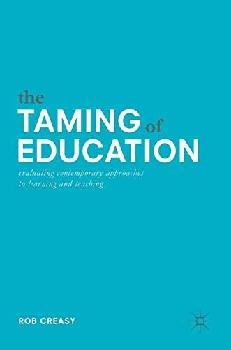
The taming of education : evaluating contemporary approaches to learning and teaching
This book evaluates contemporary approaches to education, with a particular focus on the ways in which assessment shapes the educational experience and influences pupils and students. It adopts a critical approach, arguing that there is a need for students to develop critical thinking skills, be flexible and have the capacity for originality. Education has increasingly come to be seen as a process with qualifications as the output; however, as economies change, attaining advantage increasingly relies on creativity and originality. Unfortunately, in the quest to remove uncertainty from education, creativity and originality are often overlooked; and the result is that education is impoverished. Creasy argues here that there is no single factor that has shaped education and led to this situation; rather, developments within education can be seen as having been shaped by a range of forces such as neoliberalism, New Public Management, standardization and internationalization. This is not to claim any deliberate undermining of education, but the cumulative effect is that education is less and less fit for purpose. Written for anyone involved in education, student, teacher or manager, this book draws upon Educations Studies, Sociology and Social Policy to offer a compelling critique of contemporary education. -- Back cover.
Book

The implementation of sustainability practices in Portuguese higher education institutions
Purpose
The purpose of this work is to analyze the current state of implementation of sustainability development (SD) in Portuguese higher education institutions (HEIs).
Design/methodology/approach
A questionnaire was developed to measure the level of implementation of SD practices in HEIs as well as the number of rankings, certifications and declarations of these institutions. The questionnaire was sent by e-mail to all rectors, presidents, directors of faculties, departments and schools of Portuguese universities and polytechnics. A sample of 53 leaders was obtained.
Findings
Portuguese HEIs are mainly engaged in the social dimension of sustainability. The economic dimension emerges in second place and the institutional in third; the environmental dimension is the least developed. Except for a few specific topics (e.g. related to research on SD, and the offer of degree courses in SD), there are no significant differences between universities and polytechnics in the implementation of SD practices. Only 11 per cent of HEIs are innovators in the implementation of SD practices, and a majority of HEIs have implemented less than 34 per cent of the SD practices studied.
Research limitations/implications
This research has a national scope, and the results should be interpreted only in the Portuguese context. Future studies should include a larger range of institutional actors within the faculty.
Practical implications
This study provides valuable insights and theoretical and methodological guidance for future implementation processes supporting the transition to sustainability in HEIs.
Originality/value
This is the first study conducted in Portuguese HEIs with the aim of determining their efforts to implement and promote sustainability.
Journal Article

Education, narrative technologies and digital learning : designing storytelling for creativity with computing
This book examines and illustrates the potential of narrative technology, the integration and synthesis of storytelling and digital media in education. Storytelling is a foundational and powerful process in all learning and teaching, and technology is becoming ever more ubiquitous and sophisticated, particularly in its capabilities to mediate and augment creative storytelling. The book begins with a foundational analysis of narrative use in education today, and provides a history of the emergence of narrative technology. It explores how the convergence of high-potential computing and storytelling practices and techniques can be used to enhance education, in particular the design of bespoke, interactive physical learning environments. The contemporary importance of educational design is highlighted throughout the book, which concludes with the SCâEAL design-based research framework as a proposed systematic approach to the design of narrative technology in education. The book will be a valuable resource for educational designers, technologists, teachers and policymakers, especially those with an interest in the design and use of narrative technology in education. -- Back cover.
Book
Learning and teaching sustainable business in the digital era: a connectivism theory approach
Higher education institutions may adopt various approaches to the pedagogic principles and methods used in teaching sustainable development in business and marketing courses. These methods can include the utilisation of digital technologies and online communication to facilitate distance learning and fast access to relevant information. Changes towards the digitalisation of the learning environment especially gained popularity during the Covid-19 pandemic. In the post-pandemic period, digitalisation continues to facilitate the learning and teaching processes. However, the implementation of digital technologies, besides technological expertise, requires appropriate theoretical frameworks for understanding how learning is developed. This study explores connectivism theory applied to the pedagogic practices of knowledge dissemination concerning sustainable development in the fields of business and marketing. Connectivism embraces knowledge as a network where the learner, with the help of digital technologies, develops mental connections between pieces of information during interaction with various information sources. This qualitative research empirically explores the principles of connectivism embedded in the learning and teaching of a university course conducted online. The research findings indicate that connectivism may be a suitable conceptual framework that motivates learners to develop knowledge through digital enablers, discussions and social networking and to make connections to sustainability concepts. The principles of connectivism may help instructors to develop a learning environment where learners add understandings to their previous knowledge on sustainability through online interactions and by accessing digital knowledge sources. This study makes several interdisciplinary contributions by deepening the insights into digital pedagogic methods and approaches for the facilitation of learning, which may be of interest to academic and other pedagogic practitioners.
Journal Article

Creative dimensions of teaching and learning in the 21st century
In a rapidly changing world the importance of creativity is more apparent than ever. As a result, creativity is now essential in education. 'Creative Dimensions of Teaching and Learning in the 21st Century' appeals to educators across disciplines teaching at every age level who are challenged daily to develop creative practices that promote innovation, critical thinking and problem solving. The thirty-five original chapters written by educators from different disciplines focus on theoretical and practical strategies for teaching creatively in contexts ranging from mathematics to music, art education to second language learning, aboriginal wisdom to technology and STEM. They explore and illustrate deep learning that is connected to issues vital in education -- innovation, identity, engagement, relevance, interaction, collaboration, on-line learning, dynamic assessment, learner autonomy, sensory awareness, social justice, aesthetics, critical thinking, digital media, multi-modal literacy and more. The editors and authors share their passion for creativity, teaching, learning, curriculum, and teacher education in this collection that critically examines creative practices that are appearing in today's public schools, post-secondary institutions and adult and community learning centres. Creativity is transforming education in the 21st century. -- Back cover.
Book

Entrepreneurial University governance: The case of a Cooperative University
This article presents a case study of the Cooperative University of Mondragon to explore the intricate processes through which higher education institutions (HEIs) adopt an entrepreneurial university (EU) framework across their three core missions: teaching, research, and community outreach. Using a qualitative research design, this study examines the organizational strategies that Mondragon University’s engineering faculty (MGEP) employs to embrace entrepreneurial behaviors (EBs), specifically by building on its peculiar cooperative governance model. The findings shed light on how MGEP, as a prominent example, leverages a long-term vision that centers its decision-making processes on entrepreneurship and the management tools and governance elements that favor collective participation and intrinsic motivation. This research advances our understanding of the evolving landscape of higher education and its entrepreneurial drift in the following ways: (1) by addressing the need for further exploration of governance in EUs; (2) by complementing existing studies on the role of university leadership in the adoption of EBs; and (3) by identifying strategies to overcome inherent barriers within large organizations that impede universities from being entrepreneurial. Overall, this study offers practical implications for the adoption of EBs in HEIs.
Journal Article