
Catalogue Search | MBRL


Are you sure you want to remove the book from the shelf?

{{itemTitle}}
1,286
result(s) for
"EFFICIENCY WAGE THEORY"
Sort by:

Non-optimality of intellectual capital inputs: a new avenue for research
PurposeThis paper aims to initiate new avenues of research by examining optimal intellectual capital (IC) inputs, introducing three theories into the discussion: diminishing returns to scale, transaction costs economics and efficiency wage theory. In the second part, it advocates for demonstrating the existence of such non-optimality through empirical tests.Design/methodology/approachThis paper is divided into two parts. The first part provides a theoretical justification for the necessity of observing nonlinear relationships between IC inputs and firm performance. In the empirical section, the research design follows a four-step process, each progressively building on insights gained from the preceding phase: (1) establishing a baseline linear regression model; (2) introducing the logarithm of the IC inputs; (3) incorporating the square terms of the IC inputs and (4) investigating the phenomena of over- and under-input in IC.FindingsThe background theories and the obtained results highlight the necessity for firms to adopt a strategic approach to IC, acknowledging the diverse effects of IC components on different outcomes. They emphasize the nonlinear nature of IC returns, underscoring the importance of investing up to an optimal level to maximize benefits.Practical implicationsThe study’s discovery of optimal levels for the components of IC highlights the importance for practitioners to identify and invest up to these optimal levels. This ensures that IC initiatives are strategically aligned to maximize their positive impact on firm performance.Originality/valueThe integration of theories such as diminishing returns to scale, transaction costs economics and efficiency wage theory, alongside traditional frameworks like the resource-based view, the theory of dynamic capabilities and the knowledge-based theory of the firm, opens up new avenues for research on IC. The proposed methodology and measures – from financial reports – provide opportunities for replicating this type of study.
Journal Article

Higher Nursing Staff Wages Are Associated With Lower Operating Margins in Nursing Homes: An Instrumental Variable Analysis
Nursing staff including registered nurses (RNs), licensed practical nurses (LPNs), and certified nursing assistants (CNAs) are critical to nursing home (NH) operations but account for approximately 27% of net revenues. Understanding how nursing staff wages affect financial performance is particularly important as policy efforts seek to expand NH minimum staffing hours. Drawing from efficiency wage theory, which posits that employers may pay above-market wages to enhance worker productivity and retention, this study examined the relationship between nursing staff wages and NH financial performance. We used secondary datasets, including Payroll-Based Journal data and Medicare cost reports (N = 37 933 facility-year observations, 2020-2022). The dependent variable was operating margin, while the independent variables were facility-level RN, LPN, and CNA wages. An instrumental variable (IV) approach was used to address potential endogeneity in RN wages, with county-level average wages (excluding the index facility) serving as the instrument. The first stage modeled RN wages as a function of the instrument, and the second stage estimated the effect of predicted wages on operating margin. Ordinary least squares models were used for LPN and CNA wages, for which endogeneity was not detected. A$1 increase in RN wages was associated with a 0.70 percentage-point decrease in operating margin ( P = .01, 95% CI [−1.27, −0.14]). For LPNs, a $ 1 increase was associated with a 0.17-point decrease ( P < .001, 95% CI [−0.20, −0.13]), and for CNAs, a 0.31-point decrease ( P < .001, 95% CI [−0.37, −0.26]). These findings underscore the tension between workforce investment and financial sustainability in an industry that operates in a resource-constrained environment. Policy interventions such as wage subsidies or higher Medicaid reimbursements may be necessary to balance staffing investments with financial viability.
Journal Article

Does Corporate Governance Enhance Common Interests of Shareholders and Primary Stakeholders?
Employing a unique dataset of Chinese nonlisted firms, this paper investigates the effects of the presence of 19 governance structures on 20 employees' interest indicators. In general, we find that firms with the governance structures pay workers higher hourly wages, require less monthly working hours, and have a smaller chance of wage arrears. Meanwhile, the shares of total wage and welfare expenditures in total sales revenue are lower in these firms, which results in higher profitability. Moreover, firms with the governance structures invest significantly more into training and provide employees with better fringe benefits. Considering the low labor protection standard and the weak external regulations of China's labor market, we explain the positive findings thusly: corporate governance structures induce managers to adjust wage payments to the \"efficiency wage\" level, which is the best balance point for the interests of both shareholders and employees and, therefore, for maintaining the stakeholder relationships. We also find the governance structures that give blockholders superpower are negatively associated with employees interests. These results highlight the importance of giving enough discretion to managers in order to successfully find the common ground for creating mutual values for shareholders and employees.
Journal Article

The efficiency of wages, profit sharing, and stock
PurposeThe purpose of this paper is to examine which forms of compensation are more efficient at affecting employee attitudes, thus extending efficiency wage theory from wage-based compensation to profit sharing and stock-based compensation.Design/methodology/approachThree models of efficiency wage theory were tested: shirking, turnover and gift exchange. The effects of those three modes of compensation (wages, profit sharing and stock) were contrasted for the three models of efficiency wage theory.FindingsThe findings were that raising wages is the most efficient form of compensation in the turnover and shirking models, while in the gift exchange model profit sharing and stock-based compensation may function like efficiency wages.Originality/valueThis is the first study of this particular issue.
Journal Article
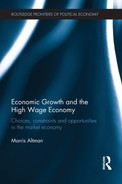
Economic Growth and the High Wage Economy
This book provides a theoretical framework to better understand how firms, economies and labor markets have evolved. This is done in a reader-friendly fashion, without complex mathematical arguments and proofs. Economic Growth and the High Wage Economy shows how high wage economies help make firms and economies more productive and why high wage economies can be competitive even in an increasingly globalized environment. It also demonstrates why concerns that labor supply will dry up as wages increase and social benefits rise are largely based on impoverished economic reasoning.The first chapters provide a theoretical basis for the rest of the book, showing for instance how higher wages are prone to increasing the level of economic efficiency by getting people to work harder and smarter (mainly smarter). Altman also explains that our understanding of technological change can be markedly improved by modelling technological change as a product of higher wages and improved working conditions and other shocks to the economic system. As the book develops, it is shown that increasing and high levels of income inequality are not necessary for growth and development, because the economic ‘pie’ grows when the economic wellbeing of the lower half and even the middle improves. The evolution of the state can also be better understood by applying this analytical framework. So too can the persistence of inefficient systems of production and cultural traits that appear to be inconsistent with economic prosperity. On top of this, the book examines the implications of Altman’s theoretical framework for macroeconomic analysis and policy. Finally, it is shown that labor supply can be better understood by introducing target income into the analytical mix. The main contribution of this book is providing the theoretical underpinning for why relatively high wages and, moreover, competition with high wages is good for dynamic growth and development. This work establishes why an alternative model of labor supply, based on the notion and reality of target income, does a better job of explaining the evolution of labor supply. The latter also reinforces the view that increasing wage and workers’ benefits should not be expected to damage the economy, even in the realm of labor supply. This book will be of interest to public policy experts, trade unions, human rights experts and scholars of behavioural economics, labour economics and globalization.
eBook

An empirical test of the efficiency wage hypothesis
The efficiency wage hypothesis is a popular explanation of observed labour market realities, however empirical testing has been very inadequate. Measuring effort and calculating productivity has been almost impossible in modern team oriented production processes. Because this study obtains a unique data set with similar production lines making the same product, across multiple geographies, but paying different wage premiums a reasonably controlled test can be conducted on the impact of wage premiums. Despite very good fitting of various production functions no statistical support is found for the idea that premium wages influence output. While these results may be somewhat surprising, given the popularity of the efficiency wage shirking model, there are possible alternative explanations discussed in this paper. As shown in this case study there is not always a connection between wage premium and output, therefore, managers should be careful about using wage premiums to increase effort and employee production.
Journal Article

Economic Growth and the High Wage Economy
This book provides a theoretical framework to better understand how firms, economies and labor markets have evolved. This is done in a reader-friendly fashion, without complex mathematical arguments and proofs. Economic Growth and the High Wage Economy shows how high wage economies help make firms and economies more productive and why high wage economies can be competitive even in an increasingly globalized environment. It also demonstrates why concerns that labor supply will dry up as wages increase and social benefits rise are largely based on impoverished economic reasoning.
The first chapters provide a theoretical basis for the rest of the book, showing for instance how higher wages are prone to increasing the level of economic efficiency by getting people to work harder and smarter (mainly smarter). Altman also explains that our understanding of technological change can be markedly improved by modelling technological change as a product of higher wages and improved working conditions and other shocks to the economic system. As the book develops, it is shown that increasing and high levels of income inequality are not necessary for growth and development, because the economic 'pie' grows when the economic wellbeing of the lower half and even the middle improves. The evolution of the state can also be better understood by applying this analytical framework. So too can the persistence of inefficient systems of production and cultural traits that appear to be inconsistent with economic prosperity. On top of this, the book examines the implications of Altman's theoretical framework for macroeconomic analysis and policy. Finally, it is shown that labor supply can be better understood by introducing target income into the analytical mix.
The main contribution of this book is providing the theoretical underpinning for why relatively high wages and, moreover, competition with high wages is good for dynamic growth and development. Th
eBook

Employment and shared growth : rethinking the role of labor mobility for development
There is one asset that poor people have in abundance: labor. Thus, what distinguishes the poor from the non-poor in low income countries is, simply, their ability to sell labor at a good price. It should be of little surprise, then, that enhancing the poor's access to employment is increasingly recognized as key to development. But while the creation of \"good\" jobs for the poor has become a policy priority for many developing countries, the mechanisms by which employment stimulates growth and reduces poverty have, until now, not been well understood. This book aims to help fill that gap. Focusing on labor market mobility as a central mechanism for both growth and poverty reduction, it brings together contributions originally presented at a conference organized by the World Bank's Poverty Reduction and Development Effectiveness department in June 2006. Using examples from all continents, these papers discuss why multi-segmented labor markets offer a good starting point for analysis, what role the informal sector plays in employment, whether self-employment is an engine of growth, how worker mobility affects income, and how firm dynamics affect both growth and employment through job creation and destruction.
eBook

NOVÁ KEYNESIÁNSKÁ MAKROEKONOMIE - NOVY POHLED NA TRH PRÁCE A MAKROEKONOMICKOU STABILITU
New Keynesian macroeconomics strives to provide a microeconomic foundation for sticky wages and prices. Efficiency wage theory argues that raising the real wages may lower costs per unit of output by raising labor productivity. As a result, involuntary unemployment persists. New Keynesian macroeconomics challenges the classical labor market result on two fronts. First, real rigidities may give rise to labor market equilibrium with involuntary unemployment. Second, nominal wage rigidities may permit temporary displacements from equilibrium. Real rigidities prevent the real wage from moving down until the market clears. Sources of real rigidities are legislation, monopolistic trade unions, efficiency wages and insider-outsider effects. Nominal rigidities in the labor market prevent the nominal wage from bringing about real wage adjustment, which is necessary after prices change. One important institutional feature making nominal wages sticky is the existence of long-term contracts.
Journal Article