
Catalogue Search | MBRL


Are you sure you want to remove the book from the shelf?

{{itemTitle}}
1,772
result(s) for
"EGYPTOLOGY"
Sort by:

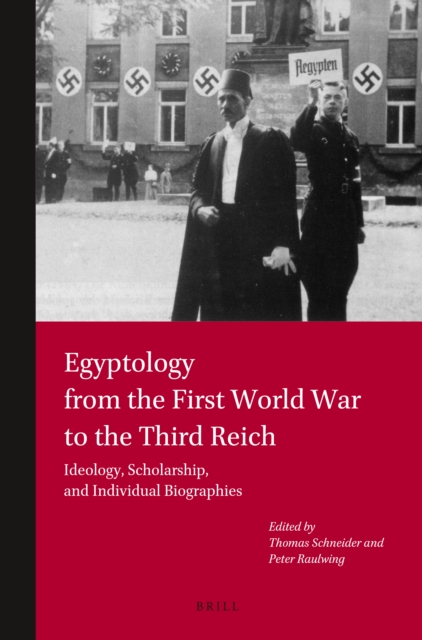
Egyptology from the First World War to the Third Reich : ideology, scholarship, and individual biographies
Only recently has Egyptology started examining ideology and its implications for our self-understanding and understanding of ancient Egypt, Egyptology, and the past as a whole. This edition presents aspects of ideology, scholarship, and individual biographies from World War I to the \"Third Reich\".
eBook


An etymological safari to Aigyptos
This article presents an overview of various ideas since Antiquity surrounding the etymology of Αἴγυπτος. A citation graph illustrates how the bibliographical items that refer to the term relate to one another.
Journal Article


Tewfik Boulos and the Administration of Egyptian Heritage at the Beginning of the Twentieth Century
Much of the research conducted into the history of Egyptology as it transitioned during the first half of the twentieth century from a collector’s backyard into an area of western-sanctioned archaeological research focuses on the experiences and perceptions of western scholars, with little attention given to the involvement or presence of Egyptians. The recent discovery of thousands of archival documents in a storeroom inside the Temple of Seti I in Abydos represents a significant and valuable dataset that can contribute to a more holistic history of the discipline that involves actors who have traditionally been side-lined. In particular, this paper focuses on a ledger (1914–15) belonging to the antiquities inspector Tewfik Boulos, shedding light on his role and responsibilities in the day-to-day administration of sites in the inspectorates of Sohag and Assiut, contextualizing his experiences and ultimately working towards a history of the field that is inclusive and multi-layered.
Journal Article
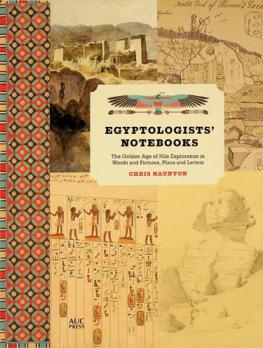
Egyptologists' notebooks : the golden age of Nile exploration in words, pictures, plans, and letters
\"A gorgeous presentation of intimate diaries and journals that captures the excitement of the golden age of Egyptology. For centuries, the ancient ruins of Egypt have provided an endless source of fascination for explorers, antiquarians, archaeologists, and the public. All, from the very earliest travelers, were entranced by the beauty of the landscape and the remains of tombs, temples, and cities consumed by drift sand. Early adventurers were gripped by the urge to capture what they saw in writings, sketches, paintings, and photographs. While it was always the Egyptologists who were in charge, they depended on the assistance of architects, artists, engineers, and photographers. Yet when we read about Flinders Petrie and Norman de Garis Davies, we rarely hear about their wives, Hilda and Nina, or how the work of Amelia Edwards helped to fund their explorations. Only through diaries, letters, and other archival discoveries have we come to realize how important these other partners were. Similarly, the contributions of Egyptians, such as Hassan Effendi Hosni, are only now coming to light. Egyptologists' Notebooks is a visual celebration of Egypt's ancient past, featuring evocative sketches, paintings, and photographs from pioneering explorers' and archaeologists' journals. Reproduced in their original form, they provide intimate, behind-the-scenes access to the archaeological discovery of Egypt.\"-- Provided by publisher
BOOK

The chronology of Gezer from the end of the late bronze age to iron age II: A meeting point for radiocarbon, archaeology egyptology and the Bible
The ancient southern Levantine city of Gezer is well-known from Egyptian, Biblical and Assyrian sources, associated with power struggles, conquests, and intriguing tales involving figures such as Milkilu and Amenhotep III, Merneptah, the Philistines, Solomon and his unidentified pharaonic father-in-law, and Shishak / Sheshonq I. Since the identity of Gezer with “Tell Jezer” is quite literally ‘set in stone’ by some dozen boundary inscriptions, along with impressive Bronze and Iron Age remains, research at this site provides a unique opportunity to compare text and archaeology, as well as bring to light the undocumented everyday lives of the city’s inhabitants. In this endeavour, independent scientific dating is crucial for anchoring the remains chronologically. This paper presents the first substantial radiocarbon dataset and Bayesian chronological analysis for Gezer spanning the last part of the Late Bronze Age (LBA; LB IIB) through Iron Age II. The dataset derives from an essentially continuous stratigraphic sequence exposed in recent years by the Tandy expedition along the central-southern edge of the site. The results allow us for the first time to independently determine the site chronology, test the viability (from a chronological perspective) of proposed historical correlations, and contribute to debates on Philistine and Iron Age chronology.
Journal Article


Out of Ruins: Contextualizing an Ancient Egyptian Spectacle of Architectural Reuse
Architectural reuse was common in ancient Egypt. Modern interpretations of this practice, particularly in royal contexts, usually ascribe it either a practical or ideological function, only rarely considering it possible that different motivations were involved. This type of approach is particularly true for the reuse of Old Kingdom blocks by the Middle Kingdom king Amenemhat I in his pyramid at Lisht, a case often classified as solely utilitarian. However, an approach that prioritizes not only the ancient Egyptian worldview and royal ideology, but also how this case of reuse fits into cross-cultural considerations of monumentality, demonstrates the necessity to look at this practice more holistically. This study focuses in particular on the possibility that the transportation of reused materials by Amenemhat I was a spectacle of construction used to showcase the king's legitimacy and authority at the start of a new dynasty.
Journal Article