
Catalogue Search | MBRL


Are you sure you want to remove the book from the shelf?

{{itemTitle}}
307
result(s) for
"EMPIRICAL BASIS"
Sort by:

Recovering the underlying trajectory from sparse and irregular longitudinal data
In this article, we consider the problem of recovering the underlying trajectory when the longitudinal data are sparsely and irregularly observed and noise-contaminated. Such data are popularly analyzed with functional principal component analysis via the principal analysis by conditional estimation (PACE) method. The PACE method may sometimes be numerically unstable because it involves the inverse of the covariance matrix. We propose a sparse orthonormal approximation (SOAP) method as an alternative. It estimates the optimal empirical basis functions in the best approximation framework rather than eigen-decomposing the covariance function. The SOAP method avoids estimating the mean and covariance function, which is challenging when the assembled time points with observations for all subjects are not sufficiently dense. The method also avoids the inverse of the covariance matrix, hence the computation is more stable. It does not require the functional principal component scores to follow the Gaussian distribution. We show that the SOAP estimate for the optimal empirical basis function is asymptotically consistent. The finite-sample performance of the SOAP method is investigated in simulation studies in comparison with the PACE method. Our method is demonstrated by recovering the CD4 percentage curves from sparse and irregular data in a multi-centre AIDS cohort study.
Cet article traite de l’estimation (ou récupération) d’une trajectoire sous-jacente à des données longitudinales clairsemées, irrégulières et contaminées par du bruit. L’analyse de ce type de données fait usuellement appel aux techniques de l’Analyse en Composantes Principales Fonctionnelles, plus spécifiquement l’Analyse Principale par Espérance Conditionnelle (PACE). La méthode PACE peut parfois être numériquement instable car elle implique l’inverse de la matrice de covariance. Pour parer à cette éventualité, les auteurs du présent travail proposent une méthode d’approximation orthonormale clairsemée (SOAP). Cette dernière adopte le meilleure cadre d’approximation pour estimer les fonctions de base empiriques optimales plutôt que de recourir à une décomposition en valeurs propres de la matrice de covariance. Ainsi, la méthode SOAP contourne la difficulté d’estimer la moyenne et la covariance lorsque l’ensemble des observations dans le temps n’est pas dense. En plus d’assurer une stabilité numérique en évitant l’inversion de la matrice de covariance, cette méthode n’impose pas la normalité des scores des composantes principales fonctionnelles. Les auteurs prouvent la convergence asymptotique de l’estimateur SOAP de la fonction de base empirique optimale et présentent des études de simulation pour comparer sa performance avec celle de la méthode PACE sur des échantillons finis. Ensuite, ils illustrent la mise en œuvre de l’approche proposée en utilisant des données éparses et irrégulières provenant d’une étude de cohorte multicentrique sur le SIDA pour estimer des courbes de CD4.
Journal Article

The World Bank Research Observer 16(2)
Counting the world's poor: problems and possible solutions; by Angus Deaton. Comments on \"counting the world's poor\"; by Martin Ravallion, and T. N. Srinivasan. Ecology, history, and development : a perspective from rural Southeast Asia; by Yujiro Hayami. Productivity growth and sustainability in post-green revolution agriculture: the case of the Indian and Pakistan Punjab; by Rinku Murgai, Mubarik Ali, and Derek Byerlee. The politics of Russian enterprise reform: insiders, local governments, and the obstacles to restructuring; by Raj M. Desai and Itzhak Goldberg.
Journal

Closed-Form Method for Atmospheric Correction (CMAC) of Smallsat Data Using Scene Statistics
High-cadence Earth observation smallsat images offer potential for near real-time global reconnaissance of all sunlit cloud-free locations. However, these data must be corrected to remove light-transmission effects from variable atmospheric aerosol that degrade image interpretability. Although existing methods may work, they require ancillary data that delays image output, impacting their most valuable applications: intelligence, surveillance, and reconnaissance. Closed-form Method for Atmospheric Correction (CMAC) is based on observed atmospheric effects that brighten dark reflectance while darkening bright reflectance. Using only scene statistics in near real-time, CMAC first maps atmospheric effects across each image, then uses the resulting grayscale to reverse the effects to deliver spatially correct surface reflectance for each pixel. CMAC was developed using the European Space Agency’s Sentinel-2 imagery. After a rapid calibration that customizes the method for each imaging optical smallsat, CMAC can be applied to atmospherically correct visible through near-infrared bands. To assess CMAC functionality against user-applied state-of-the-art software, Sen2Cor, extensive tests were made of atmospheric correction performance across dark to bright reflectance under a wide range of atmospheric aerosol on multiple images in seven locations. CMAC corrected images faster, with greater accuracy and precision over a range of atmospheric effects more than twice that of Sen2Cor.
Journal Article

Advantages and disadvantages in the use of internet as a corpus : the case of the online dictionaries of Spanish Valladolid-UVa
This paper initially discusses some of the consequences which the technological development has for lexicography, especially in terms of the different types of empirical basis which can be used in dictionary projects. The most important advantages and disadvantages of using the Internet as a corpus are then listed and compared to the usefulness of \"traditional\" cor-pora. As an example, the paper shows how the Internet is used as the main empirical source in order to select lemmata and meaning items in the Online Dictionaries of Spanish Valladolid-UVa. The methods and tools employed in the project are discussed together with the requirements to the lexicographers' competences, knowledge and skills. Finally, the paper provides some general con-clusions as well as recommendations and hypotheses for future lexicographical work and research. Voordele en nadele van die gebruik van die internet as 'n korpus: Die geval van die Aanlynwoordeboeke van Spaans Valladolid-UVa. Hierdie artikel bespreek aanvanklik sommige van die gevolge wat tegnologiese ontwikkeling vir die leksikografie inhou, veral in terme van die verskillende soorte empiriese basisse wat vir woor-deboekprojekte gebruik kan word. Die belangrikste voordele en nadele van die gebruik van die internet as 'n korpus word dan gelys en vergelyk met die nuttigheid van \"tradisionele\" korpora. As voorbeeld toon die artikel hoe die internet as die belangrikste empiriese bron gebruik word om lemmata en betekenisitems vir die Aanlyn Woordeboeke van Spaans Valladolid-UVa uit te soek.
Journal Article

Rising global interest in farmland
Interest in farmland is rising. And, given commodity price volatility, growing human and environmental pressures, and worries about food security, this interest will increase, especially in the developing world. One of the highest development priorities in the world must be to improve smallholder agricultural productivity, especially in Africa. Smallholder productivity is essential for reducing poverty and hunger, and more and better investment in agricultural technology, infrastructure, and market access for poor farmers is urgently needed. When done right, larger-scale farming systems can also have a place as one of many tools to promote sustainable agricultural and rural development, and can directly support smallholder productivity, for example, throughout grower programs. However, recent press and other reports about actual or proposed large farmland acquisition by big investors have raised serious concerns about the danger of neglecting local rights and other problems. They have also raised questions about the extent to which such transactions can provide long-term benefits to local populations and contribute to poverty reduction and sustainable development. Although these reports are worrying, the lack of reliable information has made it difficult to understand what has been actually happening. Against this backdrop, the World Bank, under the leadership of Managing Director Ngozi Okonjo-Iweala, along with other development partners, has highlighted the need for good empirical evidence to inform decision makers, especially in developing countries.
eBook
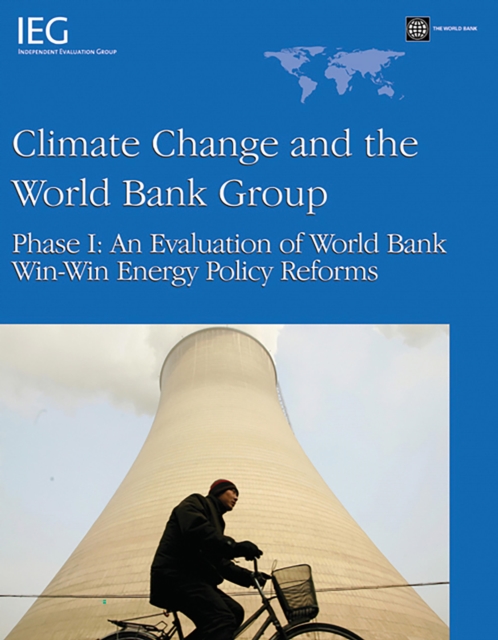
Climate change and the World Bank Group
This evaluation is the first of a series that seeks lessons from the World Bank Group's experience on how to carve out a sustainable growth path. The World Bank Group has never had an explicit corporate strategy on climate change against which evaluative assessments could be made. However, a premise of this evaluation series is that many of the climate-oriented policies and investments under discussion have close analogues in the past, and thus can be assessed, whether or not they were explicitly oriented to climate change mitigation. Two sets of win-win policies are perennial topics of discussion in the energy sector: reduction in subsidies and energy-efficiency policies, particularly those relating to end- user efficiency. This report looks at these, and at another apparently win-win topic: gas flaring. Flaring is interesting because of its magnitude, the links to pricing policy and to carbon finance, and the existence of the World Bank-led initiative to reduce flaring.
eBook


The Institutional Economics of Water
The Institutional Economics of Water evaluates water institutional reform and water sector performance from an institutional economics and political economy perspective. Against an exhaustive review of the theoretical and empirical literature on institution and performance both in general and in water sector contexts, the title develops an alternative methodology built on: ‘institutional ecology’ principle, ‘institutional decomposition and analysis’ framework, and ‘subjective theory’ of institutional change. Empirical application of this methodology with information collected from 127 water experts from 43 countries/regions and a cross-country review of recent water sector reforms within an institutional transaction cost framework enables the book to conclude with significant implications for both theory and policy in the realm of water sector reform in particular and institutional reforms in general. ‘We are both impressed by the book. It will merit prominent publication as a far-reaching application of innovative methodologies to an important, and well explained, worldwide policy problem.’– Randall Calvert, Washington University, St. Louis, US and Thrainn Eggertsson, University of Iceland ‘[The] literature review . . . is one of the best and most comprehensive that I have seen.’– Daniel W. Bromley, University of Wisconsin, US
eBook
User-oriented Understanding of Descriptive, Proscriptive and Prescriptive Lexicography
Abstract: There is much uncertainty and confusion as to the real differences between prescrip-tive and descriptive dictionaries. In general, the majority of existing accounts can be summarised as follows: Descriptive relates to the empirical basis; accordance between the empirical data and the dictionary is required. Prescriptive relates to the genuine purpose of the dictionary; the dictionary is meant to help with problems concerning text production and will thus affect usage. This asym-metrical understanding would imply prescriptive and descriptive in practice being false contrasts. In this article, a more consistent terminology is suggested which allows for both the function of the dictionary and the relation of the dictionary to the empirical basis.
Keywords: DESCRIPTION, DICTIONARY FUNCTION, EMPIRICAL BASIS, EXACTLY DESCRIPTIVE DICTIONARY, EXACTLY PROSCRIPTIVE DICTIONARY, EXPLICITLY PRE-SCRIPTIVE DICTIONARY, INTROSPECTION, LINGUISTIC SURVEY, NOT EXACTLY DE-SCRIPTIVE DICTIONARY, NOT EXACTLY PROSCRIPTIVE DICTIONARY, PRESCRIPTION, PROSCRIPTION, STRONGLY DESCRIPTIVE DICTIONARY, STRONGLY PRESCRIPTIVE DIC-TIONARY, TEXT CORPUS, USER-ORIENTED, WEAKLY DESCRIPTIVE DICTIONARY, WEAK-LY PRESCRIPTIVE DICTIONARY, WEAKLY PROSCRIPTIVE DICTIONARY
Opsomming: Gebruikersgerigte siening van deskriptiewe, proskriptiewe en preskriptiewe woordeboeke. Daar is baie onsekerheid en verwarring oor die werklike verskille tussen preskriptiewe en deskriptiewe woordeboeke. Oor die algemeen kan die meerder-heid bestaande verklarings soos volg saamgevat word: Deskriptief hou verband met die empiriese basis; ooreenstemming tussen die empiriese gegewens en die woordeboek is nodig. Preskriptief hou verband met die werklike doel van die woordeboek; die woordeboek is bedoel om te help met probleme betreffende teksproduksie en sal dus gebruik beïnvloed. Hierdie asimmetriese siening sal impliseer dat preskriptief en deskriptief in die praktyk onjuiste teenstellings is. In hierdie artikel word 'n meer konsekwente terminologie aan die hand gedoen wat rekening hou met sowel die funksie van die woordeboek as die verhouding van die woordeboek met die empiriese basis.
Sleutelwoorde: DESKRIPSIE, WOORDEBOEKFUNKSIE, EMPIRIESE BASIS, PRESIES DESKRIPTIEWE WOORDEBOEK, PRESIES PROSKRIPTIEWE WOORDEBOEK, DUIDELIK PRESKRIPTIEWE WOORDEBOEK, INTROSPEKSIE, LINGUISTIESE ONDERSOEK, NIE-PRESIES DESKRIPTIEWE WOORDEBOEK, NIE-PRESIES PROSKRIPTIEWE WOORDEBOEK, PRESKRIP-SIE, PROSKRIPSIE, STERK DESKRIPTIEWE WOORDEBOEK, STERK PRESKRIPTIEWE WOOR-DEBOEK, TEKSKORPUS, GEBRUIKERSGERIG, SWAK DESKRIPTIEWE WOORDEBOEK, SWAK PRESKRIPTIEWE WOORDEBOEK, SWAK PROSKRIPTIEWE WOORDEBOEK
Journal Article
land governance assessment framework
Seventy-five percent of the world's poor live in rural areas and most are involved in agriculture. In the 21st century, agriculture remains fundamental to economic growth, poverty alleviation, and environmental sustainability. The World Bank's Agriculture and rural development publication series presents recent analyses of issues that affect the role of agriculture, including livestock, fisheries, and forestry, as a source of economic development, rural livelihoods, and environmental services. The series is intended for practical application, and hope that it will serve to inform public discussion, policy formulation, and development planning. Increased global demand for land because of higher and more volatile food prices, urbanization, and use of land for environmental services implies an increased need for well-designed land policies at the country level to ensure security of long-held rights, to facilitate land access, and to deal with externalities. Establishing the infrastructure necessary to proactively deal with these challenges can require large amounts of resources. Yet with land tenure deeply rooted in any country's history, a wide continuum of land rights, and vast differences in the level of socioeconomic development, the benefits to be expected and the challenges faced will vary across and even within countries, implying a need to adapt the nature and sequencing of reforms to country circumstances. Also, as reforms will take time to bear fruit and may be opposed by vested interests, there is a need to identify challenges and to reach consensus on how to address them in a way that allows objective monitoring of progress over time. Without this being done, the chances of making quick progress in addressing key land policy challenges are likely to be much reduced. The Land Governance Assessment Framework (LGAF) is intended as a first step to help countries deal with these issues. It is a diagnostic tool that is to be implemented at the local level in a collaborative fashion, that addresses the need for guidance to diagnose and benchmark land governance, and that can help countries prioritize reforms and monitor progress over time.
eBook