
Catalogue Search | MBRL


Are you sure you want to remove the book from the shelf?

{{itemTitle}}
6
result(s) for
"ENIAC (Computer) History."
Sort by:


The Computer from Pascal to von Neumann
In 1942, Lt. Herman H. Goldstine, a former mathematics professor, was stationed at the Moore School of Electrical Engineering at the University of Pennsylvania. It was there that he assisted in the creation of the ENIAC, the first electronic digital computer. The ENIAC was operational in 1945, but plans for a new computer were already underway. The principal source of ideas for the new computer was John von Neumann, who became Goldstine's chief collaborator. Together they developed EDVAC, successor to ENIAC. After World War II, at the Institute for Advanced Study, they built what was to become the prototype of the present-day computer. Herman Goldstine writes as both historian and scientist in this first examination of the development of computing machinery, from the seventeenth century through the early 1950s. His personal involvement lends a special authenticity to his narrative, as he sprinkles anecdotes and stories liberally through his text.
eBook

Women who launched the computer age
The story of Jean Jennings, Kay McNulty, Frances Bilas, Ruth Lichterman, Betty Snyder, and Marlyn Wescoff, who were chosen to work on the ENIAC computer as part of a secret WWII mission.
Book
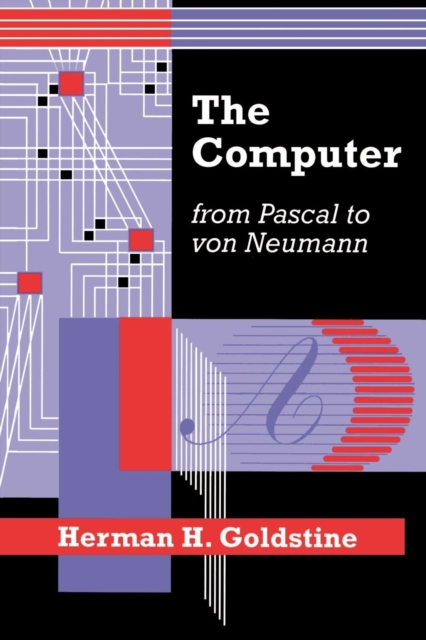
The computer from Pascal to von Neumann
In 1942, Lt. Herman H. Goldstine, a former mathematics professor, was stationed at the Moore School of Electrical Engineering at the University of Pennsylvania. It was there that he assisted in the creation of the ENIAC, the first electronic digital computer. The ENIAC was operational in 1945, but plans for a new computer were already underway. The principal source of ideas for the new computer was John von Neumann, who became Goldstine's chief collaborator. Together they developed EDVAC, successor to ENIAC. After World War II, at the Institute for Advanced Study, they built what was to become the prototype of the present-day computer. Herman Goldstine writes as both historian and scientist in this first examination of the development of computing machinery, from the seventeenth century through the early 1950s. His personal involvement lends a special authenticity to his narrative, as he sprinkles anecdotes and stories liberally through his text.
eBook
1940–1959
This chapter chronicles the development of permutation statistical methods from 1940 to 1959. This period may be considered a bridge between the early years of 1920–1939 where permutation tests were first conceptualized and the next period, 1960–1979, in which gains in computer technology provided the necessary tools to successfully employ permutation tests. The recognition of permutation methods as the gold standard against which conventional statistical methods were to be evaluated, while often implicit in the 1920s and 1930s, is manifest in many of the publications on permutation methods that appeared between 1940 and 1959. Also, a number of researchers turned their attention during this time period to rank tests, which simplified the calculation of exact probability values; other researchers continued work on calculating exact probability values, creating tables for small samples; and still others continued the theoretical work begun in the 1920s.
Book Chapter

The Face of Computing 50 Years and 18,000 Tubes Ago
\"The stored-program computer would have been developed without the Eniac,\" said Gwen Bell, director of collections for the Computer Museum in Boston. \"But the Eniac was the catalyst for a lot of things. It certainly has a legitimate claim for being the starting point for the computer age.\" \"Early on, it became Eckert's project,\" Mr. Goldstine said. \"This is not to run down Mauchly, but he was not the kind of person to get the machine finished and built. And getting the machine built was what the Eniac project was about.\" For his part, Mr. Goldstine did join I.B.M., helped set up its famed Watson laboratory and became an I.B.M. Fellow, a title that bestows recipients wide freedom in research and funding. Asked if he ever imagined what might come in the Eniac's wake, Mr. Goldstine replied: \"Oh no, it's just amazing. But I'm also amazed that I made it to 82. I never thought I'd live that long.\"
Newspaper Article