
Catalogue Search | MBRL


Are you sure you want to remove the book from the shelf?

{{itemTitle}}
491,228
result(s) for
"ENVIRONMENTAL ECONOMICS"
Sort by:

The low-carbon good life
\"The Low-Carbon Good Life is about how to reverse and repair four interlocking crises arising from modern material consumption: the climate crisis, growing inequality, biodiversity loss, and food related ill-health. Across the world today and throughout history, good lives are characterised by healthy food, connections to nature, being active, togetherness, personal growth, a spiritual framework, and sustainable consumption. A low-carbon good life offers opportunities to live in ways that will bring greater happiness and contentment. Slower ways of living await. A global target of no more than one tonne of carbon per person would allow the poorest to consume more and everyone to find our models of low-carbon good lives. But dropping old habits is hard, and large scale impacts will need fresh forms of public engagement and citizen action. Local to national governments need to act; equally they need pushing by the power and collective action of citizens. Innovative and engaging and written in a style that combines storytelling with scientific evidence, this book will be of great interest to students and scholars of climate change, sustainability, environmental economics and sustainable consumption, as well as non-specialist readers concerned about the climate crisis\"-- Provided by publisher.
Book

Disrupted landscapes
The fall of the Soviet Union was a transformative event for the national political economies of Eastern Europe, leading not only to new regimes of ownership and development but to dramatic changes in the natural world itself. This painstakingly researched volume focuses on the emblematic case of postsocialist Romania, in which the transition from collectivization to privatization profoundly reshaped the nation's forests, farmlands, and rivers. From bureaucrats abetting illegal deforestation to peasants opposing government agricultural policies, it reveals the social and political mechanisms by which neoliberalism was introduced into the Romanian landscape.
eBook


The environmental effects of the “twin” green and digital transition in European regions
This study explores the nexus between digital and green transformations—the so-called “twin” transition—in European regions in an effort to identify the impact of digital and environmental technologies on the greenhouse gas (GHG) emissions originating from industrial production. We conduct an empirical analysis based on an original dataset that combines information on environmental and digital patent applications with information on GHG emissions from highly polluting plants for the period 2007–2016 at the metropolitan region level in the European Union and the UK. Results show that the local development of environmental technologies reduces GHG emissions, while the local development of digital technologies increases them, albeit in the latter case different technologies seem to have different impacts on the environment, with big data and computing infrastructures being the most detrimental. We also find differential impacts across regions depending on local endowment levels of the respective technologies: the beneficial effect of environmental technologies is stronger in regions with large digital technology endowments and, conversely, the detrimental effect of digital technologies is weaker in regions with large green technology endowments. Policy actions promoting the “twin” transition should take this evidence into account, in light of the potential downside of the digital transformation when not combined with the green transformation.
Journal Article

The Environmental Impacts of the Coronavirus
The Covid-19 coronavirus pandemic has resulted in global lockdowns, sharply curtailing economic activity. It is a unique experiment with substantial impacts that will form the agenda for research. There are five sets of questions: the short-term impacts on emissions, the natural environment and environmental policy, including regulations and COP26; longer-term consequences from the deployment of macroeconomic monetary and fiscal stimuli, and investment in green deals; possible further deglobalisation and its impact on climate change and nature; intergenerational environmental impacts including debt and pollution burdens on future generations; and possible behavioural changes to the environment, both positive and negative.
Journal Article
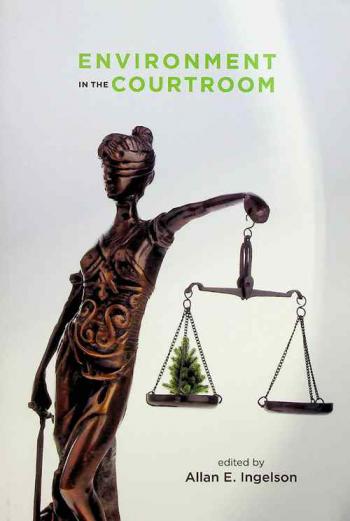
Environment in the courtroom
\"'Environment in the Courtroom' provides extensive insight into Canadian environmental law. Covering key environmental concepts and the unique nature of environmental damage, environmental prosecutions, sentencing and environmental offences, evidentiary issues in environmental processes and hearings, issues associated with site inspections, investigations, and enforcement, and more, this collection has the potential to make a significant difference at the level of understanding and practice. Containing perspective and insight from experienced and prominent Canadian legal practitioners and scholars, Environment in the Courtroom addresses the Canadian provinces and territories and provides context by comparison to the United States and Australia\"--Provided by the publisher
How Does Green Investment Affect Environmental Pollution? Evidence from China
China is currently undergoing an important stage wherein it is adjusting its development mode and upgrading its industrial structure. Green investment has become a major driving force through which China can achieve green and sustainable development. Based on the panel data of 30 Chinese provinces for the 2006–2017 period, this paper uses a spatial Durbin model and a dynamic threshold model to empirically analyze the impact of green investment and institutional quality on environmental pollution. The research results show that China’s environmental pollution is significantly characterized by spatial dependence. Local environmental pollution is negatively impacted by green investment, but it is not affected by green investment in neighboring areas; this conclusion remains valid after a series of robustness tests. Green investment can reduce environmental pollution by improving efficiency of energy conservation and emission reduction, expanding technological innovation capabilities and upgrading the industrial structure. The regression results of the dynamic threshold model show that green investment has a nonlinear impact on environmental pollution that is dependent on institutional quality. A higher degree of regional corruption can lead to a gradual decrease in the role of green investment in reducing environmental pollution. However, improvements in marketization and intellectual property protection can increase the positive influence of green investment in reducing environmental pollution. Significant regional heterogeneity is also found in the impact of green investment on environmental pollution, and this impact gradually decreases from the eastern coast to the western region.
Journal Article

Economics for a fragile planet
\"In a world of growing environmental risks and ecological scarcities, ensuring a safe Anthropocene for humankind is essential. Managing an increasingly \"fragile\" planet requires new thinking on markets, institutions, and governance built on five principles: ending the underpricing of nature; fostering collective action; accepting absolute limits; attaining sustainability; and promoting inclusivity. Rethinking economics and policies in this way can help to overcome the global challenges posed by climate change, biodiversity loss, freshwater scarcity, and deteriorating marine and coastal habitats. It requires decoupling wealth creation from environmental degradation through business, policy, and financial actions aimed at better stewardship of the biosphere. In this book, renowned environmental economist Edward B. Barbier offers a blueprint for a greener and more inclusive economy, and outlines the steps we must take now to build a post- COVID world that limits environmental threats while sustaining per capita welfare\"-- Provided by publisher.
Book

Rethinking private authority
Rethinking Private Authorityexamines the role of non-state actors in global environmental politics, arguing that a fuller understanding of their role requires a new way of conceptualizing private authority. Jessica Green identifies two distinct forms of private authority--one in which states delegate authority to private actors, and another in which entrepreneurial actors generate their own rules, persuading others to adopt them.
Drawing on a wealth of empirical evidence spanning a century of environmental rule making, Green shows how the delegation of authority to private actors has played a small but consistent role in multilateral environmental agreements over the past fifty years, largely in the area of treaty implementation. This contrasts with entrepreneurial authority, where most private environmental rules have been created in the past two decades. Green traces how this dynamic and fast-growing form of private authority is becoming increasingly common in areas ranging from organic food to green building practices to sustainable tourism. She persuasively argues that the configuration of state preferences and the existing institutional landscape are paramount to explaining why private authority emerges and assumes the form that it does. In-depth cases on climate change provide evidence for her arguments.
Groundbreaking in scope,Rethinking Private Authoritydemonstrates that authority in world politics is diffused across multiple levels and diverse actors, and it offers a more complete picture of how private actors are helping to shape our response to today's most pressing environmental problems
eBook