
Catalogue Search | MBRL


Are you sure you want to remove the book from the shelf?

{{itemTitle}}
258
result(s) for
"Early modern and Elizabethan, 1500-1600"
Sort by:


Speaking of the Moor
Selected byChoicemagazine as an Outstanding Academic Title \"Speak of me as I am,\" Othello, the Moor of Venice, bids in the play that bears his name. Yet many have found it impossible to speak of his ethnicity with any certainty. What did it mean to be a Moor in the early modern period? In the late sixteenth and early seventeenth centuries, when England was expanding its reach across the globe, the Moor became a central character on the English stage. InThe Battle of Alcazar,Titus Andronicus,Lust's Dominion, andOthello, the figure of the Moor took definition from multiple geographies, histories, religions, and skin colors. Rather than casting these variables as obstacles to our-and England's-understanding of the Moor's racial and cultural identity, Emily C. Bartels argues that they are what make the Moor so interesting and important in the face of growing globalization, both in the early modern period and in our own. InSpeaking of the Moor, Bartels sets the early modern Moor plays beside contemporaneous texts that embed Moorish figures within England's historical record-Richard Hakluyt'sPrincipal Navigations, Queen Elizabeth's letters proposing the deportation of England's \"blackamoors,\" and John Pory's translation ofThe History and Description of Africa. Her book uncovers the surprising complexity of England's negotiation and accommodation of difference at the end of the Elizabethan era.
eBook

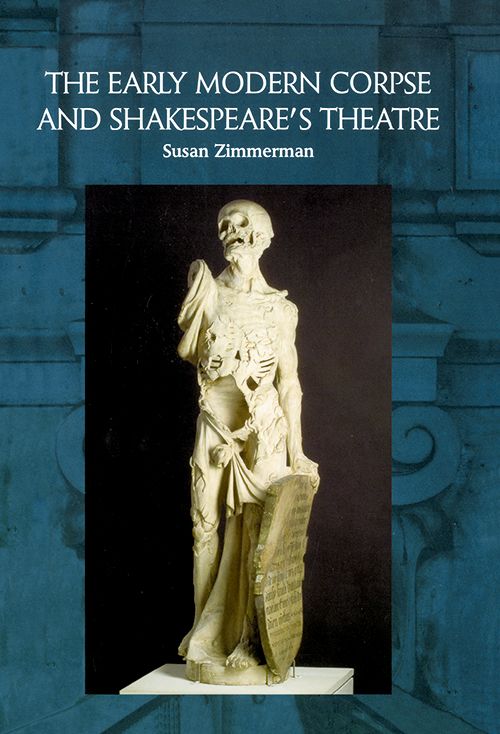
The Early Modern Corpse and Shakespeare's Theatre
Within a theoretical framework that makes use of history, psychoanalysis and anthropology, The Early Modern Corpse and Shakespeare's Theatre explores the relationship of the public theatre to the question of what constituted the 'dead' in early modern English culture.Susan Zimmerman argues that concepts of the corpse as a semi-animate, generative and indeterminate entity were deeply rooted in medieval religious culture. Such concepts ran counter to early modern discourses that sought to harden categorical distinctions between body/spirit, animate/inanimate - in particular, the attacks of Reformists on the materiality of 'dead' idols, and the rationale of the new anatomy for publicly dissecting 'dead' bodies. Zimmerman contends that within this context, theatrical representations of the corpse or corpse/revenant - as seen here in the tragedies of Shakespeare and his contemporaries - uniquely showcased the theatre's own ideological and performative agency. Features*Original in its conjunction of critical theory (Bataille, Kristeva, Lacan, Benjamin) with an historical account of the shifting status of the corpse in late medieval and early modern England.*The first study to demonstrate connections between the meanings attached to the material body in early modern Protestantism, the practice of anatomical dissection, and the English public theatre.*Strong market appeal to scholars and graduate students with interests in the theatre of Shakespeare and his contemporaries, early modern religion and science, and literary theory. *Relevant to advanced undergraduates taking widely taught courses in Shakespeare and in Renaissance drama.
eBook


Three romances of Eastern conquest
This volume brings together three little-known works by key playwrights from the late sixteenth-century golden age of English drama. All three convey the public theatre’s fascination with travel and adventure through the popular genre of heroic romance, while reflecting the contemporaries’ wide range of responses to cross-cultural contacts with the Muslim East and the Mediterranean challenges posed by the Ottoman empire.The volume presents the first modern-spelling editions of the three plays, with extensive annotations catering for specialised scholars while also making the texts accessible to students and theatregoers. A detailed introduction discusses issues of authorship, dates and sources, and sets the plays in their historical and cultural contexts, offering exciting insights on Elizabethan performance strategies, printing practices, and the circulation of knowledge and stereotypes related to ethnic and religious difference.
eBook

The Oxford anthology of Tudor drama
This anthology is the sister volume to 'The Oxford Handbook of Tudor Drama'. It contains sixteen of the most important, innovative, and dramatically exciting plays from the long Tudor century (1485-1603) newly edited in accessible modern spelling from original manuscripts or printed texts. Unlike previous anthologies, which have tended to divide the period by selecting examples of only 'medieval' or 'Renaissance' drama, and so eliding the continuities between the two, this volume gives readers an overview of the whole period. For in reality 'medieval' plays such as the magnificent York mystery cycle and the interludes of John Heywood were being performed through much of the sixteenth century, alongside 'Renaissance' works such as the comedy 'Gammer Gurton's Needle' and Jasper Heywood's English re-imagining of Seneca's tragedy of blood, 'Thyestes'.
Book

War and nation in the theatre of shakespeare and his contemporaries
This original study explores a vital aspect of early modern cultural history: the way that warfare is represented in the theatre of Shakespeare and his contemporaries.
eBook


Magical Imaginations
With this new understanding of early modern magic, and a fresh context for compelling readings of classic literary works,Magical Imaginationsreveals the central importance of magic to English literary history.
eBook