
Catalogue Search | MBRL


Are you sure you want to remove the book from the shelf?

{{itemTitle}}
35,911
result(s) for
"Earth construction."
Sort by:

Light earth building : a handbook for building with wood and earth
\"Over the last 30 years, interest has grown in using clay as an environmentally friendly building material that has proved its ideal sustainability for centuries. Light earth constructions, where a wooden framework or timber-framed walls are infilled with clay and fiber material, have extraordinarily solid, structural characteristics. Earth constructions are no longer considered exotic today, which, in part, is due to this standard work. The publication presents the use of this 'old' building material comprehensively and modernly, and contains many practical tips about simplifying designs as well as using prefabricated clay materials in the contemporary construction process. The selected project examples show the diversity of this building material, and the self-build projects demonstrate the beauty of working with lightweight earth using your own hands. The book is aimed at builders, architects and engineers, producers and artisans, as well as self-builders.\" Publisher.
Book
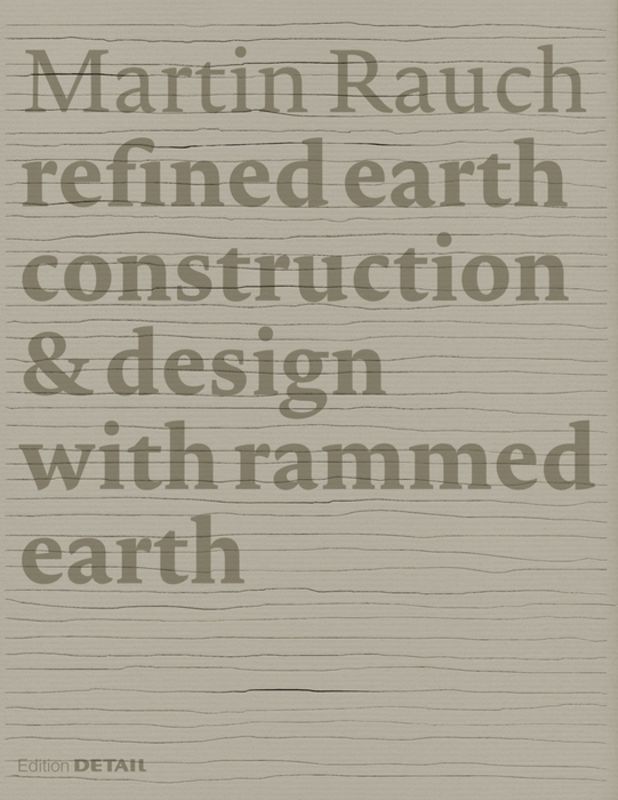
Martin Rauch refined earth : construction & design with rammed earth
A fundamental guide to building with earth
eBook


Rammed Earth Conservation
Dealing with rammed earth architecture and its restoration, and, in a more general sense, with the construction techniques and restoration of all earthen structures, Rammed Earth Conservation will be a valuable source of information for academics and professionals in the fields of civil engineering, construction and building engineering, and architecture.
eBook

Earth as construction material in the circular economy context
The need for a vast quantity of new buildings to address the increase in population and living standards is opposed to the need for tackling global warming and the decline in biodiversity. To overcome this twofold challenge, there is a need to move towards a more circular economy by widely using a combination of alternative low-carbon construction materials, alternative technologies and practices. Soils or earth were widely used by builders before World War II, as a primary resource to manufacture materials and structures of vernacular architecture. Centuries of empirical practices have led to a variety of techniques to implement earth, known as rammed earth, cob and adobe masonry among others. Earth refers to local soil with a variable composition but at least containing a small percentage of clay that would simply solidify by drying without any baking. This paper discusses why and how earth naturally embeds high-tech properties for sustainable construction. Then the potential of earth to contribute to addressing the global challenge of modern architecture and the need to re-think building practices is also explored. The current obstacles against the development of earthen architecture are examined through a survey of current earth building practitioners in Western Europe. A literature review revealed that, surprisingly, only technical barriers are being addressed by the scientific community; two-thirds of the actual barriers identified by the interviewees are not within the technical field and are almost entirely neglected in the scientific literature, which may explain why earthen architecture is still a niche market despite embodying all the attributes of the best construction material to tackle the current climate and economic crisis.
This article is part of the theme issue 'The role of soils in delivering Nature's Contributions to People'.
Journal Article


Mechanical behaviour of hypercompacted earth for building construction
This paper investigates the mechanical behaviour of a hypercompacted unstabilized earth material manufactured by compressing a moist soil to very high pressures up to 100 MPa. The hypercompaction procedure increases material density, which in turn improves mechanical characteristics. Samples were manufactured at the scale of both small cylinders and masonry bricks. The effect of ambient humidity on the mechanical characteristics of the material was investigated at the scale of cylindrical samples, showing that both strength and stiffness are sensitive to environmental conditions and tend to increase as ambient humidity reduces. The strength of the bricks was instead investigated under laboratory ambient conditions by using different experimental configurations to assess the influence of sample slenderness and friction confinement. Additional tests were also performed to evaluate the influence of mortar joints and compaction-induced anisotropy. Overall, the hypercompacted earth material exhibits mechanical characteristics that are comparable with those of traditional building materials, such as fired bricks, concrete blocks or stabilized compressed earth.
Journal Article

Drift-driven design of buildings : Mete Sozen's works on earthquake engineering
\"This book summarizes the most essential concepts that every engineer designing a new building or evaluating an existing structure should consider to control the damage caused by drift (deformation) induced by earthquakes. It presents the work on earthquake engineering done by Dr. Mete Sozen and dozens of his collaborators and students over decades of experimentation, analysis, and reconnaissance. Many of the concepts produced through this work are integral part of earthquake engineering today. Nevertheless, the connection between the concepts in use today and the original sources is not always explained. Drift-Driven Design of Buildings summarizes Sozen's research, provides common language and notation from subject to subject, provides examples and supporting data, and adds historical context as well as class notes that were the result of Sozen's dedication to teaching. It distills reinforced concrete building design to resist earthquake demands to its essence in a way that no other available book does. The recommendations provided are not only essential but also of the utmost simplicity - which is not the result of uninformed neglect of relevant parameters but rather the result of careful consideration and selection of parameters to retain only those that are most critical. Features: Provides the reader with a clear understanding of the essential features that control the seismic response of RC buildings, describes a simple (perhaps the simplest) seismic design method available, includes the underlying hard data to support and explain the methods described, and presents decades of work by one of the most prolific and brilliant civil engineers in the United States in the second half of the 20th century. Drift-Driven Design of Buildings serves as a useful guide for civil and structural engineering students for self-study or in-class learning, as well as instructors and practicing engineers\"-- Provided by publisher.
Book

Life Cycle Assessment (LCA) in Earth Construction: A Systematic Literature Review Considering Five Construction Techniques
In the past decade, there has been an increase in the environmental performance assessment in earth construction through the life cycle assessment (LCA) methodology. A Systematic Literature Review verified LCA methodology trends of five earth construction techniques from 2016 to April 2022, resulting in 27 studies. The results have been analyzed through qualitative thematic analysis, considering LCA methodology. Considering embodied carbon (GWP) and embodied energy, transportation and binder content were the main factors that influenced environmental performance. Hence, earth-based constructions exhibit better results in different impact categories than conventional materials. Environmental guidelines and technical features that were presented in the LCA studies are discussed for Adobe, Cob, Rammed Earth (RE), Compressed Earth Block (CEB), and Light Straw Clay (LSC). This study presents environmental benchmarks at the unit, wall, and building scales aiming to encourage LCA methodology applied to earth construction techniques and fostering the discussion of earth construction sustainability.
Journal Article