
Catalogue Search | MBRL


Are you sure you want to remove the book from the shelf?

{{itemTitle}}
49,616
result(s) for
"Earth structure"
Sort by:

Into the heart of our world : a journey to the center of the earth : a remarkable voyage of scientific discovery
The journey to the center of the earth is a voyage like no other we can imagine. Over 6300 km below the earth's surface, an extraordinary inner world the size of Mars awaits us. Dive through the molten iron of the outer core and eventually you will reach a solid sphere-- an iron-clad world held within a metal sea and unattached to anything above. At the earth's core is the history of our planet written in temperature and pressure, crystals and minerals. Our planet appears tranquil from outer space. And yet the arcs of volcanoes, the earthquake zones and the auroral glow rippling above our heads are testimony to something remarkable happening inside. For thousands of years, these phenomena were explained in legend and myth. Only in recent times has the brave new science of seismology emerged. One hundred and fifty years after the extraordinary, imaginative feat of Jules Verne's Journey to the center of the Earth, David Whitehouse embarks on a voyage of scientific discovery into the heart of our world. Seismologists today reveal a planet astonishingly buried within a planet. We watch as supercomputers convert signals from the ground into three-dimensional scans of subterranean continents, visit laboratories where scientists attempt to reproduce the intense conditions at the center of the Earth, travel down the throat of a volcano, look into the deepest hole ever drilled, and imagine a voyage through enormous crystals of iron. Whitehouse's enthralling journey vividly charts all we are able to understand about the mysteries of the deep Earth. His book encompasses the history of our planet and the latest findings about its inner core, allowing us to embark on an adventure that brings us closer to the enigma of our existence.
Book

Bedrock uplift reduces Antarctic sea-level contribution over next centuries
The contribution of the Antarctic Ice Sheet to barystatic sea-level rise could be as high as eight metres around 2300 but remains deeply uncertain. Ice sheet retreat causes bedrock uplift, which can exert a stabilising effect on the grounding line. Yet, sea-level projections exclude bedrock adjustment, use simplified Earth structures or omit the uncertainty in climate response and Earth structure. We show that the grounding line retreat is delayed by 50 to 130 years and the barystatic sea-level contribution reduced by 9–23% when the heterogeneity of the solid Earth is included in a coupled ice – bedrock model under different emission scenarios till 2500. The effect of the solid Earth feedback in ice sheet projections can be twice as large as the uncertainty due to differences between climate models. We emphasise that realistic Earth structures should be considered when projecting the Antarctic contribution to barystatic sea-level rise on centennial time scales.
This study finds that Antarctica’s ground uplift slows ice retreat. More realistic Earth models show future sea-level rise could be up to about 20% lower than estimates that ignore this effect.
Journal Article

Peeking underground
\"Illustrates the layers below Earth's surface, from crust to core, and the plants and animals that live within\"-- Provided by publisher.
Book

Feedback mechanisms controlling Antarctic glacial-cycle dynamics simulated with a coupled ice sheet–solid Earth model
The dynamics of the ice sheets on glacial timescales are highly controlled by interactions with the solid Earth, i.e., the glacial isostatic adjustment (GIA). Particularly at marine ice sheets, competing feedback mechanisms govern the migration of the ice sheet's grounding line (GL) and hence the ice sheet stability. For this study, we developed a coupling scheme and performed a suite of coupled ice sheet–solid Earth simulations over the last two glacial cycles. To represent ice sheet dynamics we apply the Parallel Ice Sheet Model (PISM), and to represent the solid Earth response we apply the 3D VIscoelastic Lithosphere and MAntle model (VILMA), which, in addition to load deformation and rotation changes, considers the gravitationally consistent redistribution of water (the sea-level equation). We decided on an offline coupling between the two model components. By convergence of trajectories of the Antarctic Ice Sheet deglaciation we determine optimal coupling time step and spatial resolution of the GIA model and compare patterns of inferred relative sea-level change since the Last Glacial Maximum with the results from previous studies. With our coupling setup we evaluate the relevance of feedback mechanisms for the glaciation and deglaciation phases in Antarctica considering different 3D Earth structures resulting in a range of load-response timescales. For rather long timescales, in a glacial climate associated with the far-field sea-level low stand, we find GL advance up to the edge of the continental shelf mainly in West Antarctica, dominated by a self-amplifying GIA feedback, which we call the “forebulge feedback”. For the much shorter timescale of deglaciation, dominated by the marine ice sheet instability, our simulations suggest that the stabilizing sea-level feedback can significantly slow down GL retreat in the Ross sector, which is dominated by a very weak Earth structure (i.e., low mantle viscosity and thin lithosphere). This delaying effect prevents a Holocene GL retreat beyond its present-day position, which is discussed in the scientific community and supported by observational evidence at the Siple Coast and by previous model simulations. The applied coupled framework, PISM–VILMA, allows for defining restart states to run multiple sensitivity simulations from. It can be easily implemented in Earth system models (ESMs) and provides the tools to gain a better understanding of ice sheet stability on glacial timescales as well as in a warmer future climate.
Journal Article

The street beneath my feet
Constructed on one continuous folded page, this book explores the layers of the Earth from human-made structures like sewers, subways, and archeological finds, down through various formations of rock, to the Earth's core and back up again.
Book
Approximating 3D bedrock deformation in an Antarctic ice-sheet model for projections
The bedrock deformation in response to a melting ice sheet provides negative feedback on ice mass loss. When modelling the future behaviour of the Antarctic Ice Sheet, the impact of bed deformation on ice dynamics varies but can reduce projections of future sea-level rise by up to 40 % in comparison with scenarios that assume a rigid Earth. The rate of the solid Earth response is mainly dependent on the viscosity of the Earth's mantle, which varies laterally and radially with several orders of magnitude across Antarctica. Because modelling the response for a varying viscosity is computationally expensive and has only recently been shown to be necessary over centennial time scales, sea-level projection ensembles often exclude the Earth's response or apply a globally constant relaxation time or viscosity. We use a coupled model to investigate the accuracy of various approaches to modelling the bedrock deformation to ice load change. Specifically, we compare the sea-level projections from an ice-sheet model coupled to (i) an elastic lithosphere, relaxed asthenosphere (ELRA) model, with either uniform and laterally varying relaxation times, (ii) a glacial isostatic adjustment (GIA) model with a radially varying Earth structure (1D GIA model), and (iii) a GIA model with laterally varying earth structures (3D GIA model). Furthermore, using the 3D GIA model we determine a relation between relaxation time and viscosity which can be used in ELRA and 1D models. We conduct 500-year projections of Antarctic Ice Sheet evolution using two different climate models and two emissions scenarios: the high emission scenario SSP5-8.5 and the low emission scenario SSP1-2.6. Using a rigid Earth model, this results in ∼3–7.5 m of barystatic sea-level rise with significant retreat in various basins due to marine ice sheet instability. The results show that using a uniform relaxation time of 300 years in an ELRA model leads to a total sea-level rise that deviates less than 40 cm (6 %) from the average of the 3D GIA models in 2500. This difference in the projected sea-level rise can be further reduced to 20 cm (4 %) by using an upper mantle viscosity of 1019 Pa s in the 1D GIA model, and to 10 cm (2 %) in 2500 by using a laterally varying relaxation time map in an ELRA model. Our results show that the Antarctic Ice Sheet contribution to sea-level rise can be approximated sufficiently accurate using ELRA or a 1D GIA model when the recommended parameters derived from the full 3D GIA model are used.
Journal Article

The sensitivity of ocean tide loading displacements to the structure of the upper mantle and crust of Taiwan Island
Ocean tide loading (OTL) displacements are sensitive to the shallow structure of the solid Earth; hence, the high-resolution spatial pattern of OTL displacement can provide knowledge to constrain the shallow Earth structure, especially in coastal areas. In this study, we investigate the sensitivity of the modeled M2 OTL displacement over Taiwan Island to perturbations of three physical quantities, namely, the density, bulk modulus, and shear modulus in the upper mantle and crust. Then, we compare the sensitivity of the modeled M2 OTL displacement to Earth models with the sensitivity to ocean tide models using root mean square (RMS) differences. We compute the displacement Green’s function and OTL displacement relative to the center of mass of the solid Earth (CE) reference frame, analyze the sensitivity to the three physical quantities in the CRUST1.0 model and the Preliminary Reference Earth Model (PREM), and present their spatial patterns. We find that displacement Green’s functions and OTL displacements are more sensitive to the two elastic moduli than the density in the upper mantle and crust. Moreover, their distinctive sensitivity patterns suggest that the three physical quantities might be constrained independently. The specific relationships between the perturbed structural depths and the distance ranges of peak sensitivities from the observation points to the coastline revealed by the shear modulus can mitigate the nonuniqueness problem in inversion. In particular, the horizontal tidal components observed by the Global Positioning System (GPS) can yield better results in inversions than the vertical component owing to the smaller OTL model errors and the higher structural sensitivity (except for the shear modulus in the asthenosphere).
Journal Article

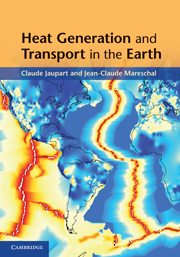
Heat Generation and Transport in the Earth
Heat provides the energy that drives almost all geological phenomena and sets the temperature at which these phenomena operate. This book explains the key physical principles of heat transport with simple physical arguments and scaling laws that allow quantitative evaluation of heat flux and cooling conditions in a variety of geological settings and systems. The thermal structure and evolution of magma reservoirs, the crust, the lithosphere and the mantle of the Earth are reviewed within the context of plate tectonics and mantle convection - illustrating how theoretical arguments can be combined with field and laboratory data to arrive at accurate interpretations of geological observations. Appendices contain data on the thermal properties of rocks, surface heat flux measurements and rates of radiogenic heat production. This book can be used for advanced courses in geophysics, geodynamics and magmatic processes, and is a reference for researchers in geoscience, environmental science, physics, engineering and fluid dynamics.
eBook