
Catalogue Search | MBRL


Are you sure you want to remove the book from the shelf?

{{itemTitle}}
56,643
result(s) for
"Earthquake engineering."
Sort by:


Fault Lines
Earth's fractured geology is visible in its fault lines. It is along these lines that earthquakes occur, sometimes with disastrous effects. These disturbances can significantly influence urban development, as seen in the aftermath of two earthquakes in Messina, Italy, in 1908 and in the Belice Valley, Sicily, in 1968. Following the history of these places before and after their destruction, this book explores plans and developments that preceded the disasters and the urbanism that emerged from the ruins. These stories explore fault lines between \"rural\" and \"urban,\" \"backwardness\" and \"development,\" and \"before\" and \"after,\" shedding light on the role of environmental forces in the history of human habitats.
eBook

Development of a building information model-guided post-earthquake building inspection framework using 3D synthetic environments
Computer vision-based inspection methods show promise for automating post-earthquake building inspections. These methods survey a building with unmanned aerial vehicles and automatically detect damage in the collected images. Nevertheless, assessing the damage’s impact on structural safety requires localizing damage to specific building components with known design and function. This paper proposes a BIM-based automated inspection framework to provide context for visual surveys. A deep learning-based semantic segmentation algorithm is trained to automatically identify damage in images. The BIM automatically associates any identified damage with specific building components. Then, components are classified into damage states consistent with component fragility models for integration with a structural analysis. To demonstrate the framework, methods are developed to photorealistically simulate severe structural damage in a synthetic computer graphics environment. A graphics model of a real building in Urbana, Illinois, is generated to test the framework; the model is integrated with a structural analysis to apply earthquake damage in a physically realistic manner. A simulated UAV survey is flown of the graphics model and the framework is applied. The method achieves high accuracy in assigning damage states to visible structural components. This assignment enables integration with a performance-based earthquake assessment to classify building safety.
Journal Article

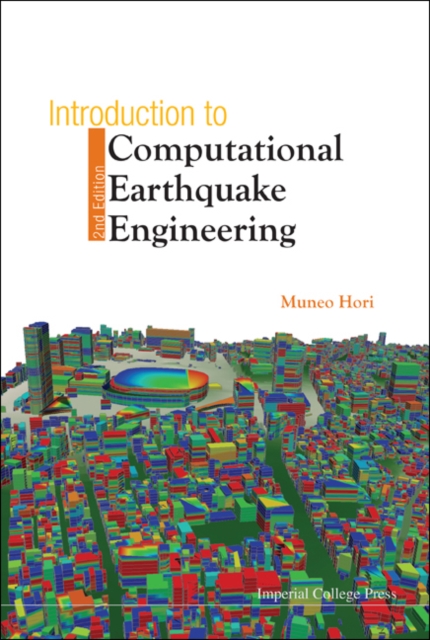
Introduction to computational earthquake engineering
Introduction to Computational Earthquake Engineering covers solid continuum mechanics, finite element method and stochastic modeling comprehensively, with the second and third chapters explaining the numerical simulation of strong ground motion and faulting, respectively. Stochastic modeling is used for uncertain underground structures, and advanced analytical methods for linear and non-linear stochastic models are presented. The verification of these methods by comparing the simulation results with observed data is then presented, and examples of numerical simulations which apply these methods to practical problems are generously provided. Furthermore three advanced topics of computational earthquake engineering are covered, detailing examples of applying computational science technology to earthquake engineering problems.
eBook

Performance-based seismic design of nonstructural building components:The next frontier of earthquake engineering
With the development and implementation of performance-based earthquake engineering,harmonization of performance levels between structural and nonstructural components becomes vital. Even if the structural components of a building achieve a continuous or immediate occupancy performance level after a seismic event,failure of architectural,mechanical or electrical components can lower the performance level of the entire building system. This reduction in performance caused by the vulnerability of nonstructural components has been observed during recent earthquakes worldwide. Moreover,nonstructural damage has limited the functionality of critical facilities,such as hospitals,following major seismic events. The investment in nonstructural components and building contents is far greater than that of structural components and framing. Therefore,it is not surprising that in many past earthquakes,losses from damage to nonstructural components have exceeded losses from structural damage. Furthermore,the failure of nonstructural components can become a safety hazard or can hamper the safe movement of occupants evacuating buildings,or of rescue workers entering buildings. In comparison to structural components and systems,there is relatively limited information on the seismic design of nonstructural components. Basic research work in this area has been sparse,and the available codes and guidelines are usually,for the most part,based on past experiences,engineering judgment and intuition,rather than on objective experimental and analytical results. Often,design engineers are forced to start almost from square one after each earthquake event: to observe what went wrong and to try to prevent repetitions. This is a consequence of the empirical nature of current seismic regulations and guidelines for nonstructural components. This review paper summarizes current knowledge on the seismic design and analysis of nonstructural building components,identifying major knowledge gaps that will need to be filled by future research. Furthermore,considering recent trends in earthquake engineering,the paper explores how performance-based seismic design might be conceived for nonstructural components,drawing on recent developments made in the field of seismic design and hinting at the specific considerations required for nonstructural components.
Journal Article

Drift-driven design of buildings : Mete Sozen's works on earthquake engineering
\"This book summarizes the most essential concepts that every engineer designing a new building or evaluating an existing structure should consider to control the damage caused by drift (deformation) induced by earthquakes. It presents the work on earthquake engineering done by Dr. Mete Sozen and dozens of his collaborators and students over decades of experimentation, analysis, and reconnaissance. Many of the concepts produced through this work are integral part of earthquake engineering today. Nevertheless, the connection between the concepts in use today and the original sources is not always explained. Drift-Driven Design of Buildings summarizes Sozen's research, provides common language and notation from subject to subject, provides examples and supporting data, and adds historical context as well as class notes that were the result of Sozen's dedication to teaching. It distills reinforced concrete building design to resist earthquake demands to its essence in a way that no other available book does. The recommendations provided are not only essential but also of the utmost simplicity - which is not the result of uninformed neglect of relevant parameters but rather the result of careful consideration and selection of parameters to retain only those that are most critical. Features: Provides the reader with a clear understanding of the essential features that control the seismic response of RC buildings, describes a simple (perhaps the simplest) seismic design method available, includes the underlying hard data to support and explain the methods described, and presents decades of work by one of the most prolific and brilliant civil engineers in the United States in the second half of the 20th century. Drift-Driven Design of Buildings serves as a useful guide for civil and structural engineering students for self-study or in-class learning, as well as instructors and practicing engineers\"-- Provided by publisher.
Book

Generative adversarial networks review in earthquake-related engineering fields
Within seismology, geology, civil and structural engineering, deep learning (DL), especially via generative adversarial networks (GANs), represents an innovative, engaging, and advantageous way to generate reliable synthetic data that represent actual samples’ characteristics, providing a handy data augmentation tool. Indeed, in many practical applications, obtaining a significant number of high-quality information is demanding. Data augmentation is generally based on artificial intelligence (AI) and machine learning data-driven models. The DL GAN-based data augmentation approach for generating synthetic seismic signals revolutionized the current data augmentation paradigm. This study delivers a critical state-of-art review, explaining recent research into AI-based GAN synthetic generation of ground motion signals or seismic events, and also with a comprehensive insight into seismic-related geophysical studies. This study may be relevant, especially for the earth and planetary science, geology and seismology, oil and gas exploration, and on the other hand for assessing the seismic response of buildings and infrastructures, seismic detection tasks, and general structural and civil engineering applications. Furthermore, highlighting the strengths and limitations of the current studies on adversarial learning applied to seismology may help to guide research efforts in the next future toward the most promising directions.
Journal Article