
Catalogue Search | MBRL


Are you sure you want to remove the book from the shelf?

{{itemTitle}}
60
result(s) for
"East Asia -- Civilization -- Philosophy"
Sort by:

Civilization, Nation and Modernity in East Asia
This book explores the crisis of cultural identity which has assaulted Asian countries since Western countries began to have a profound impact on Asia in the nineteenth century. Confronted by Western 'civilization' and by 'modernity', Asian countries have been compelled to rethink their identity, and to consider how they should relate to Western 'civilization' and 'modernity'. The result, the author argues, has been a redefining by Asian countries of their own character as nations, and an adaptation of 'civilization' and 'modernity' to their own special conditions. Asian nations, the author contends, have thereby engaged with the West and with modernity, but on their own terms, occasionally, and in various inconsistent ways in which they could assert a sense of difference, forcing changes in the Western concept of civilization. Drawing on postmodern theory, the Kyoto School, Confucian and other traditional Asian thought, and the actual experiences of Asian countries, especially China and Japan, the author demonstrates that Asian countries' redefining of the concept of civilization in the course of their quest for an appropriate postmodern national identity is every bit as key a part of 'the rise of Asia' as economic growth or greater international political activity.
eBook

Fundamentals of Chinese Culture
Chinese culture, to readers of English, is somewhat veiled in mystery. Fundamentals of Chinese Culture (in pinyin, Zhongguo wenhua yaoyi), a classic of great insight and profundity by noted Chinese thinker, educator and social reformist Liang Shuming, takes readers on an intellectual journey into the five-thousand-year-old culture of China, the world's oldest continuous civilization. With a set of Chinese-style cultural theories, the book well serves as a platform for Westerners' better understanding of the distinctive worldview of the Chinese people, who value family life, group-centered life and social stability, and for further mutual understanding and greater mutual consolidation among humanities scholars in different contexts, dismantling common misconceptions about China and bridging the gap between Chinese culture and Western culture. As a translation of Liang Shuming's original text, this book pulls back the curtain to reveal to Westerners a highly complex and nuanced picture of a fascinating people.
eBook

Can non-europeans think?
'In Can Non-Europeans Think? Dabashi takes his subtle but vigorous polemic to another level.'
Pankaj Mishra What happens to thinkers who operate outside the European philosophical pedigree? In this powerfully honed polemic, Hamid Dabashi argues that they are invariably marginalised, patronised and misrepresented. Challenging, pugnacious and stylish, Can Non-Europeans Think? forges a new perspective in postcolonial theory by examining how intellectual debate continues to reinforce a colonial regime of knowledge, albeit in a new guise. Based on years of scholarship and activism, this insightful collection of philosophical explorations is certain to unsettle and delight in equal measure.
eBook

Founding Gods, Inventing Nations
From the dawn of writing in Sumer to the sunset of the Islamic empire, Founding Gods, Inventing Nations traces four thousand years of speculation on the origins of civilization. Investigating a vast range of primary sources, some of which are translated here for the first time, and focusing on the dynamic influence of the Greek, Roman, and Arab conquests of the Near East, William McCants looks at the ways the conquerors and those they conquered reshaped their myths of civilization's origins in response to the social and political consequences of empire.
eBook

The nature of the beasts
It is widely known that such Western institutions as the museum, the university, and the penitentiary shaped Japan’s emergence as a modern nation-state. Less commonly recognized is the role played by the distinctly hybrid institution—at once museum, laboratory, and prison—of the zoological garden. In this eye-opening study of Japan’s first modern zoo, Tokyo’s Ueno Imperial Zoological Gardens, opened in 1882, Ian Jared Miller offers a refreshingly unconventional narrative of Japan’s rapid modernization and changing relationship with the natural world. As the first zoological garden in the world not built under the sway of a Western imperial regime, the Ueno Zoo served not only as a staple attraction in the nation’s capital—an institutional marker of national accomplishment—but also as a site for the propagation of a new “natural” order that was scientifically verifiable and evolutionarily foreordained. As the Japanese empire grew, Ueno became one of the primary sites of imperialist spectacle, a microcosm of the empire that could be traveled in the course of a single day. The meaning of the zoo would change over the course of Imperial Japan’s unraveling and subsequent Allied occupation. Today it remains one of Japan’s most frequently visited places. But instead of empire in its classic political sense, it now bespeaks the ambivalent dominion of the human species over the natural environment, harkening back to its imperial roots even as it asks us to question our exploitation of the planet’s resources.
eBook

Before and After Muhammad
Islam emerged amid flourishing Christian and Jewish cultures, yet students of Antiquity and the Middle Ages mostly ignore it. Despite intensive study of late Antiquity over the last fifty years, even generous definitions of this period have reached only the eighth century, whereas Islam did not mature sufficiently to compare with Christianity or rabbinic Judaism until the tenth century.Before and After Muhammadsuggests a new way of thinking about the historical relationship between the scriptural monotheisms, integrating Islam into European and West Asian history.
Garth Fowden identifies the whole of the First Millennium--from Augustus and Christ to the formation of a recognizably Islamic worldview by the time of the philosopher Avicenna--as the proper chronological unit of analysis for understanding the emergence and maturation of the three monotheistic faiths across Eurasia. Fowden proposes not just a chronological expansion of late Antiquity but also an eastward shift in the geographical frame to embrace Iran.
InBefore and After Muhammad, Fowden looks at Judaism, Christianity, and Islam alongside other important developments in Greek philosophy and Roman law, to reveal how the First Millennium was bound together by diverse exegetical traditions that nurtured communities and often stimulated each other.
eBook

Questioning Science in \u2028East Asian Contexts
Questioning Science in East Asian Contexts brings together twelve essays written by Yung Sik Kim addressing various questions about the social and cultural contexts of science in East Asia. Most of the essays deal with the relationship between science and Confucianism, especially the roles that Confucian thought, values, and institutions have on the development of science. Kim shows that this relationship is very complex and multifaceted, and cannot be dealt with in a simplistic manner. Kim offers comparative perspectives and discusses the problems of intercultural comparisons; he demonstrates that in spite of the potential dangers that accompany these comparisons, they should be made nonetheless as they allow for a better understanding of the situation in East Asia.
eBook

The Language of the Gods in the World of Men
In this work of impressive scholarship, Sheldon Pollock explores the remarkable rise and fall of Sanskrit, India's ancient language, as a vehicle of poetry and polity. He traces the two great moments of its transformation: the first around the beginning of the Common Era, when Sanskrit, long a sacred language, was reinvented as a code for literary and political expression, the start of an amazing career that saw Sanskrit literary culture spread from Afghanistan to Java. The second moment occurred around the beginning of the second millennium, when local speech forms challenged and eventually replaced Sanskrit in both the literary and political arenas. Drawing striking parallels, chronologically as well as structurally, with the rise of Latin literature and the Roman empire, and with the new vernacular literatures and nation-states of late-medieval Europe, The Language of the Gods in the World of Men asks whether these very different histories challenge current theories of culture and power and suggest new possibilities for practice.
eBook

Universe and Inner Self in Early Indian and Early Greek Thought
From the sixth century BCE onwards there occurred a revolution in thought, with novel ideas such as such as that understanding the inner self is both vital for human well-being and central to understanding the universe. This intellectual transformation is sometimes called the beginning of philosophy. And it occurred – independently it seems - in both India and Greece, but not in the vast Persian Empire that divided them. How was this possible? This is a puzzle that has never been solved. This volume brings together Hellenists and Indologists representing a variety of perspectives on the similarities and differences between the two cultures, and on how to explain them. It offers a collaborative contribution to the burgeoning interest in the Axial Age and will be of interest to anyone intrigued by the big questions inspired by the ancient world.
eBook
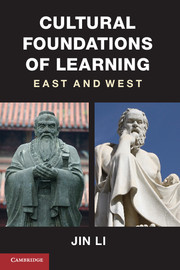
Cultural Foundations of Learning
Western and East Asian people hold fundamentally different beliefs about learning that influence how they approach child rearing and education. Reviewing decades of research, Dr Jin Li presents an important conceptual distinction between the Western mind model and the East Asian virtue model of learning. The former aims to cultivate the mind to understand the world, whereas the latter prioritizes the self to be perfected morally and socially. Tracing the cultural origins of the two large intellectual traditions, Li details how each model manifests itself in the psychology of the learning process, learning affect, regard of one's learning peers, expression of what one knows and parents' guiding efforts. Despite today's accelerated cultural exchange, these learning models do not diminish but endure.
eBook