
Catalogue Search | MBRL


Are you sure you want to remove the book from the shelf?

{{itemTitle}}
5,802
result(s) for
"Eastern Europe History."
Sort by:


Memory and Change in Europe
In studies of a common European past, there is a significant lack of scholarship on the former Eastern Bloc countries. While understanding the importance of shifting the focus of European memory eastward, contributors to this volume avoid the trap of Eastern European exceptionalism, an assumption that this region's experiences are too unique to render them comparable to the rest of Europe. They offer a reflection on memory from an Eastern European historical perspective, one that can be measured against, or applied to, historical experience in other parts of Europe. In this way, the authors situate studies on memory in Eastern Europe within the broader debate on European memory.
eBook


Socialist Escapes
During much of the Cold War, physical escape from countries in the East Bloc was a near impossible act. There remained, however, possibilities for other socialist escapes, particularly time away from party ideology and the mundane routines of everyday life. The essays in this volume examine sites of socialist escapes, such as beaches, camp sites, nightclubs, concerts, castles, cars, and soccer matches. The chapters explore the effectiveness of state efforts to engineer society through leisure, entertainment, and related forms of cultural programming and consumption, as it was in leisure and tourism that the party's intentions encountered Eigen-Sinn, the pursuit of individual interests. This volume leads to a deeper understanding of state- society relations in the East Bloc, where the state did not simply \"dictate from above\" and inhabitants had some opportunities to shape solidarities, identities, and meaning.
eBook

Long awaited West : Eastern Europe since 1944
\"What is Eastern Europe and why is it so culturally and politically separate from the rest of Europe? In Long Awaited West, Stefano Bottoni considers what binds these countries together in an increasingly globalized world. Focusing on economic and social policies, Bottoni explores how Eastern Europe developed and, more importantly, why it remains so distant from the rest of the continent. He argues that this distance arises in part from psychological divides which have only deepened since the global economic crisis of 2008, and provides new insight into Eastern Europe's significance as it finds itself located--both politically and geographically--between a distracted European Union and Russia's increased aggressions\"--Provided by publisher.
Book

Property in East Central Europe
Property is a complex phenomenon comprising cultural, social, and legal rules. During the twentieth century, property rights in land suffered massive interference in Central and Eastern Europe. The promise of universal and formally equal rights of land ownership, ensuring predictability of social processes and individual autonomy, was largely not fulfilled. The national appropriation of property in the interwar period and the communist era represent an onerous legacy for the postcommunist (re)construction of a liberal-individualist property regime. However, as the scholars in this collection show, after the demise of communism in Eastern Europe property is again a major factor in shaping individual identity and in providing the political order and culture with a foundational institution. This volume analyzes both historical and contemporary forms of land ownership in Poland, Romania, and Yugoslavia in a multidisciplinary framework including economic history, legal and political studies, and social anthropology.
eBook

Goodbye, Eastern Europe : an intimate history of a divided land
\"In light of Russia's aggressive 2022 invasion of Ukraine, Goodbye, Eastern Europe is a crucial, elucidative read, a sweeping epic chronicling a thousand years of strife, war, and bloodshed--from pre-Christianity to the fall of Communism--illuminating the remarkable cultural significance and richness of a place perpetually lost to the margins of history. Eastern Europe, the moniker, has gone out of fashion since the fall of the Soviet Union. Ask someone now, and they might tell you that Estonia is in the Baltics, or Scandinavia, that Slovakia is in Central Europe and Croatia is in the Eastern Adriatic or the Balkans. In fact, Eastern Europe is a place that barely exists at all, except in cultural memory. Yet it remains a powerful marker of identity for many, with a fragmented and wide history, defined by texts, myths, and memories of centuries of hardship and suffering. Goodbye, Eastern Europe is a masterful narrative about a place that has survived the brink of being forgotten. Beginning with long-lost accounts of early pagan life, Mikanowski offers a kaleidoscopic tour recounting the rise and fall of the great empires--Ottoman, Hapsburg, and Russian--the dawn of the modern era, the ravages of Fascism and Communism, as well as Capitalism, the birth of the modern nation-state, and more. A student of literature, history, and the ghosts of his own family's past, Mikanowski paints a magisterial portrait of a place united by diversity, and eclecticism, and a people with the shared story of being the dominated rather than the dominating. The result is a loving and ebullient celebration of the distinctive and vibrant cultures that stubbornly persisted at the margins of Western Europe, and a powerful corrective that re-centers our understanding of how the modern Western world took shape\"-- Provided by publisher.
Book

Remembering Communism
Remembering Communism examines the formation and transformation of the memory of communism in the post-communist period. The majority of the articles focus on memory practices in the post-Stalinist era in Bulgaria and Romania, with occasional references to the cases of Poland and the GDR. Based on an interdisciplinary approach, including history, anthropology, cultural studies and sociology, the volume examines the mechanisms and processes that influence, determine and mint the private and public memory of communism in the post-1989 era. The common denominator to all essays is the emphasis on the process of remembering in the present, and the modalities by means of which the present perspective shapes processes of remembering, including practices of commemoration and representation of the past.
The volume deals with eight major thematic blocks revisiting specific practices in communism such as popular culture and everyday life, childhood, labor, the secret police, and the perception of \"the system\".
eBook

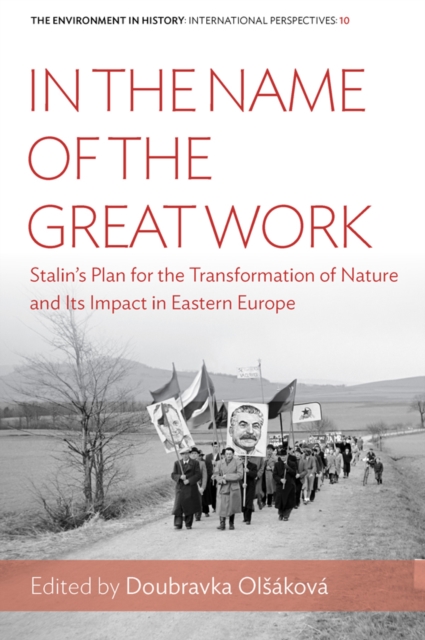
In the name of the great work
Beginning in 1948, the Soviet Union launched a series of wildly ambitious projects to implement Joseph Stalin's vision of a total \"transformation of nature.\" Intended to increase agricultural yields dramatically, this utopian impulse quickly spread to the newly communist states of Eastern Europe, captivating political elites and war-fatigued publics alike. By the time of Stalin's death, however, these attempts at \"transformation\"-which relied upon ideologically corrupted and pseudoscientific theories-had proven a spectacular failure. This richly detailed volume follows the history of such projects in three communist states-Poland, Hungary, and Czechoslovakia-and explores their varied, but largely disastrous, consequences.
eBook