
Catalogue Search | MBRL


Are you sure you want to remove the book from the shelf?

{{itemTitle}}
184
result(s) for
"Eastern Front"
Sort by:

Myths and legends of the Eastern Front : reassessing the Great Patriotic War 1941-1945
The memory of the Second World War on the Eastern Front - still referred to in modern Russia as the Great Patriotic War - is an essential element of Russian identity and history, as alive today as it was in Stalin's time. It is represented as a defining episode, a positive historical myth that sustains the Russian national idea and unites the majority of Russian citizens. As a result, as Boris Sokolov shows in this powerful and thought-provoking study, the heroic and tragic side of the war is highlighted while the dark side - the incompetent, negligent and even criminal way the war was run - is overlooked. Although almost eighty years have passed since the defeat of Nazi Germany, he demonstrates that many of the fabrications put forward during the war and immediately afterwards persist into the present day. In a sequence of incisive chapters he uncovers the truth about famous wartime episodes that have been consistently misrepresented. His bold reinterpretation should go some way towards dispelling the enduring myths about the Great Patriotic War. It is necessary reading for anyone who is keen to understand how it continues to be misrepresented in Russia toda
Book
Germany's War and the Holocaust
Omer Bartov, a leading scholar of the Wehrmacht and the Holocaust, provides a critical analysis of various recent ways to understand the genocidal policies of the Nazi regime and the reconstruction of German and Jewish identities in the wake of World War II.Germany's War and the Holocaustboth deepens our understanding of a crucial period in history and serves as an invaluable introduction to the vast body of literature in the field of Holocaust studies.
Drawing on his background as a military historian to probe the nature of German warfare, Bartov considers the postwar myth of army resistance to Hitler and investigates the image of Blitzkrieg as a means to glorify war, debilitate the enemy, and hide the realities of mass destruction. The author also addresses several new analyses of the roots and nature of Nazi extermination policies, including revisionist views of the concentration camps. Finally, Bartov examines some paradigmatic interpretations of the Nazi period and its aftermath: the changing American, European, and Israeli discourses on the Holocaust; Victor Klemperer's view of Nazi Germany from within; and Germany's perception of its own victimhood.
eBook

The Eastern Front : a history of the First World War
In the second volume of his landmark First World War trilogy, Professor Nick Lloyd tells the story of what Winston Churchill once called the 'unknown war': the vast conflict in Eastern Europe and the Balkans that brought about the collapse of three empires. Much has been written about the fighting in France and Belgium, yet the Eastern Front was no less bloody. Between 1914 and 1917, huge numbers of people were killed, wounded or maimed in enormous battles that sometimes ranged across a front of 100 km in length. Through intimate eyewitness reports, diary entries, and memoirs, Lloyd reconstructs the full story of a war that began in the Balkans as a local struggle between Austria-Hungary and Serbia, and which sucked in Russia, Germany, and Italy, right through to the final collapse of the Habsburg Empire in 1918.
BOOK

Grand Duke Nikolai Nikolaevich
Grand Duke Nikolai Nikolaevich Romanov (1856-1929) was a key
figure in late Imperial Russia, and one of its foremost soldiers.
At the outbreak of World War I, his cousin, Tsar Nicholas II,
appointed him Supreme Commander of the Russian Army. From 1914 to
1915, and then again briefly in 1917, he was commander of the
largest army in the world in the greatest war the world had ever
seen. His appointment reflected the fact that he was perhaps the
man the last Emperor of Russia trusted the most. At six foot six,
the Grand Duke towered over those around him. His fierce temper was
a matter of legend. However, as Robinson's vivid account shows, he
had a more complex personality than either his supporters or
detractors believed. In a career spanning fifty years, the Grand
Duke played a vital role in transforming Russia's political system.
In 1905, the Tsar assigned him the duty of coordinating defense and
security planning for the entire Russian empire. When the Tsar
asked him to assume the mantle of military dictator, the Grand
Duke, instead of accepting, persuaded the Tsar to sign a manifesto
promising political reforms. Less opportunely, he also had a role
in introducing the Tsar and Tsarina to the infamous Rasputin. A few
years after the revolution in 1917, the Grand Duke became de facto
leader of the Russian émigré community. Despite his importance, the
only other biography of the Grand Duke was written by one of his
former generals in 1930, a year after his death, and it is only
available in Russian. The result of research in the archives of
seven countries, this groundbreaking biography-the first to appear
in English-covers the Grand Duke's entire life, examining both his
private life and his professional career. Paul Robinson's engaging
account will be of great value to those interested in World War I
and military history, Russian history, and biographies of notable
figures.
eBook

Eastern Front images : imagery from WWII and Cold War intelligence files
\"Despite the Luftwaffe being ordered to destroy millions of aerial photos in 1945, the Allies found no less than twenty tons of photos in eleven locations, including a hoard in a Bavarian barn. These together with vast numbers of photographs taken by German soldiers used for Intelligence analysis were put into classified Allied Intelligence files at a time when USAAF and RAF imagery was being destroyed. Covering Iron Curtain countries they were valuable for cartography and target intelligence during the Cold War. The captured German imagery (called GX) in this book show what the German Army knew about the Soviet Union before and during Operation Barbarossa. Examples show Eastern Front landforms, key cities such as Stalingrad, Moscow, Sevastopol, Leningrad and factories. They are accompanied by helpful comments from a skilled photo interpreter. This unique and diverse collection, some taken from 28,000 feet overhead, others taken by soldiers on the ground, reveal the war on the Eastern Front as it has never been seen before.\"--Publisher's description.
Book
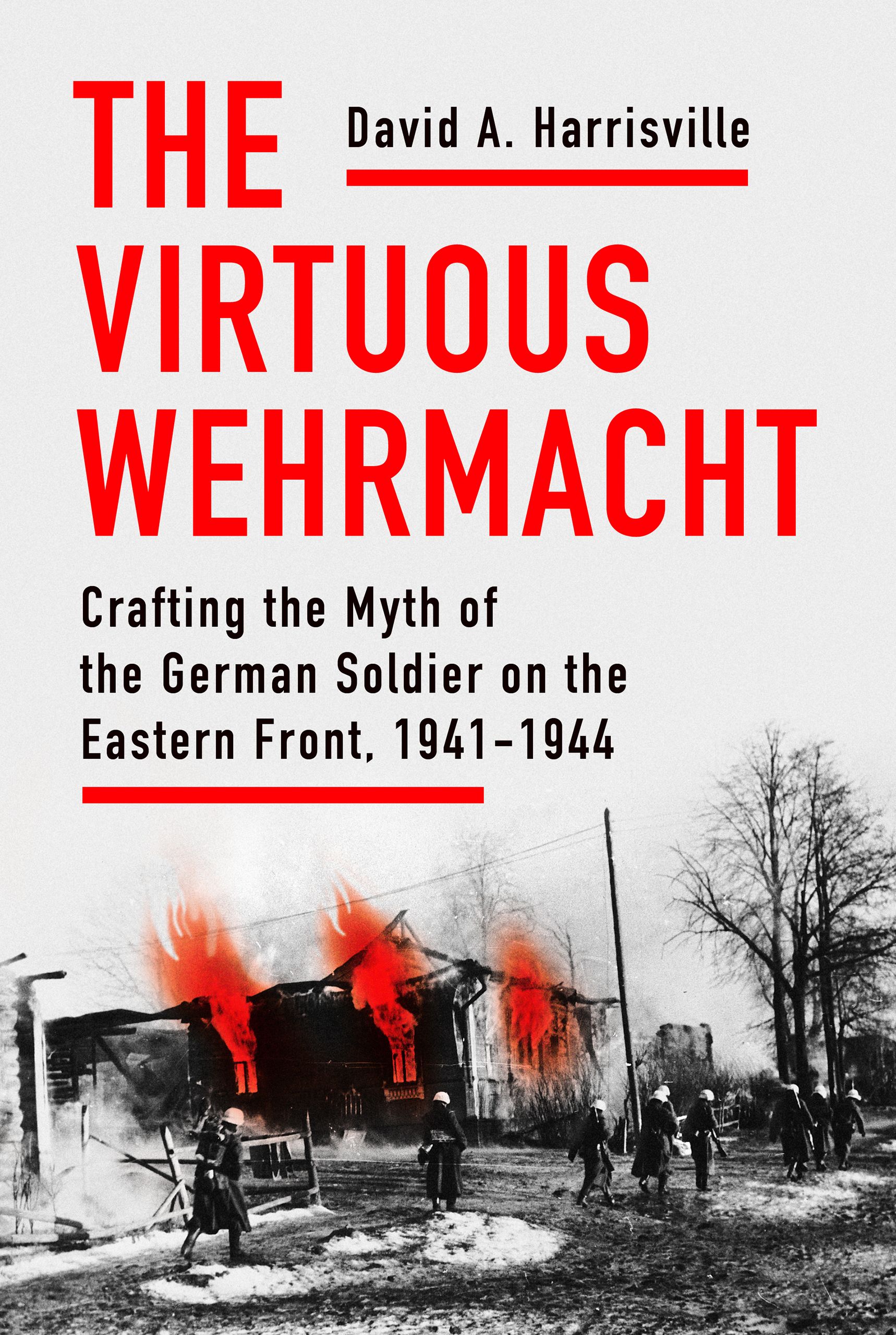
The Virtuous Wehrmacht
The Virtuous Wehrmacht
explores the myth of the German armed forces' innocence
during World War II by reconstructing the moral world of German
soldiers on the Eastern Front. How did they avoid feelings
of guilt about the many atrocities their side committed? David A.
Harrisville compellingly demonstrates that this myth of innocence
was created during the course of the war itself-and did not arise
as a postwar whitewashing of events. In 1941 three million
Wehrmacht troops overran the border between German- and
Soviet-occupied Poland, racing toward the USSR in the largest
military operation in modern history. Over the next four years,
they embarked on a campaign of wanton brutality, murdering
countless civilians, systemically starving millions of Soviet
prisoners of war, and actively participating in the genocide of
Eastern European Jews. After the war, however, German servicemen
insisted that they had fought honorably and that their institution
had never involved itself in Nazi crimes.
Drawing on more than two thousand letters from German soldiers,
contextualized by operational and home front documents, Harrisville
shows that this myth was the culmination of long-running efforts by
the army to preserve an illusion of respectability in the midst of
a criminal operation. The primary authors of this fabrication were
ordinary soldiers cultivating a decent self-image and developing
moral arguments to explain their behavior by drawing on a
constellation of values that long preceded Nazism.
The Virtuous Wehrmacht explains how the army encouraged
troops to view themselves as honorable representatives of a
civilized nation, not only racially but morally superior to
others.
eBook

On the Eastern Front
In graphic novel format, explores \"how the German generals brought about the collapse of the entire Russian army at the Battle of Tannenberg, how Lieutenant Ernst Enzmann of the Austrian Fifth Army was captured by the Russians during the Brusilov Offensive, [and] what happened when the Bolsheviks stormed the Winter Palace is Russia, as seen through the eyes of an American journalist\"--Page 4 of cover.
Book

The Eurasian Triangle
Even the best books on international history are ignorant of the secret war against the Russian Empire and the Soviet Union waged jointly by the Caucasian peoples and Japan in the first half of the twentieth century. This book explores and exposes previously unknown passages in Eurasian international history. Although the secret war ultimately failed in liberating the Caucasian peoples, the lessons of this Eurasian collaboration were not lost on the United States, which after World War II confronted the Soviet Union just as Japan had earlier. Washington copied the strategy of its former enemy and developed it further. The Eurasian triangle of Russia, the Caucasus, and Japan is a forgotten history of cardinal importance that, stretching from the Russo-Japanese War to World War II, influenced Western Cold War strategies. This book is also the story of a friendship rare in international politics between two unlikely partners unspoiled by political vicissitudes.
eBook


Kiev 1941
In just four weeks in the summer of 1941 the German Wehrmacht wrought unprecedented destruction on four Soviet armies, conquering central Ukraine and killing or capturing three quarters of a million men. This was the Battle of Kiev - one of the largest and most decisive battles of World War II and, for Hitler and Stalin, a battle of crucial importance. In this book, David Stahel charts the battle's dramatic course and aftermath, uncovering the irreplaceable losses suffered by Germany's 'panzer groups' despite their battlefield gains, and the implications of these losses for the German war effort. He illuminates the inner workings of the German army as well as the experiences of ordinary soldiers, showing that with the Russian winter looming and Soviet resistance still unbroken, victory came at huge cost and confirmed the turning point in Germany's war in the East.
eBook