
Catalogue Search | MBRL


Are you sure you want to remove the book from the shelf?

{{itemTitle}}
3,767
result(s) for
"Eastern Russia"
Sort by:


Byzantine Hermeneutics and Pedagogy in the Russian North
The first micro-historical 'ethnology of reading' in the Early Slavic field,Byzantine Hermeneutics and Pedagogy in the Russian Northwill prove fascinating to western medievalists, Byzantinists, Slavists, and book historians.
eBook


Constitution for a Disunited Nation
This collection is the most comprehensive account of the Fundamental Law and its underlying principles. The objective is to analyze this constitutional transition from the perspectives of comparative constitutional law, legal theory and political philosophy. The authors outline and analyze how the current constitutional changes are altering the basic structure of the Hungarian State. The key concepts of the theoretical inquiry are sociological and normative legitimacy, majoritarian and partnership approach to democracy, procedural and substantive elements of constitutionalism. Changes are also examined in the field of human rights, focusing on the principles of equality, dignity, and civil liberties.
eBook


Letters from Heaven
Letters from Heavenfeatures an international group of scholars investigating the place and function of 'popular' religion in Eastern Slavic cultures. The contributors examine popular religious practices in Russia and Ukraine from the middle ages to the present, considering the cultural contexts of death rituals, miracles, sin and virtue, cults of the saints, and icons. The collection not only fills a void in religious scholarship, but also responds to current theoretical challenges.
Reflecting critically on the heuristic value of popular religion and on the concept of popular culture in general,Letters from Heavenis characterized by a shift of focus from churches, institutions, and theological discourse to the religious practices themselves and their interconnections with the culture, mentality, and social structures of the societies in question. An important contribution to the fields of religion and Eastern Slavic studies, this volume challenges readers to rethink old pieties and to reconsider the function of religion.
eBook

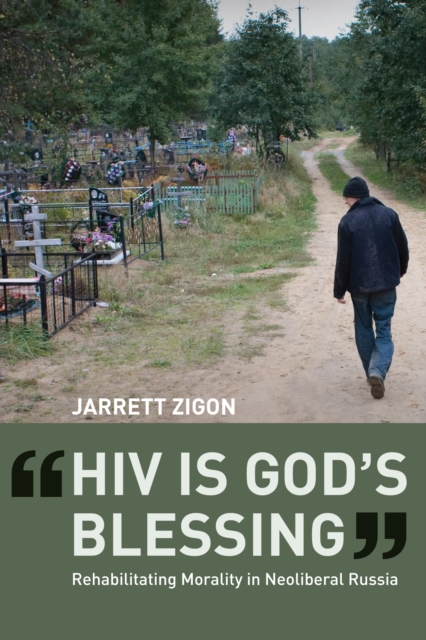
\HIV is God's blessing\
This provocative study examines the role of today's Russian Orthodox Church in the treatment of HIV/AIDS. Russia has one of the fastest-growing rates of HIV infection in the world—80 percent from intravenous drug use—and the Church remains its only resource for fighting these diseases. Jarrett Zigon takes the reader into a Church-run treatment center where, along with self-transformational and religious approaches, he explores broader anthropological questions—of morality, ethics, what constitutes a \"normal\" life, and who defines it as such. Zigon argues that this rare Russian partnership between sacred and political power carries unintended consequences: even as the Church condemns the influence of globalization as the root of the problem it seeks to combat, its programs are cultivating citizen-subjects ready for self-governance and responsibility, and better attuned to a world the Church ultimately opposes.
eBook

Scattered late-glacial and early Holocene tree populations as dispersal nuclei for forest development in north-eastern European Russia
Aim Concepts about patterns and rates of post-glacial tree population migration are changing as a result of the increasing amount of palaeobotanical information being provided by macroscopic plant remains. Here we combine macrofossil, pollen and stomata records from five sites in north-eastern European Russia and summarize the results for the late-glacial-early Holocene transition. The late-glacial-early Holocene transition encompasses the first indications of trees (tree-type Betula, Picea abies, Abies sibirica and Larix sibirica) and subsequent forest development. Considerable time-lags between the first macrobotanical and/or stomata finds of spruce (Picea abies) and the establishment of a closed forest are reconsidered. Location Pechora basin, north-eastern European Russia. Methods We used plant macrofossil, stomata, pollen and radiocarbon analyses to reconstruct late-glacial and early Holocene tree establishment and forest development. The data were derived from lake sediment and peat archives. Results Palaeobotanical data reveal an early Holocene presence (11,500-10,000 cal. yr bp) of arboreal taxa at all five sites. One site presently located in the northernmost taiga zone, shows the presence of spruce and reproducing tree birch during the late-glacial. Given the current view of post-glacial population dynamics and migration rates, it seems likely that the source area of these early tree populations in north-eastern European Russia was not located in southern Europe but that these populations had local origins. Results thus support the emerging view that the first post-glacial population expansions in non-glaciated regions at high latitudes do not reflect migration from the south but were a result of an increase in the size and density of small persisting outlying tree populations. Main conclusions Results suggest that the area east of the margin of the Scandinavian ice sheet to the Ural Mountains had isolated patches of trees during the late-glacial and early Holocene and that these small populations acted as initial nuclei for population expansion and forest development in the early Holocene.
Journal Article