
Catalogue Search | MBRL


Are you sure you want to remove the book from the shelf?

{{itemTitle}}
18,425
result(s) for
"Economia"
Sort by:
Big Picture Economics
Navigate the economy with this insightful new book The world is awash with economic information. Governments release reports. Pundits give their interpretation on television. And the stock market may go its own way, confusing everyone. How can you better understand what it means for you? Big Picture Economics, a new book by award-winning columnist and futurist Joel Naroff and veteran journalist Ron Scherer, says the thread that ties everything together is \"context.\" The authors show how consumers, business, the Federal Reserve, and government take into account what's going on around them to make critical decisions like buying new products, building new factories, changing interest rates, or setting budget goals. The book provides a clear roadmap to understanding the whole story behind the global economy. Big Picture Economics helps readers understand how context impacts decisions and decision makers.
- The Federal Reserve and Congress in formulating economic policy
- Consumers in a shopper nation and what makes us buy or not buy
- Corporations making decisions on whether to build new factories and buy other companies
- The federal budget that must deal with complex issues, including the reduction of health care spending
- A simple test for tax cuts or increases: will they help the economy grow?
- Where to produce and where to sell in a global economy that is more like a Mobius strip than a flat world
- International events that can ripple through the economy and ultimately affect workers in the Midwest
- Technology, such as intelligent drones to wearable computers, are changing the future Experts laud the book for its perceptive insights:
\"It all sounds like common sense, but it is actually based on a close, expert reading of economic history and what that history implies for the future. Read this book to become a more educated judge of economic policy.\"
—Robert Moffitt, Krieger-Eisenhower Professor of Economics at Johns Hopkins University
\"Naroff and Scherer show how seemingly unrelated things like an upgrade of the Panama Canal, a Tex-Mex restaurant's menu change, or how many Americans are overweight turn out to be intricately linked to our daily experiences. What brings the book to life is the authors' focus on these hidden interconnections.\"
—Brendan Conway, blogger and columnist, Barron's
eBook
Islamic economics : a short history
This comprehensive survey of Islamic economic thought covers the development of ideas from the early Muslim jurists to the period of the Umayyads and Abbasids. The economic concerns of the Ottomans, Safawids and Moghuls are examined, as is the profusion of more recent writing.
eBook

The Routledge International Handbook of Financialization
Financialization has become the go-to term for scholars grappling with the growth of finance. This Handbook offers the first comprehensive survey of the scholarship on financialization, connecting finance with changes in politics, technology, culture, society and the economy.
It takes stock of the diverse avenues of research that comprise financialization studies and the contributions they have made to understanding the changes in contemporary societies driven by the rise of finance. The chapters chart the field's evolution from research describing and critiquing the manifestations of financialization towards scholarship that pinpoints the driving forces, mechanisms and boundaries of financialization.
Written for researchers and students not only in economics but from across the social sciences and the humanities, this book offers a decidedly global and pluri-disciplinary view on financialization for those who are looking to understand the changing face of finance and its consequences.
eBook

Transição para a economia circular no Brasil: um modelo de decisão multicritério sob a perspectiva da Nova Teoria Institucional
This study proposes a decision-making model for prioritizing strategies for the transition to a circular economy in Brazil, an emerging economy located in the Global South. The model is structured in three stages: (i) analysis of strategies versus criteria across environmental, economic, social, and technical dimensions, based on the New Institutional Theory (NIT); (ii) application of the ELECTRE method using the scale validated by Guarnieri et al. (2023); and (iii) analysis of the institutional context and formulation of recommendations. The results indicate a prioritisation of more reactive strategies, reflecting the Brazilian context. This study contributes to deepening the understanding of the transition to a circular economy and proposes a model applicable to the development of strategies, policies, and action plans aligned with regional specificities, being useful for researchers and other stakeholders involved in the process.
Este estudo propõe um modelo de decisão para priorizar estratégias de transição à economia circular no Brasil, uma economia emergente localizada no Sul Global. O modelo envolve três etapas: i) análise de estratégias vs. critérios nas dimensões ambiental, econômica, social e técnica, à luz da Nova Teoria Institucional (NTI); ii) aplicação do método Electre com escala validada por Guarnieri et al. (2023); e iii) análise do contexto institucional e formulação de recomendações. Os resultados revelam a priorização de estratégias reativas, refletindo o contexto brasileiro. O estudo contribui ao aprofundar o entendimento sobre a transição para a economia circular e ao oferecer um modelo aplicável ao desenvolvimento de estratégias, políticas e planos de ação alinhados às especificidades regionais, sendo útil para pesquisadores e demais stakeholders envolvidos no processo.
Este estudio propone un modelo de decisión para priorizar estrategias de transición hacia una economía circular en Brasil, una economía emergente ubicada en el sur global. El modelo se estructura en tres etapas: (i) análisis de estrategias versus criterios en las dimensiones ambiental, económica, social y técnica, a la luz de la nueva teoría institucional (NTI); (ii) aplicación del método ELECTRE utilizando la escala validada por Guarnieri et al. (2023); y (iii) análisis del contexto institucional y formulación de recomendaciones. Los resultados indican la priorización de estrategias más reactivas, en consonancia con el contexto brasileño. El estudio contribuye a profundizar la comprensión del proceso de transición hacia la economía circular y propone un modelo aplicable al desarrollo de estrategias, políticas y planes de acción alineados a las especificidades regionales, siendo útil para investigadores y demás actores involucrados en el proceso.
Journal Article

Inequality, Taxation and Intergenerational Transmission
Research on Economic Inequality, volume 26, primarily contains papers presented at the 8th Society for the Study of Economic Inequality (ECINEQ) meeting. The papers cover such topics as the effect of inheritance taxation on the \"pre-distribution\" of income, and tax progressivity under alternative inequality definitions.
eBook

Money and the Early Greek Mind
How were the Greeks of the sixth century BC able to invent philosophy and tragedy? In this book Richard Seaford argues that a large part of the answer can be found in another momentous development, the invention and rapid spread of coinage which produced the first ever thoroughly monetised society. By transforming social relations, monetisation contributed to the ideas of the universe as an impersonal system (presocratic philosophy) and of the individual alienated from his own kin and from the gods (in tragedy). Seaford argues that an important precondition for this monetisation was the Greek practice of animal sacrifice, as represented in Homeric Epic, which describes a premonetary world on the point of producing money. This book combines social history, economic anthropology, numismatics and the close reading of literary, inscriptional, and philosophical texts. Questioning the origins and shaping force of Greek philosophy, this is a major book with wide appeal.
eBook
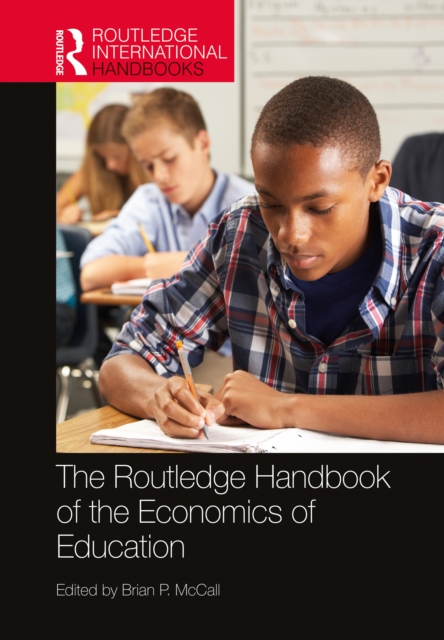
The Routledge Handbook of the Economics of Education
\"The economics of education is a burgeoning area of study, employing increasingly sophisticated analytical tools to answer questions with high societal impact. Thus, the aim of this handbook is to provide readers with an up-to-update overview of the current state of the field of the economics of education and its main areas of research. This comprehensive handbook provides an authoritative overview of key theoretical and policy areas, covering topics like econometric methods for education economics, returns to education, competition in education provision, education and economic growth, and education and inequality. It reviews the current state of research from early childhood through post-graduate education as well as adult education and life-long learning. Offering a truly international perspective, the handbook benefits from a global group of contributors and attention to both developed and developing country contexts. The Routledge Handbook of the Economics of Education will be a valuable resource for advanced students, researchers and policymakers across economics, education, and public policy.\" -- Contents: Introduction / Brian P. McCall -- Econometric methods for education / Luc Behaghel and Maria Florencia Pinto -- Early childhood education in the United States : what, when, where, who, how, and why / Elizabeth U. Cascio -- Nearly three decades into the charter school movement, what has research told us about charter schools? / Ron Zimmer, Richard Buddin, Sarah Ausmus Smith and Danielle Duffy-Chipman -- School accountability / Jason Burns and Katharine Strunk -- Evaluating teacher effectiveness : a review of historical developments and current trends / Chris Brooks and Matthew G. Springer -- Is education different? : a review of the voucher literature and lessons for implementation / Dennis Epple, Richard E. Romano and Miguel Urquiola -- Teacher labor markets : what have we learned over the last decade? / Jessalynn James and James Wyckoff -- Teacher labor markets in developing countries / Lee Crawfurd and Todd Pugatch -- School resources and educational outcomes in developing countries / Paul Glewwe, Celestine Siameh, Bixuan Sun and Suzanne Wisniewski -- Peer effects in education / Angela Cools and Eleonora Patacchini -- Socio-economic inequalities in education beyond the early years / Claire Crawford, Lindsey Macmillan and Gill Wyness -- Factors shaping college investment and enrollment gaps / George Bulman and Jesse Cunha -- Vocational education : an international perspective / Celeste Carruthers and Christopher Jepsen -- Student persistence and bachelor's degree completion / Brian P. McCall -- College majors / Arpita Patnaik, Matthew Wiswall and Basit Zafar -- Student loan borrowing and repayment decisions : risks and contingencies / Kartik Athreya, Christopher Herrington, Felicia Ionescu and Urvi Neelkakantan' -- For-profit colleges in the United States : insights from two decades of research / Stephanie Riegg Cellini -- Competition in higher education / Michael Kaganovich, Sinan Sarpça and Xuejuan Su -- Education and economic growth / Anna Valero.
eBook

Handbook integrated care
This handbook gives profound insight into the main ideas and concepts of integrated care.It offers a managed care perspective with a focus on patient orientation, efficiency, and quality by applying widely recognized management approaches to the field of health care.
eBook